Moment in Oddity - Masonic Temple Becomes a Family Home
(Suggested by Kim Gasiorowski and Erina Garcia)
Back in 2017, the Cannizzaro family decided to make a big change and this was facilitated with an interesting purchase. Theresa and Atom Cannizzaro bought a former Masonic Temple in Indiana and have been renovating it into their new home ever since. The couple and their three children had lived in San Diego all their lives, but they wanted a change and thought that perhaps a farm in the Midwest would be perfect. A Masonic Temple is no farm, but when they attended a family reunion in Indiana and spotted the building for sale, they immediately fell in love. The price tag was nice too. They paid only $89,000 for the property. They quickly began renovating, starting with the bathrooms and they installed a shower. The second floor has become their living space, which has the typical open-floor design with a large kitchen and living room connected in that space. The offices were turned into five bedrooms. The great room on the third floor has become a movie theater for the family. The basement is wide open and the couple hope to eventually turn it into an event space for the community. But perhaps they could consider opening it up to investigations as Theresa thinks the house is haunted and has heard the jangling of janitor's keys in that basement. The library is supposedly haunted too. The kids enjoy riding their bikes down there. Turning a 20,000 square foot former meeting place for a secretive male fraternity into a family home, certainly is odd!
This Month in History - Yorkshire Ripper Confesses
In the month of January, on the 4th, in 1981, truck driver Peter Sutcliffe confesses that he is the "Yorkshire Ripper." Sutcliffe murdered 13 women over a six year period. He attacked his first woman in 1969, but she didn't press charges. This started him down a road of targeting women with his first murder victim being a mother of four. The women he killed were Marguerite Walls, Yvonne Pearson, Jayne MacDonald, Josephine Whitaker, Wilma McCann, Patricia Atkinson, Helen Rytka, Jacqueline Hill, Irene Richardson, Vera Millward, Barbara Leach, Jean Jordan and Emily Jackson. It took awhile to arrest Sutcliffe. He was questioned and released nine times because he gave a false alibi. The police had zeroed in on him because of a five pound note left at the scene of a murder victim that was traced to a group of 8,000 workers who had been paid with this set of bills. He initially was arrested for having false plates on his car. They found a hammer, knife and rope in his car and he confessed to being the Ripper. He claimed he was a paranoid schizophrenic, but was still found guilty and sentenced to 20 concurrent life sentences. An appeal was dismissed and the court said he would never have the opportunity to be released.
New Orleans' Haunted Brothels
*Special note: The modern accepted vernacular at the time of publication for the term prostitute is sex worker. We will not being using this term, not only because the historical value is questionable, but we find its use questionable. Sex worker is impersonal and dehumanizing to us. We prefer to use Ladies of the Evening or just simply women or ladies. Also, we will be talking about madams. These were the boss ladies of the brothels and we are torn on how to present them. These women were caught up in an industry that they probably had little choice in being a part of and managed to rise to the top. That is laudable. But they also were making money off of women being used for sex. They were better than a pimp, of course, but how much better? We tend to glamorize them in movies, books and history. So we will try to walk that fine line.*
Storyville was about two things: women and music. This area was a famous red-light district in New Orleans that would give birth to jazz. Today, it no longer exists, but its legacy does and the place it holds in New Orleans' history is significant. Brothels were plentiful in this city of vice and some of these structures still stand today. The lady bosses of these establishments are some of the most famous people in New Orleans' history and some of them still have a hold on the city as the subjects of ghost stories. Join us as we explore the history and hauntings of New Orleans' Brothels!
When France decided to send some of her citizens to their territory known as Nouvelle Orleans to expand the population, the country didn't pick her best citizens. France sent its criminals. John Law was a Scottish financier who managed to worm his way into controlling this French colony in America. He told the Duke of Orleans that he had a plan to expand the population. It was his idea to send the criminals. He offered the male and female convicts a one-way ticket to the colony if they agreed to marry each other and then they would have land and provisions. One hundred eighty-four female prisoners picked mates and were married. They were then shipped off to the New World where they actually would not have land or provisions. Later, people from hospitals and asylums were sent as well. Before long, New Orleans was a crazy place that was very dangerous.
For women, this new world was just more of what they already knew. Their main prospects were in the sex industry. Over the years, several areas of New Orleans became known as red light districts. The most famous of these was Storyville, which was on the outskirts of the French Quarter. The district ran along Basin Street, between Canal Street and St. Louis Cemetery No. 1 and between Iberville (Customhouse) and Robertson Streets. The area got its name from Alderman Sidney Story in honor of the fact
that he created an ordinance in 1897 to legalize prostitution in the
area that became Storyville. The nickname "Tenderloin District" was sometimes used for it. Business ran here in the form of brothels and saloons from 1897 until 1917. Brothels ran the gamut from cheap run-down buildings with cribs to fancy mansions for the upscale clientele. Some of the brothels were segregated, while others had a mix of races. Some may wonder why the city would legalize that sort of activity. This
actually was so the city could have some control over a business that
was getting way out of hand. Some women would do their business right on
the street for very little money with any man that didn't mind a little
exhibition. Other women would drag men back to their cribs and either
rob them or rob them and kill them and the police would never find the
bodies.
New Orleans had a unique guide for the man about town looking for a good time, the Blue Book.
Blue Books were basically guidebooks to sin giving clients all the information they needed for finding liquor and women and they offered venereal disease cures. Not all of them were blue. Some were actually red. The books were pocket-sized and sold in barber shops, hotel, railroad stations and saloons. Hundreds of ladies of the evening were listed and categorized by race. To give you an idea of the contents, here are a couple of examples. A blue book published in 1907 described Madame Emma Johnson’s brothel as "Emma’s 'Home of all Nations,' as it is commonly called, is one place of
amusement you can’t very well afford to miss while in the Tenderloin
District. Everything goes here. Fun is the watchword." Another listing from a 1905 book reads, "Miss Cummings also has the distinction of keeping one of the
quietest and most elaborately furnished establishments in the city,
where an array of beautiful women, and good times reign supreme. A visit
will teach more than the pen can describe." They were considered lewd at the time, but are pretty tame in our modern world.
A military base was built near Storyville and the rule was that no place of prostitution could be within five miles of the base and so prostitution was outlawed in 1917. Mayor Martin “Papa” Behrman wholly supported the civic
implementation of Storyville and traveled to Washington, D.C.
in 1917 when there was a threat to shut down Storyville and he said,
“You can make it illegal, but you can’t make it unpopular.” Many of the former brothels
were demolished eventually. Today, only three structures from Storyville are still
standing. The Iberville Housing Projects grew up in the remnants of Storyville. These projects were the last of the New Deal era public housing that had been built in New Orleans. They were demolished and today they are a modernized apartment complex called the Bienville Basin Apartments. This is the fourth incarnation of the neighborhood. So finding a haunted former brothel in Storyville is impossible, but some former madams seem to still be around in the afterlife.
Kate Townsend
There once stood a grand brothel at 40 Basin Street in New Orleans before prostitution was legalized and the neighborhood became known as Storyville. This brothel was built by Kate Townsend in 1866. I first heard about Kate Townsend in Episode 59 of the Southern Mysteries Podcast. I encourage you to check it out to get the full story. Kate Townsend was born in Liverpool, England as Katherine Cunningham. She fell for a man she met working as a barmaid and became pregnant with twins. She left for America sometime in 1856 and landed in New York. In early 1857, she moved to New Orleans. Clara Fisher had a brothel on Phillipa Street and she quickly embraced the beautiful and voluptuous Kate, who worked for her for six months. Kate then moved on to Maggie Thompson's brothel where she stayed until she was 24-years-old. She decided to make a go of it on her own and rented a house and made her way into the lives of politicians and influential people in New Orleans. She soon had enough money to built her own brothel, which she did as we said at 40 Basin Street. This was a gorgeous house that rose three stories and was built from brownstone and marble. The marble also made its way inside for the fireplace mantelpieces. The furnishings were of black walnut with damask upholstery and velvet carpet covered the floors. The brothel and interiors cost around a hundred thousand dollars, which is a little over 3 million dollars today. The grandest room was Kate's, of course, decorated with marble statuettes, a French mirror that was gilded, costly oil paintings and the finest linens. Kate's women were the highest paid in the profession and most encounters started at $100.
Things were great for Kate for many years and her brothel was incredibly successful. As we read about Kate, we found that she had a man named Treville Egbert Sykes who was her fancy man for twenty-five years and many stories claimed that they lived as husband and wife. He kept the books and ran the business. Obviously, we had to look up what this term fancy man was all about and we found two meanings. One was that this was a pimp, which doesn't make much sense when talking about a madam, and the other was the lover of a Lady of the Evening. So this Sykes was longtime boyfriend. She started seeing another man and this made Sykes angry, but he was no match for Kate who could apparently hold her own. He made her angry enough, that she told one of her girls that she would basically like to gut him with a knife. This young woman talked her out of that, but she continued to beat Sykes off and on. On November 3, 1883, the Picayune published a story about the murder of Kate Townsend, "Carved to death! Terrible fate of Kate Townsend at the hands of Treville Sykes with the instrumentality of a bowie knife. Her breast and shoulders literally covered with stabs." Yep, Sykes killed Kate. He stabbed her eleven times with her own bowie knife and claimed that it was self-defense, that she had been coming at him with the knife and after he took it from her, she grabbed a pair of pruning shears. Sykes was tried and acquitted and actually presented a will that gave him Kate's estate. Eventually, that went to court and with court costs, legal counsel and such, Sykes got about $34. Kate was laid out in the drawing room in an expensive white silk dress with all the furniture covered in white silk too. She was buried in a $400 metallic coffin.
Josie Arlington
The Arlington was an opulent brownstone opened up by Josie Arlington and was located at 225 North Basin Street. This was an elegant four story mansion with a tulip-domed cupola, numerous bay windows and the interior had the finest furnishings and the works of great artists. There was a Turkish, American and Chinese Parlor. She had anywhere from ten to twenty women working for her with the higher number being during Mardi Gras season. The Arlington wasn't her first brothel. She had operated a house at No. 172 Customhouse. She had a boyfriend through most of her early work and while at this house, but he shot her brother and she broke things off. About this time, the Storyville ordinance went through and she opened The Arlington. Josie was one of the most notorious madams in Storyville, but her brothel was one of the classiest and she paid her girls well at $5 an hour. She had been born Mary Deubler and started her life in prostitution at the age of
seventeen. Josie was known to have a quick temper and to be a spunky
fighter. Marita Woywod Crandle writes of Josie in her book "Josie Arlington's Storyville: The Life and Times of a New Orleans Madam,"This crafty creature turned the tables from what had been a somewhat scary and dangerous beginning to an extraordinary existence." Josie unfortunately suffered from early onset dementia and died in 1914 when she was only 50. She was originally buried at Metairie Cemetery in a tomb designed by Albert Weiblen. The memorial is a red marble tomb topped by two blazing pillars and features a bronze female figure. The grave became a tourist attraction because of her reputation and her family was mortified, so they had the body moved. But her spirit remains, perhaps because the body was moved. One of the legends told about her former grave is that the bronze female figure leaves its post at the door of the monument and walks around the other graves. And early on, people claimed that the tomb would appear to burst into flames after dark. Two grave diggers said they witnessed the statue of the girl at the door vanish and walk about in the cemetery. And it is said she continues to do that to this day. The urn outside the memorial is said to glow red as well.
Lulu White
Lulu White was the Diamond Queen of Storyville. She was mixed race and ran a very successful brothel, Mahogany Hall. Her place was known for its diversity and wealthy white men loved it. The women here were mainly known as octaroons, meaning they were one-eighth black, and Lulu White was one of them. Octaroon is obviously considered offensive today, but it was an important distinction at the time because of what it revealed about slavery for black women who were raped and impregnated by white masters. And it puts a light on racism as the fact that even having one drop of black blood made one segregated. But as we said, despite the race of the women inside, this brothel was very successful. White had it built for $40,000 and it was described as "unquestionably the most elaborately furnished house in the city of New Orleans, and without a doubt one of the most elegant palaces in this or any other country." A pamphlet claimed her girls were "gifted with nature's best charms." The building stood four-stories and had five parlors and fifteen bedrooms. The exterior and interior were built from marble. Her life began in Selma, Alabama and she came to New Orleans in 1880. She was called the Diamond Queen because she was known to dress in jewels and loved to look glamorous. When Storyville was shut down in 1917, she was left in debt and destitute before leaving the city. She died in poverty in 1931. Louis Armstrong recorded Mahogany Hall Stomp, which is a tribute the place. The building survived most of the other brothels, serving as a department store warehouse until November 22, 1949 when it was razed and turned into a parking garage. Lulu White's Saloon at 237 Basin Street still does exist.
Norma Wallace
Norma Wallace was a woman born in Mississippi who relocated to New Orleans with her mother and brother. For some reason, she announced to her mother at the age of twelve that she wanted to run her own brothel some day. I'm not sure what life she lived, but the prospect of being a woman servicing men and not in control of her life was not appealing, but being a madam was because she never wanted to be reliant on a man. She was so committed that she traveled to Chicago and New York to study under the best madams. She opened her own brothel at 1026 Conti Street in 1917. She had bad timing as the legalization of prostitution was ending, but she still managed to be successful and she was never caught. She always got a tip that the police were coming and she would get out with her girls before they arrived. They did this by connecting a ladder to the saloon next door and they would make their way across the rungs. She had a gangster boyfriend that brought everything to an end when he shot her in front of the brothel.
She lived, but eventually lost almost all her money when the banks collapsed in the 1930s. She started stashing money at the brothel since she didn't trust the banks. The brothel shut down in the 1960s when she was arrested. She decided to convert the place into an Italian
restaurant. This was the end of openly run brothels in New Orleans. Norma found out her husband was having an affair and she shot herself in the head. Now it is said that she haunts 1026 Conti Street. There are seven apartments here today and people who live there claim to hear the tinkling of glasses, to smell the scent of cigarette smoke - Norma was a heavy smoker - and they hear music and husky laughter.
Gallatin Alley
Gallatin Alley was a
notorious location that is now known as French Market Place. This is a
stretch of two blocks that has many shops, but was once filled with
saloons, dance halls and bordellos. This was a dangerous place full of
thieves, drunks, drug dealers, murderers and, of course, Ladies of the
Evening. One would not believe that the ladies could be the most
dangerous, but many of them could be. They swindled the men and a few of
them were even murderers. These included Mary Jane "Bricktop" Jackson
who stabbed many men, killing four of them, Bridget Fury who was also
known as Delia Swift and America Williams, who was very tall and got
into many brawls with men. It ran this way from 1840 to the mid-1870s.
Smokey Row
Another red light district could
be found between Bienville and Conti Streets along Burgundy Street
behind the French Quarter that was called Smokey Row. This name came
from the fact that this was a district where African American women
worked. This was s place where a cheap date could be found with many
women working in cribs and charging as little as fifteen cents.These women were hard, chewing tobacco, stealing from customers and drinking rot gut whiskey.
The Creole Gardens Inn
The Creole Gardens Inn is an historic 19th century antebellum mansion that was originally built in the 1840s for the Reverend Benjamin Palmer. He lived here during the Civil War and considered Jefferson Davis his friend. He stayed in the home until he died in 1902 after being struck by a streetcar. Today, this is a bed and breakfast with many remnants of the past. Some of the rooms had been part of the old slave quarters and when Storyville was in full swing, some of the rooms were part of a bordello. Rooms have been named for some of the madams of that era. There is a lot of southern charm here, but there are also spirits. When the inn was been renovated, contracters witnessed heavy doors closing and opening on their own. They also found bathroom tiles stacked very neatly one morning when they had not been left that way the day before. The energy seemed to be fed by guests staying and the activity increased with people claiming to hear disembodied voices, feelings of being watched and they would see shadow figures. The top spot in the inn is Room 2C where people experience cold spots and have been pushed or experienced vertigo.
May Baily's Place
The Dauphine Orleans Hotel sits on land that passed through many hands
through the decades, most of whom were rich families. A Charity Hospital
spent time there for awhile. This hospital provided care to anyone
regardless of race or social status. A red light sits outside May Baily's Place at the Dauphine Orleans Hotel as an homage to its former history and is decorated with Victorian wallpaper and gold accents. This bar was one of the first and most notorious brothels just outside of Storyville. As was the case for many brothels, this one was around long before prostitution was legalized. May Baily was granted her operating license in 1857. Now you might be wondering since this kind of business wasn't legal yet, how did May Baily get that license. Apparently, the police would go around and fine these establishments to get them to clean up their acts. May had no intention of shutting down, so she paid the fines ahead of time and this became a brothel license. That also explains how her's became the first. The building that hosted the brothel was built in 1821. The original purpose of all things, was to be a convent. Several wounded Confederate soldiers died here during the Civil War and many more found comfort in the arms of May Baily's ladies.
One of those former employees is said to still be roaming the halls of the Dauphine Orleans Hotel. She apparently was a courtesan who had a special talent for mixing cocktails for her gentleman callers. And for that reason, most people who have encounters with this spirit, have them in the back of the bar where liquor bottles move about and a shadow is seen in the mirror. She responds most favorably to men, although she has been blamed for locking a few in the bathroom. Civil War era ghosts are seen here too. Many are seen accompanied by a Lady of the Evening. A man in a general's uniform is seen sometimes pacing the courtyard looking rather worried. There are guests who claim to have their beds shaken by something they can't see. Could this be residual movement for something else? The Ballroom hosts a dancing entity that people say is named Jewell and a little orb seen around this spirit is said to be a ghost cat. Patrons see brochures and books fly off of shelves. May Baily's sister Millie lived at the brothel and is seen roaming the hallways and is our Woman in White here. She wears a wedding dress to be specific. People have nicknamed her the "Lost Bride" and it seems she is searching for her groom who was a Confederate soldier that was killed. One of the craziest stories reports a bar stool levitating off the ground.
Two of the main haunts are Suite 110 and Suite 111. Suite 110 likes to keep the guests out. Many times the door will not unlock or it won't open even when unlocked. Housekeeping staff has the most experiences with lots of poltergeist type pranks and the lights are often turned off, leaving them in darkness. Guests complain of having their covers yanked off them at night too. Suite 111 is right above the bar and in this room objects and furniture get moved around on their own. The apparition people report in here is an African American man. People call him George.
The Hermann House is across the street from the Dauphine Orleans Hotel and is owned by the hotel. This home was owned by German born Samuel Hermann, Sr. He moved to the Louisiana colony to chase opportunity and he found it through many investments. He married a woman from a wealthy family and worked as an agent and broker for plantations. In 1813, Hermann and his family relocated to New Orleans and had architect William Brand build his home. It was done in the Federal Style and spared no expense including several coats of paint. About six years after moving into the house, the English Cotton Market crashed in which Hermann was heavily invested. He eventually lost the house. Today, it is a museum known as the Hermann-Grima House. At some point, it was known as the White Elephant.
The White Elephant was quite different then May Baily's place. It was pretty low-class where the ladies stood in the doorways trying to entice the men to come inside. They were not considered very classy. Two of these women were Nellie O'Neal and Eliza Riddle. Riddle was cunning and violent, known to beat up other women. One she clunked over the head on two separate occasions and another on she hit with a lamp. She was arrested at least twenty-four times. There were rumors that men had been killed at the White Elephant and buried in the courtyard. Not sure if Riddle had anything to do with that, but we wouldn't be surprised.
The Hermann House is reputedly haunted. Guests feel cold spots when the AC is off, bursts of an icy wind and the disembodied sounds of soft music playing. Lights turn off an on by themselves and footsteps are heard, even on the carpeting.
Mississippi River Bar
Near to Gallatin Street and on the side of the French Quarter sits the Mississippi River Bar. Locals call it the MRB.This was another tough area of town and at about this point, it seems that most of the French Quarter was this way. Fights were a regular occurrence with the local papers reporting things like a barber striking a journalist "in the left eye with a colt [ . . . ] thereby endangering his life and considerably marring his beauty." The Mississippi River Bar had been a brothel in the 19th century. There was a young Irish woman who was working there and looking for a way to get out. She fell in love with a young man who promised to marry her. He went off to war and was killed. And like so many of these stories, this one ends with her hanging herself out in the courtyard from despair.
Her spirit is said to be here still. She hangs out in the women's bathroom most of the time where she turns the lights off and on and when women are washing their hands at the sink and look into the mirror, they sometimes see the apparition of the woman standing behind them. Now, we don't know how true this is, but some stories claim that some women get their heads are smashed into the mirror. Management has had to replace the mirror.
Hotel Villa Convento
The Hotel Villa Convento is located at 616 Ursuline Avenue and there are claims that it is the most haunted hotel in New Orleans. Many of you have probably heard the song "House of the Rising Sun" and this hotel is rumored to be that very house. But keep in mind that many brothels had a carved quarter rising sun marking them in some way, so it could be argued that all brothels are "Houses of the Rising Sun." The land under this structure was owned by the Ursuline nuns. The Ursuline nun convent in New Orleans is one of the creepiest places when considering it in light of the vampire stories told about it. Diane tells the story of the casket girls. The original convet started with fourteen nuns who were sent to help the poor and sick and to educate the young girls in the city. They built timber structures that didn't hold up in the southern weather. In 1823, they moved to the Ursuline Convent that stands today.
Jean Baptiste Poeyfarre purchased the land from the nuns and built a Creole townhome in 1833. The property was sold in 1843 to Octave Voorheis and he lost it after the Civil War in 1872. The house passed through several hands and was bought by Pasquale Taromina in 1902. The Tarominas lived there until 1946. The widow sold the property and it again passed through a few hands and was converted to housekeeping rooms. Many of the residents were students and they called it Old Town Villa. Fun Fact: Jimmy Buffett was one of those students. The Campo Family bought the Villa Convento in September of 1981. There are a variety of rooms for rent at the hotel running from suites to smaller budget rooms. It was probably during the late nineteenth century that the house served as the brothel.
The Hotel Villa Convento is thought to be one of the more haunted locations here. Many people believe that the main ghost here is the former madam of the brothel. Women rarely experience anything here. Most unexplained activity happens to men. One story reports that a couple checked into the hotel and the husband went out to have a smoke. He was started when he heard his name. It was early in the morning and no one was up, but he still thought he would turn around and see his wife. She was not there. He went in and asked his wife if she had called him and she said she had not.
Later, they decided to head out and explore the French Quarter. They returned to their room and the wife got into bed while the man went into the restroom. He heard a female voice say his name again. This was whispered in his ear and really freaked him out. He actually yelled out and woke up his wife to tell her what happened. They searched the room and found no one, of course.
Guests claim to hear disembodied laughter and feel people sit on the bed that they cannot see. Many times, male guests claim to wake up and see female spirits shrouded in black like shadows hovering above them and staring at them. Kalila Smith wrote, "New Orleans Ghosts, Voodoo and Vampires, Journey Into Darkness" and he also founded the Haunted History Tours in New Orleans. In the book he writes of an experience one of their tour guests told him on Page 64.
The history of brothels, madams and Ladies of the Evening in New Orleans is extensive. It's an important history. Is it a haunted history? That is for you to decide!
Thursday, January 9, 2020

Thursday, January 2, 2020
HGB Ep. 321 - Malvern Manor
Moment in Oddity - Worst Hole of Golf Ever
Some of you probably find golf to be of interest. We really don't, but there is one hole of golf that made the history books that was both interesting and odd, all at the same time. This took place all the way back in 1913 and happened at the Shawnee Invitational for Ladies. A female golfer named M. H. Meehan set up her shot and gave it a whack, only to watch it fly up and into a tributary of the Delaware River. This would give her a penalty stroke as we understand if she didn't play the shot. Something in her must have thought that she could whack that floating ball back to the green and that the result would be better then taking the penalty because she convinced her husband to row her out into the river aboard a row boat. She swung and swung at the ball as the judges counted her swings. On the fortieth stroke, she finally hit the ball back onto land, but it was in the woods off the green. She bushwhacked through the woods and just as she got the ball to the main green, it got stuck between two rocks. This was like the challenging mini golf hole from Hell. It took another dozen swings to free the ball from the rocks. She got it up onto the green and finally into the hole on stroke 161. We're not sure if this was persistence, stubbornness or something else, but it certainly was odd!
This Month in History - Lord Haw Haw Executed
In the month of January, on the 3rd, in 1946, William Joyce, who was better known as Lord Haw Haw was hanged for treason in London. Joyce was an Irish American Fascist who had broadcast Nazi propaganda via radio from Germany to Britain during World War II. He opened his broadcasts with "Germany calling, Germany calling"in what sounded like an upper-class English accent. Joyce would try to escape the collapse of the Third Reich. He moved to the Dutch border when Berlin was bombed in 1945. The Nazis initially were going to smuggle Joyce and his wife Margaret to Ireland aboard a U-boat, but that plan had to be abandoned. He made his last broadcast on April 30, 1945. He was clearly drunk. On the same night of his last broadcast, a car whisked him and his wife away and they were carried into Denmark. The couple continued to run as the British hunted them down. Joyce had a prominent scar on his right cheek and he was recognized while walking on a road one day. He was shot in the buttocks by a German Jew serving in the British army using a captured Nazi weapon. Very poignant. He was tried and found guilty of treason, but was acquitted on two charges because he was American and so the British couldn't claim that he had betrayed them. A third charge stuck though as the Attorney General pointed out that even though Joyce had lied to get his British passport, he had British diplomatic protection under it meaning he owed allegiance to the King at the time. He was found guilty and sentenced to death. He was executed on January 3, 1946 at Wandsworth Prison.
Malvern Manor
Malvern is located in Southwest Iowa. This is a really small town similar to most of the small towns we visited in Iowa. Agriculture is the main economy here, but for Malvern, they have a claim to fame that gives them a tourism angle. Malvern Manor is here and is reputedly one of the most haunted buildings in America. This was a former hotel that became a place for the discarded people of society. Could this be why this place has so many spirits locked inside of it today? We got to take a tour of the place and also had the opportunity to do a mini investigation. Join us as we share the history and hauntings of Malvern Manor!
I first heard about Malvern Manor from a podcasting friend named Josh Heard. He hosts the Ectoplasm Show and I remember a few years back that he talked about buying this property with several people that was located in Iowa. Since then, I had heard a little about this location and most of what I heard was that this place was really haunted. So when we decided to visit my sister in Iowa and were mapping out a plan to hit some haunted locations, when we saw that Malvern Manor was only about 40 minutes from Omaha, Nebraska, we wanted to try to visit. We didn't think we would have time, but we mentioned wanting to check it out to Jessica and Erina Garcia and they said they'd like to join us, so we made it part of our plan the day they chauffered us around.
Malvern Manor is named for the city in which it resides, Malvern, Iowa. Malvern started as a pioneer village named Milton and was founded in 1869 by John Paddock. He and his wife built a store and soon more people came when the Burlington and Missouri River Railroad was completed there. The town changed its name and really exploded. Factories started popping up within the farming community. There was a poultry factory, hog packing plant, and an electric generating factory. As the agricultural community began to shrink, the economy of Malvern went down and people moved away. Today, Malvern is a small, mainly agricultural town.
We pulled up to Malvern Manor and immediately noticed that this is a place in need of some love. It's a bit shabby. Josh was mowing the lawn and greeted us with a big smile. It was great getting to meet him in person. Josh had us sign a pretty detailed waiver and then he took our group through, giving us a personal tour that lasted about 20 minutes and then he set us free to do our investigating. We didn't know much more than, you paid $10 and got a tour, so the chance to explore and investigate was a nice surprise. The basic history of the structure is that it started as a house that was built in 1870 by A.B. Ringlan. In 1890, the house had rooms added to it and became the Cottage Hotel. This was a nice family run place that was close to the train and many salesmen stopped in to get a good meal and a night's rest. Most nights it was booked solid. An Iowa atlas advertised it in 1912 as charging only $2 for a room and a meal. As more and more people started turning to cars for transportation, the hotel started losing business. The hotel eventually was converted into a convalescent home in the 1950s and then a place for the castoffs of society: the developmentally disabled, the addicted and the mentally ill. There was not enough staff, so neglect and abuse became a big part of the story here and quite possibly could be why the place has such a haunted reputation.
The first room we started investigating was the Captain's room. This room was like taking a trip back to the 80s with a tube TV that has the old turn dials. There was a simple twin mattress in here and a sink in the corner. The walls are painted a sky blue. The room is full of light because of the windows and does not feel heavy. We got out the dowsing rods and asked a few questions, but we got no activity in this room. The stories about the Captain are numerous. Many times, investigators claim that he has scratched or push them. It is believed that the Captain runs the place in the spiritual realm. Josh believes that the Captain dislikes all the investigators coming through.
Next we headed to Suzie's room. This room was painted a bright yellow and was a jumble of children's toys and coloring books, most of them strewn across the twin bed. Suzie was a middle-aged resident who was mentally challenged with the intellect of an eight-year-old. This is why there are toys and such in this room. We introduced ourselves and then Kelly started using the dowsing rods. We also got out our flashlight and the EMF detector and invited Suzie to turn the devises on. Here is a sound bite from that and the knocking you hear is construction going on. (Suzie Room) So you hear us checking to make sure the rods aren't being triggered by water. Josh had told us that Suzie never leaves her room and that she has indicated to investigators that a man makes her stay in there, so we asked her about that. She seems to answer that it is a spirit. We do return to her room again and get a few more answers with the rods. We left her an HGB Button pin on her dresser. Another investigator once caught a Class A EVP in here of a voice answering "pink" when asked what her favorite color.
We went to Inez's Room next and here is what Josh told us about Inez. (Josh Inez) This time we got Jessica to hold the rods while we did our session, which we like because she was unfamiliar with them and has less of a chance of swaying them. Incidentally, we are brainstorming some things with Dolly to develop a way to have the rods held stable without human interaction. Although we also wonder if our energy is needed to help move the rods. These are all experiments we want to try as we continue to investigate the unexplained. The story behind Inez is that she never lived in the manor, but rather lived a couple of houses down. She was just a young girl when she hanged herself in her closet. Her spirit is thought to be at the manor because she liked visiting it as a child. This was a hotel at that time. Or it could be that the investigations going on here have attracted her spirit. Here is a sound bite of our investigation (Inezs Room) So yeah, we seemed to have a male spirit just passing through or something. But other people have heard the sound of a child running up and down the hallway outside this room. That's the weird thing, the sound of children. And the place is full of random children's shoes here and there. Why?
At this point, we're kinda disappointed with the activity, but we haven't done our investigations at the Squirrel Cage Jail or Villisca House yet, which I'm glad or we might have been even more disappointed. For this place being crazy haunted, we weren't getting much. The eeriest place in the manor is this hallway that has blood all along the walls and a handprint at the end. Here is Josh talking about that. (Josh Blood) We headed into Henry's room. This is a guy who traditionally is thought to not like women, so we were a bit apprehensive as four women standing in his room. We did a dowsing rod session. We felt pretty welcome. We'll play that interaction here. (Henrys Room)
We headed up to the creepy attic. This is a malevolent area with stories of growling, disembodied voices and other kinds of sounds. Josh said that people feel a tightness in their chest and then they get nauseous and get sick sometimes. There are lots of beer cans and cigarettes up here, almost as though they have been left as offerings. There are two crawl spaces up here that Josh has been inside of several times and he has found playing cards and keys. He usually is trying to find critters that may have died. Erina did not join us up here. The only interaction we got up here was basically the entity telling us they wanted us to leave.
Gracie's Room was our next stop. This room was fairly dark with a hospital bed that still had the head position set upright and a wheelchair. A little nearby shelf on the wall held her glasses. This is the dwelling area for one of the manor's more well known ghosts. Her story is a tragic one as she was diagnosed with both Schizophrenia and Multiple Personality Disorder or what we now refer to as Dissociative Identity Disorder. No one is sure how many personalities Gracie had locked in her brain, but nurses once documented thirteen personalities in a two hour period. Josh says that he believes that some of the entities that people encounter here could be some of her different personalities. And this is hugely fascinating to us and a reason we would want to go back and investigate with more purpose in the future. Imagine the possibility that there is only one spirit in this building, but that she can present as a series of personalities. And then what does that say about the afterlife. Are these just all residual imprints? Is Gracie still suffering from these illnesses in the afterlife? No one wants to believe that is possible. We have Richard Estep's book on Malvern Manor and it is titled, "The Devil's Coming to Get Me." The book bears that title because it is something that would come out of Grace's mouth many times in a low gruff tone as though a man were speaking. The staff would be chilled to the bones when they heard this, particularly because it tended to happen at night. We got a bunch of nothing in her room as this sound bite indicates. (Gracies Room)
Another one of the sad rooms here belongs to a nameless woman who was admitted by her husband at a young age. She had become obsessed with the idea that he no longer found her attractive and that he was going to leave. No treatment seemed to help her. Staff would find her standing at the mirror in her room and she would be pulling out chunks of her own hair. She just slowly deteriorated and died shortly thereafter. Visitors often report seeing her spirit at the mirror looking very angry.
The Internet will tell you that the rooms right below the attic, Rooms 17 and 18, contain some really sinister energy. The story that is told is that there were two men here that lived across the hall from one another. After the nightly bed check, the one patient would cross the hall, enter the other male patient's room and physically and sexually abuse him. This went on for years it was believed. But Josh told us that his investigations have him thinking something else quite different was going on and this will make it very poignant that the four of us investigating are two lesbian couples. Josh thinks that the men were in a relationship and that the activity was consensual, but not allowed in the house and that is why there was the sneaking going on. Here is some audio of us in this room. (Gay Rooms) So it seems like we were getting responses that the gay angle might be true.
The most unsettling area of the manor was a dark hallway that branched off of the nursing station. There was not much left of the nursing station, save for shelving that was made into wooden pigeon-holes similar to mail slots or boxes. The names of whomever each box belonged to where still visible and Josh told us that they had found items still in these boxes. After telling us a bit about the station, Josh pointed down a hallway that branched off to the left, the end of which was swallowed in darkness. It is from a door at the very end that Josh says many people claim to see a shadow figure emerge and then rush down the hallway at them before dissipating. He believes them because it has happened to him too, at least 3 times. He says he hates to vacuum in this hallway. And Josh pointed out that the rushing is faster than running. No human being could move this fast. You know us, we just had to wander down that hallway to Room 2, which we found to be padlocked. Here is the audio from that. (Shadow Man Hallway). So you hear us there at the end that we basically got a whole lot of nothing throughout the building. We definitely think the Shadow Man is nothing to fear and just a residual occurrence.
Dolly, who joined us at the jail and Villisca House, went and did a public investigation at the Malvern Manor about a month and a half after we did. She was disappointed in the fact that the group of people that were there with her treated most of this as a joke with boyfriends trying to share girlfriends and one kid with a ton of equipment who was catching a ton of activity that she didn't feel was legit. We trust Dolly and we consider her a part of the HGB Paranormal Investigation Team and she got a whole lot of nothing and left early knowing that anyone not taking this stuff seriously is not going to get any kind of worthwhile results. That's one thing people can always trust with us. We don't make stuff up and we don't provoke.
This place has a crazy history and walking through it is a time capsule that has captured a place of disregard and sadness. Today, it seems to be more of a paranormal investigators playground. Although we had very little of what we would call activity, is the Malvern Manor haunted? That is for you to decide!
Thursday, December 26, 2019
HGB Ep. 320 - General Dodge House
Moment in Oddity - Kitty Cat Gods
Is there any doubt that cats think they are gods? This is their world and we just live in it. And that living, is to serve them. But there are humans who have thought of cats as gods too. Sephardic Jews had ancient myths about Lilith that claimed she roamed the Earth as a black vampire cat named El Broosha and that she sucked the blood of newborn babies. Matagots are a cat god from European folklore that are magical. People claimed that Dick Whittington was able to attain his position of mayor of London in the 15th century because of his matagot. The French believed that once a matagot was lured into the house, perhaps by way of a plump mouse, that their home would have good luck. Li Shou was an ancient fertility cat goddess to the Chinese and it was believed that she brought rain and protected crops. The Chinese also believed that the ability for humans to talk was given to them by cats who could once speak. And then there is the ancient Egyptian goddess Bastet who had a cat head. Her name meant devouring lady and her feast day was October 31st. She was associated with music, dancing, motherhood and vengeance. She would destroy the bodies of the dead with her flame if they failed a test to enter the underworld. For this reason, the Egyptians would hold big funerals for dead cats and bury them with riches and gem-studded cat figurines. We like cats, but to treat them like gods, certainly is odd!
This Month in History - Joyce Kilmer Born
In the month of December, on the 6th, in 1886, American journalist and poet Joyce Kilmer was born in New Brunswick, New Jersey. Kilmer had graduated from Rutgers College and Columbia University and became a literary editor and worked on the staff of the New York Times. He was known for his poetry that celebrated the beauty of the natural world and he was best known for his poem "Trees." This poem was published in 1914 and was unique in that it personified trees in the poem. Even though he was not required to enlist when World War I started, he did and requested a transfer to the infantry and was deployed to Europe. He rose to the rank of Sergeant and served as an intelligence officer. He was killed by a sniper's bullet on July 30, 1918 in France. His poem "Trees" became very popular after that. The French awarded him the prestigious Croix de Guerre (War Cross) for his bravery. In 1938, the U.S. government named a 3,800 acres section of old growth forest in North Carolina for him. A park in the Bronx is also named for him.
General Dodge House (Suggested by: Jessica Garcia)
When one thinks of the state of Iowa, they probably just envision fields of corn. While there definitely are fields of soybeans and corn here, this state is also a hotbed of paranormal activity. We visited and investigated several haunted locations while in Iowa and the General Dodge House is one of them. The man who built the home has a fascinating history, as does his wife, and the house he had constructed is one of the most beautiful Victorians I have ever seen. The inside is incredible and the historical society has done a beautiful renovation and upkeep of the structure. And while people probably expect to find interest accoutrements and antiques inside, they probably don't expect to run into ghosts. The house is reputedly haunted. Join us as we explore the history and hauntings of the General Dodge House!
We met up with listeners Jessica and Erina Garcia in Council Bluffs, Iowa in September and much to our surprise, they took us on a tour of the place zipping us from the Fairview Cemetery to see the Black Angel to the General Dodge House to the Squirrel Cage Jail to Malvern Manor, which we will bring to you early next year. When visiting the General Dodge House you get two houses. The August Beresheim House is right next door and we started our tour at that house. This house has been through several changes over the years. (Beresheim 1) This house was built for August Beresheim, who was a banker and a state legislator. The construction was completed in 1899. The house is a three-story frame house that is hard to pinpoint to a style. There are many different designs and it is definitely not as beautifully Victorian as the General Dodge House. There is a wonderful wrap-around porch. The things I liked about the interior of this house was the wrap-around staircase, the gaslights that were also electric lights once they were converted and the transom windows above the doors. One of our fun finds was among the antiques downstairs. It was an old hotel register that had been transformed into a scrapbook full of old newspaper articles. (Beresheim 2)So yeah, articles in there from 1889. So cool to see something like that! Then we made our way over to the Dodge House.
General Grenville Dodge was born Grenville Mellen Dodge in Danvers, Massachusetts in 1831. He came through the Council Bluffs area when he was 22-years-old as part of the Trans Iowa Railroad Route. He was doing the survey work and fell in love with Council Bluffs. He decided to make it his home. When the Civil War broke out, he joined the Union and worked his way up to Major General. He was the youngest man to be a General until World War II. He also founded the first military spy system during the war and used information from unionists living in Confederate territory, female spies and runaway slaves and this information helped win the war. Dodge became friends with Generals Logan, Black, Sherman, Sheridan, Rawlins and Grant and they would visit him often after the war. A fun fact for us is that his troupe built a bridge over the Chattahoochee in Roswell, Georgia before the Atlanta campaign. We were in Roswell in October. The bridge was 710 feet long and 14 feet above the water. It took them only three days to complete. In the Battle of Atlanta, a bullet grazed his skull and he was lucky to come away with only a concussion.
He went on to even bigger things after the war. Dodge became Chief Engineer for the Union Pacific Railroad and supervised the construction of the first Transcontinental Railroad, which was completed in 1869. And the railroad would really be his thing. He would continue as a railroad builder, financier, director and lobbyist and other countries would have him visit to advise on railroad construction. These countries included Cuba, France and Russia. He would get into politics too and he represented Iowa in the 40th U.S. Congress. Republican presidents who served between the Civil War and World War I would seek his advise. Dodge would also get involved in the mercantile business and organized a bank. This all made him a very wealthy man and he built himself a magnificent home in 1869 for $35,000.
The General Dodge House was designed by Chicago architect William Boyington with heavy supervision by the General. He insisted on upgrades like central heating and hot and cold running water and most importantly, closets! There were also telephones in various parts of the house like the library and kitchen. The General spared no expense. For those of you familiar with the awesome gothic water tower in Chicago, Boyington designed that. It was one of the only structures to survive the Chicago Fire. The exterior is just gorgeous done in the Second Empire style with a mansard roof with modillioned eave. There are many dormers with eared and rounded tops and lots of windows, many which are tall and narrow,. Some have segmented-arch tops and others have decorative stone hoods. The house stands three stories with a basement.
The interior of the house is spectacular. After entering the front door, you find yourself standing in a foyer that branches off into rooms with this amazing ending into a staircase at the end that is almost impossible to describe. The wall and stairs curve around and there is a niche in the staircase wall that displays an 1806 Simon Willard banjo clock, that Dodge was given by his parents. On top of the base of the staircase banister, or what is referred to as the newel post, is a very unique lamp. Once a kid was sliding down the banister and knocked it off so there is a rod going through it now. This and the chandelier were original pieces for the house. The wallpaper is similar to what was originally in the house and follows the style that was prevalent during the Victorian era with the ceiling being wallpapered as well. Another original piece found in this entrance hall was this beautiful etagere, or fancy bookshelf, that was inlaid with mother-of-pearl. An elk head is mounted on the wall as well. We want to share this sound bite (Dodge House 1) So this naming contest took place in 2014. It was hard to understand the names the guide said. One kid wanted to name it Elkon John, which won most creative. The third place name was Spike, Second Place was Sherman for General Sherman and the winning name was actually Arbor, not Alder.
One of the rooms the hall opens into is the library, which houses the original black walnut and butternut bookcases. This was clearly a room that General Dodge spent much of his time writing and pondering life. Some of his treasures still remain here including sabers, a Tiffany bronze inkwell. bison horn candlesticks, a Winchester Saddle-ring carbine, a Turkish-style table and books, some of which he wrote about his personal adventures. A solarium branches off of this and we found an old wheelchair out there.The door to it was actually a window and there was an old wheelchair out there. There were so many interesting details here: The walls were a foot thick and the smaller doorways indicated a private space in the house. The shutters from the windows folded up into the walls. You history nerds are probably familiar with the practice during the Victorian era of taxing houses according to how many doors there were. This is why many balconies were accessed through long windows. There were 7 fireplaces in the house and all had marble mantle pieces marble. I commented that someone should make a coffee book table of mantle pieces. Kathy, who did the investigation of Villisca with us, had posted a bunch of mantle pieces in the Crew that she had taken pictures of and it just solidified to us that there is a real need for this out there! LOL! Imagine how gorgeous the house must be at this time decorated for Christmas.
Another of the rooms off the hallway is the dining room There's a funny story about the picture above the mantle in this room. (Dodge House 2) Five former presidents ate in this room: Grant, McKinley, Teddy Roosevelt, Taft and Hoover. Much of what is in here is original including the mahogany server, corner hutch, dining table and eight chairs. There are four massive silver candlesticks from his private railroad car. There is a small butlery opening off the dining room that passes through to the kitchen. On the opposite side of the library and dining room are the front and back parlors that were like similar ones in other Victorians where the owners could close off the parlors from each other to separate the women from the men. The marble fireplace in the front parlor is graced with ear vases Mrs. Dodge brought back from Paris. There is an inlaid fruitwood table with an amethyst Mary Gregory vase displayed on top. Mirrors on the front and back wall are huge and have given the parlors the nickname "The Hall of Mirrors" and they make the rooms feel much larger. The guide said it is breathtaking when the Christmas trees are in here. The Brussels lace curtains were reproductions made in Switzerland. The parquet floors were laid with square nails and our group loved the elaborate door hinges that had intricate designs. We mean, on door hinges?! The back parlor has portraits of the General and Ruth Anne circa the 1870s. There were 6 Victorian parlor chairs in here along with a red arm chair that were all original to the Dodges.
We went upstairs to the bedrooms. As is the case for many couples as they get older the General and
Mrs. Dodge did not share a bedroom. The former Master Suite became the General's Den and is painted and decorated in gray, red and gold. Some of his belongings are still here like razors, a walking stick, vest, eyeglasses, black shoes and a paper weight. There is a nursery next to this room that contains a doll house with Victorian furnishings and Anne Dodge's cherry wood Jenny Lind Bed. And we need to go down that rabbit hole for just a minute. *Rabbit Hole: We became familiar with Jenny Lind from watching "The Greatest Showman." She was known as the Swedish Nightingale and P.T. Barnum brought her to America in 1851. He was a big time promoter and one way that he promoted her was to create the "Jenny Lind" brand. Products under this brand included hats and gloves, tobacco and, clearly, furniture. The Jenny Lind bed is a spool bed with square corners on the head and foot boards and the design is still popular today. Supposedly, the singer slept in this style bed during her American tour.* There is also The Gold Room on this floor that was one of the daughter's rooms and a trunk room and bathroom. Strangely, there is a phone in the trunk room. The bathroom had a flush toilet with the tank high up on the wall that used gravity to flush the bowl. There is a marble framed mirror in here and a tub, but the tub was not installed until later. For bathing, servants would take portable tubs into each family member's bedroom.
We went up to the third floor and saw the ballroom, which was being set up for a special tea. The highlight of this room was the rosewood square grand piano that was brought up the Missouri River by steamboat. There were servant bedrooms up here too. We went back down the stairs and saw the servant staircase, which was really narrow and the walls were scarred from years of being banged into. We found Mrs. Dodge's Room here too and it had the unique addition of a marble sink area, kind of like having a vanity in the room. There is a fireplace here with her original sewing basket and a shawl and handbag nearby. The wallpaper in here was really unique. There were these foot wide pieces of wallpaper on the walls and they painted out the edges, so you couldn't see the straight lines. The guide pointed out that in each of these rooms were lights retrofitted to be gas and electric and she pointed up at the medallion and told us something we had never heard before. (Dodge House 3) There was a guest room up here called the Art Nouveau Room because the furnishings inside were of that style including a French brass bed. There are also Pairpoint puffed apple tree table lamps in here.
We continued back down to the main level and got to see the kitchen that had a large all marble sink with a big working slab. The servants had their dining table in here. The General felt that this was the most important room in the house. A pantry branched off of the kitchen and had an icebox and Hoosier style cupboard. Then we went down to the basement, which had mostly just been for storage with a wine cellar, ice room, laundry room and boiler area. This boiler had originally been a coal burning furnace. An interesting feature was the brick flooring, which was not original and was made from Council Bluffs street bricks. The basement is now a place of memorabilia with family photographs, books, a replica of Dodge's Council Bluffs Savings Bank office and a framed newspaper advertising a reward for the capture of the man who killed Lincoln.
We've put pictures up on Instagram and have some here too.


General Dodge married Ruth Anne Browne in May of 1854 in Boston, Massachusetts. They had met in Peru, Illinois and Ruth Anne was quite the catch with violet eyes and tomboy leanings that made her good at horseback riding and handling guns. And while she would eventually end up living her life out in their grand home, the early years were rough as Ruth Anne lived in pioneer conditions as she followed Dodge from camp to camp during the war. When the war first started, she joined a local group of women to form the Soldier’s Aid Society. This society would prepare supplies for the soldiers in the form of food, medical supplies and towels. And when her husband took sick with typhoid, she nursed him back to health out in the field. At one point, the couple were in St. Louis and Ruth Anne witnessed a man beating a female slave. She wrote this letter to the wife of Colonel Woods about the incident on March 31, 1862, "Dear Mrs. Wood, I write this to let you know that old scamp Wheelan had been to work here about the Negroes. Went and got a justice to come and take Louisa away from Mrs. J. Robbins and has taken her off in some slave yard in another part of the city. You have no idea how it made my blood boil to hear how he treated the poor thing. Made her go without bonnet or shawl and struck her with an umbrella to make her go faster and she expecting every moment her child, would be born – I wish you would let Col Wood know all about it. I think it is horrible and outrageous and I hope that Col Wood will catch him and make him suffer for it. How I would like to see him shot. Tell the captain to get some one to call him down to Rolla by some way and then sick his men on him. He then carried Louisa off. She had sent her little boy up to her sister’s and then he beat her till she told him where he was - I felt like crying and was bound to let you know and your husband know how that scamp had been acting and all I ask is Col Wood catch him yet. My husband is quite ill and has not been up at all today. Am in hopes a few weeks rest will restore him. Do you think of leaving Rolla soon and have your husband come back. I shall be glad to hear from you. Truly, Mrs. G. M. Dodge."
Ruth Anne would go on to become part of the Executive Committee for Women's Suffrage. She and her sister-in-law worked to save the library in Council Bluffs as well. Ruth Anne loved art, literature and music and could play both the piano and the guitar. She and Dodge would have three daughters together. In January of 1916, General Dodge died and his wife died 8 months later. She told her daughters about a dream she had prior to her death in which she saw an angel offering her the water of life. Ruth Anne said, "I was not yet ready for this supreme blessing. I felt unworthy, and it seemed to me it would be presumption on my part to partake of anything so wonderfully pure, so heavenly, so spiritual." The angel appeared a second time in a dream and Ruth Anne wouldn't drink again. The angel came a third time in a dream and this time she accepted the offer. After drinking from the bowl, Mrs. Dodge said she had been "transformed into a new and glorious spiritual being. I drank of that wonderful water of life and it gave me immortality." After she died, her daughters commissioned the sculptor who made the Lincoln Monument, Daniel Chester French, to make a memorial for their mother featuring this angel. This is the Ruth Anne Dodge Memorial or more famously, the Black Angel found at Fairview Cemetery. The Dodges are actually buried in the family mausoleum in Walnut Hill Cemetery. The couples youngest daughter Anne, took over the house, but she only used it occasionally throughout the year. She died in 1950 and the Dodge Family Trust sold the house and in 1961 it became a National Historic Landmark. The Historical Society of Pottawatomie County held a public drive to raise funds to buy the house and it did so successfully. The City of Council Bluffs restored the house and made it into a museum.*Fun Fact: Fort Dodge in Kansas is named in his honor as is Dodge City.*
The Dodge family loved this house and some believe that they never left. When we asked our guide about her experiences, she really had not had any yet, but she had only been there for a short time. (Dodge House 4) So our guide believes in this stuff, but the main people in charge shy away from talking about hauntings. We run into this a lot in these homes because they don't want to be known for their hauntings. This usually results in not a lot of ghost stories. So what IS out there?
The main apparition people claim to feel and see here is the man who loved this place the most and had it built to his specifications: General Dodge. Several people have claimed to see his full-bodied apparition sitting in his favorite rocking chair. His shadow is also seen walking the hallways of the house. There are other hauntings here though that are hard to pinpoint as to what is causing them. Light flashes and the smell of smoke are experienced outside the residence on the property. Inside, people have claimed to hear the disembodied voices of two men fighting with each other. There were quite a few political people in the home, so maybe arguments about politics. The spirit of a young girl is seen in the home too particularly in the servant's quarters area, but we don't know of any children that died in the house. People have claimed to take her picture in the small windows of the front door. We never trust window pictures.
Now considering the nice story behind the creation of the Black Angel Monument in Fairview Cemetery for Ruth Anne Dodge, it's hard to believe that it has malevolent stories about it. The stories are pretty crazy. People scare children by telling them that she shoots lines of fire from her eyes when the clock strikes midnight. Other stories claim that she springs to life after it gets dark and roams among the tombstones. Her stare is said to curse anyone who looks into it too long or if you gaze into her eyes at midnight. And the weirdest story is that children who run behind the statue disappear forever.
We had such a great time touring this house and we never fail to learn new things when visiting these Victorian homes. Is the General Dodge House haunted? That is for you to decide!
Is there any doubt that cats think they are gods? This is their world and we just live in it. And that living, is to serve them. But there are humans who have thought of cats as gods too. Sephardic Jews had ancient myths about Lilith that claimed she roamed the Earth as a black vampire cat named El Broosha and that she sucked the blood of newborn babies. Matagots are a cat god from European folklore that are magical. People claimed that Dick Whittington was able to attain his position of mayor of London in the 15th century because of his matagot. The French believed that once a matagot was lured into the house, perhaps by way of a plump mouse, that their home would have good luck. Li Shou was an ancient fertility cat goddess to the Chinese and it was believed that she brought rain and protected crops. The Chinese also believed that the ability for humans to talk was given to them by cats who could once speak. And then there is the ancient Egyptian goddess Bastet who had a cat head. Her name meant devouring lady and her feast day was October 31st. She was associated with music, dancing, motherhood and vengeance. She would destroy the bodies of the dead with her flame if they failed a test to enter the underworld. For this reason, the Egyptians would hold big funerals for dead cats and bury them with riches and gem-studded cat figurines. We like cats, but to treat them like gods, certainly is odd!
This Month in History - Joyce Kilmer Born
In the month of December, on the 6th, in 1886, American journalist and poet Joyce Kilmer was born in New Brunswick, New Jersey. Kilmer had graduated from Rutgers College and Columbia University and became a literary editor and worked on the staff of the New York Times. He was known for his poetry that celebrated the beauty of the natural world and he was best known for his poem "Trees." This poem was published in 1914 and was unique in that it personified trees in the poem. Even though he was not required to enlist when World War I started, he did and requested a transfer to the infantry and was deployed to Europe. He rose to the rank of Sergeant and served as an intelligence officer. He was killed by a sniper's bullet on July 30, 1918 in France. His poem "Trees" became very popular after that. The French awarded him the prestigious Croix de Guerre (War Cross) for his bravery. In 1938, the U.S. government named a 3,800 acres section of old growth forest in North Carolina for him. A park in the Bronx is also named for him.
General Dodge House (Suggested by: Jessica Garcia)
When one thinks of the state of Iowa, they probably just envision fields of corn. While there definitely are fields of soybeans and corn here, this state is also a hotbed of paranormal activity. We visited and investigated several haunted locations while in Iowa and the General Dodge House is one of them. The man who built the home has a fascinating history, as does his wife, and the house he had constructed is one of the most beautiful Victorians I have ever seen. The inside is incredible and the historical society has done a beautiful renovation and upkeep of the structure. And while people probably expect to find interest accoutrements and antiques inside, they probably don't expect to run into ghosts. The house is reputedly haunted. Join us as we explore the history and hauntings of the General Dodge House!
We met up with listeners Jessica and Erina Garcia in Council Bluffs, Iowa in September and much to our surprise, they took us on a tour of the place zipping us from the Fairview Cemetery to see the Black Angel to the General Dodge House to the Squirrel Cage Jail to Malvern Manor, which we will bring to you early next year. When visiting the General Dodge House you get two houses. The August Beresheim House is right next door and we started our tour at that house. This house has been through several changes over the years. (Beresheim 1) This house was built for August Beresheim, who was a banker and a state legislator. The construction was completed in 1899. The house is a three-story frame house that is hard to pinpoint to a style. There are many different designs and it is definitely not as beautifully Victorian as the General Dodge House. There is a wonderful wrap-around porch. The things I liked about the interior of this house was the wrap-around staircase, the gaslights that were also electric lights once they were converted and the transom windows above the doors. One of our fun finds was among the antiques downstairs. It was an old hotel register that had been transformed into a scrapbook full of old newspaper articles. (Beresheim 2)So yeah, articles in there from 1889. So cool to see something like that! Then we made our way over to the Dodge House.
General Grenville Dodge was born Grenville Mellen Dodge in Danvers, Massachusetts in 1831. He came through the Council Bluffs area when he was 22-years-old as part of the Trans Iowa Railroad Route. He was doing the survey work and fell in love with Council Bluffs. He decided to make it his home. When the Civil War broke out, he joined the Union and worked his way up to Major General. He was the youngest man to be a General until World War II. He also founded the first military spy system during the war and used information from unionists living in Confederate territory, female spies and runaway slaves and this information helped win the war. Dodge became friends with Generals Logan, Black, Sherman, Sheridan, Rawlins and Grant and they would visit him often after the war. A fun fact for us is that his troupe built a bridge over the Chattahoochee in Roswell, Georgia before the Atlanta campaign. We were in Roswell in October. The bridge was 710 feet long and 14 feet above the water. It took them only three days to complete. In the Battle of Atlanta, a bullet grazed his skull and he was lucky to come away with only a concussion.
He went on to even bigger things after the war. Dodge became Chief Engineer for the Union Pacific Railroad and supervised the construction of the first Transcontinental Railroad, which was completed in 1869. And the railroad would really be his thing. He would continue as a railroad builder, financier, director and lobbyist and other countries would have him visit to advise on railroad construction. These countries included Cuba, France and Russia. He would get into politics too and he represented Iowa in the 40th U.S. Congress. Republican presidents who served between the Civil War and World War I would seek his advise. Dodge would also get involved in the mercantile business and organized a bank. This all made him a very wealthy man and he built himself a magnificent home in 1869 for $35,000.
The General Dodge House was designed by Chicago architect William Boyington with heavy supervision by the General. He insisted on upgrades like central heating and hot and cold running water and most importantly, closets! There were also telephones in various parts of the house like the library and kitchen. The General spared no expense. For those of you familiar with the awesome gothic water tower in Chicago, Boyington designed that. It was one of the only structures to survive the Chicago Fire. The exterior is just gorgeous done in the Second Empire style with a mansard roof with modillioned eave. There are many dormers with eared and rounded tops and lots of windows, many which are tall and narrow,. Some have segmented-arch tops and others have decorative stone hoods. The house stands three stories with a basement.
The interior of the house is spectacular. After entering the front door, you find yourself standing in a foyer that branches off into rooms with this amazing ending into a staircase at the end that is almost impossible to describe. The wall and stairs curve around and there is a niche in the staircase wall that displays an 1806 Simon Willard banjo clock, that Dodge was given by his parents. On top of the base of the staircase banister, or what is referred to as the newel post, is a very unique lamp. Once a kid was sliding down the banister and knocked it off so there is a rod going through it now. This and the chandelier were original pieces for the house. The wallpaper is similar to what was originally in the house and follows the style that was prevalent during the Victorian era with the ceiling being wallpapered as well. Another original piece found in this entrance hall was this beautiful etagere, or fancy bookshelf, that was inlaid with mother-of-pearl. An elk head is mounted on the wall as well. We want to share this sound bite (Dodge House 1) So this naming contest took place in 2014. It was hard to understand the names the guide said. One kid wanted to name it Elkon John, which won most creative. The third place name was Spike, Second Place was Sherman for General Sherman and the winning name was actually Arbor, not Alder.
One of the rooms the hall opens into is the library, which houses the original black walnut and butternut bookcases. This was clearly a room that General Dodge spent much of his time writing and pondering life. Some of his treasures still remain here including sabers, a Tiffany bronze inkwell. bison horn candlesticks, a Winchester Saddle-ring carbine, a Turkish-style table and books, some of which he wrote about his personal adventures. A solarium branches off of this and we found an old wheelchair out there.The door to it was actually a window and there was an old wheelchair out there. There were so many interesting details here: The walls were a foot thick and the smaller doorways indicated a private space in the house. The shutters from the windows folded up into the walls. You history nerds are probably familiar with the practice during the Victorian era of taxing houses according to how many doors there were. This is why many balconies were accessed through long windows. There were 7 fireplaces in the house and all had marble mantle pieces marble. I commented that someone should make a coffee book table of mantle pieces. Kathy, who did the investigation of Villisca with us, had posted a bunch of mantle pieces in the Crew that she had taken pictures of and it just solidified to us that there is a real need for this out there! LOL! Imagine how gorgeous the house must be at this time decorated for Christmas.
Another of the rooms off the hallway is the dining room There's a funny story about the picture above the mantle in this room. (Dodge House 2) Five former presidents ate in this room: Grant, McKinley, Teddy Roosevelt, Taft and Hoover. Much of what is in here is original including the mahogany server, corner hutch, dining table and eight chairs. There are four massive silver candlesticks from his private railroad car. There is a small butlery opening off the dining room that passes through to the kitchen. On the opposite side of the library and dining room are the front and back parlors that were like similar ones in other Victorians where the owners could close off the parlors from each other to separate the women from the men. The marble fireplace in the front parlor is graced with ear vases Mrs. Dodge brought back from Paris. There is an inlaid fruitwood table with an amethyst Mary Gregory vase displayed on top. Mirrors on the front and back wall are huge and have given the parlors the nickname "The Hall of Mirrors" and they make the rooms feel much larger. The guide said it is breathtaking when the Christmas trees are in here. The Brussels lace curtains were reproductions made in Switzerland. The parquet floors were laid with square nails and our group loved the elaborate door hinges that had intricate designs. We mean, on door hinges?! The back parlor has portraits of the General and Ruth Anne circa the 1870s. There were 6 Victorian parlor chairs in here along with a red arm chair that were all original to the Dodges.
We went upstairs to the bedrooms. As is the case for many couples as they get older the General and
 |
| Jenny Lind Bed |
 |
| Pairpoint puffed apple tree table lamp |
We continued back down to the main level and got to see the kitchen that had a large all marble sink with a big working slab. The servants had their dining table in here. The General felt that this was the most important room in the house. A pantry branched off of the kitchen and had an icebox and Hoosier style cupboard. Then we went down to the basement, which had mostly just been for storage with a wine cellar, ice room, laundry room and boiler area. This boiler had originally been a coal burning furnace. An interesting feature was the brick flooring, which was not original and was made from Council Bluffs street bricks. The basement is now a place of memorabilia with family photographs, books, a replica of Dodge's Council Bluffs Savings Bank office and a framed newspaper advertising a reward for the capture of the man who killed Lincoln.
We've put pictures up on Instagram and have some here too.


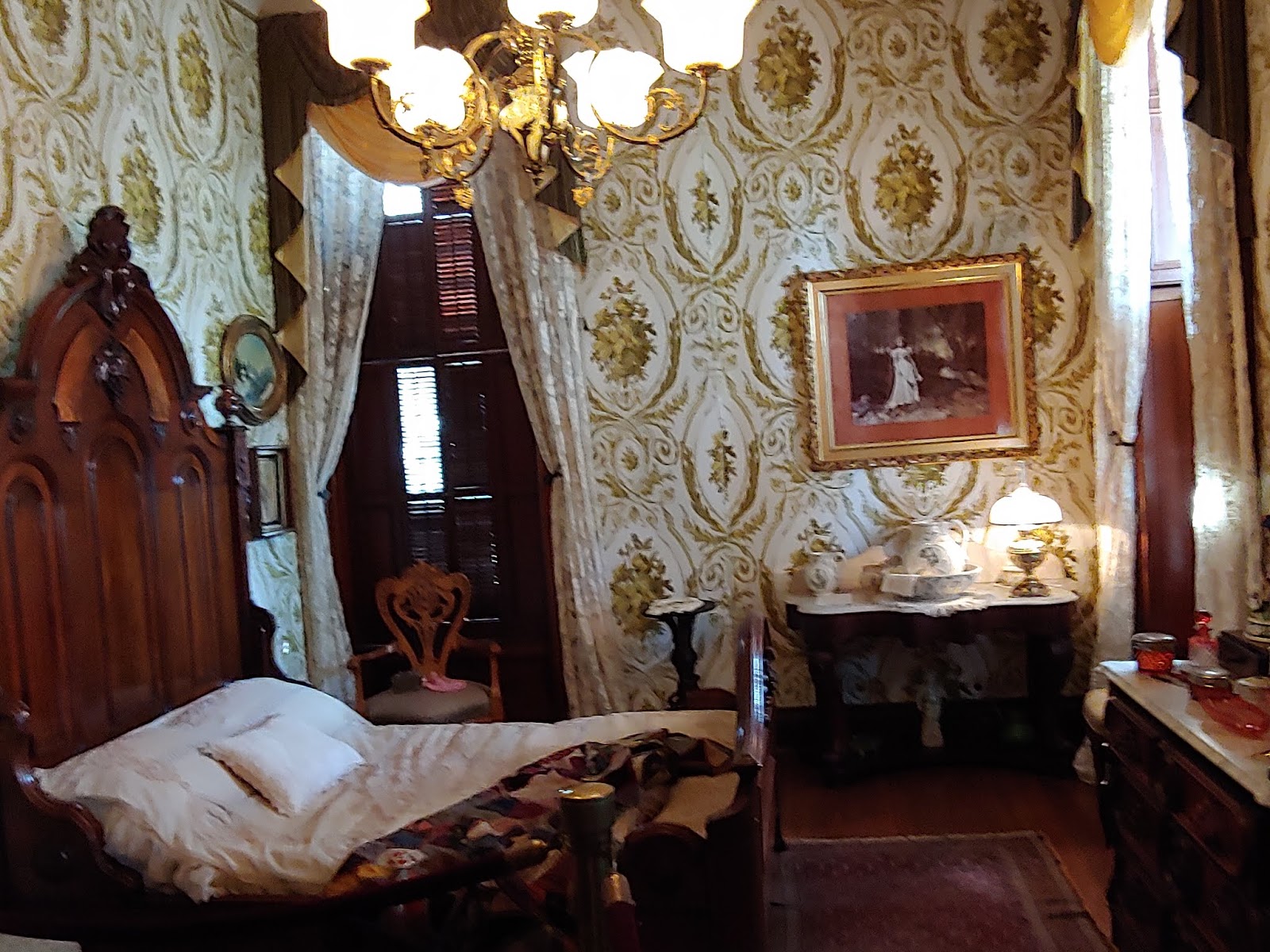


General Dodge married Ruth Anne Browne in May of 1854 in Boston, Massachusetts. They had met in Peru, Illinois and Ruth Anne was quite the catch with violet eyes and tomboy leanings that made her good at horseback riding and handling guns. And while she would eventually end up living her life out in their grand home, the early years were rough as Ruth Anne lived in pioneer conditions as she followed Dodge from camp to camp during the war. When the war first started, she joined a local group of women to form the Soldier’s Aid Society. This society would prepare supplies for the soldiers in the form of food, medical supplies and towels. And when her husband took sick with typhoid, she nursed him back to health out in the field. At one point, the couple were in St. Louis and Ruth Anne witnessed a man beating a female slave. She wrote this letter to the wife of Colonel Woods about the incident on March 31, 1862, "Dear Mrs. Wood, I write this to let you know that old scamp Wheelan had been to work here about the Negroes. Went and got a justice to come and take Louisa away from Mrs. J. Robbins and has taken her off in some slave yard in another part of the city. You have no idea how it made my blood boil to hear how he treated the poor thing. Made her go without bonnet or shawl and struck her with an umbrella to make her go faster and she expecting every moment her child, would be born – I wish you would let Col Wood know all about it. I think it is horrible and outrageous and I hope that Col Wood will catch him and make him suffer for it. How I would like to see him shot. Tell the captain to get some one to call him down to Rolla by some way and then sick his men on him. He then carried Louisa off. She had sent her little boy up to her sister’s and then he beat her till she told him where he was - I felt like crying and was bound to let you know and your husband know how that scamp had been acting and all I ask is Col Wood catch him yet. My husband is quite ill and has not been up at all today. Am in hopes a few weeks rest will restore him. Do you think of leaving Rolla soon and have your husband come back. I shall be glad to hear from you. Truly, Mrs. G. M. Dodge."
Ruth Anne would go on to become part of the Executive Committee for Women's Suffrage. She and her sister-in-law worked to save the library in Council Bluffs as well. Ruth Anne loved art, literature and music and could play both the piano and the guitar. She and Dodge would have three daughters together. In January of 1916, General Dodge died and his wife died 8 months later. She told her daughters about a dream she had prior to her death in which she saw an angel offering her the water of life. Ruth Anne said, "I was not yet ready for this supreme blessing. I felt unworthy, and it seemed to me it would be presumption on my part to partake of anything so wonderfully pure, so heavenly, so spiritual." The angel appeared a second time in a dream and Ruth Anne wouldn't drink again. The angel came a third time in a dream and this time she accepted the offer. After drinking from the bowl, Mrs. Dodge said she had been "transformed into a new and glorious spiritual being. I drank of that wonderful water of life and it gave me immortality." After she died, her daughters commissioned the sculptor who made the Lincoln Monument, Daniel Chester French, to make a memorial for their mother featuring this angel. This is the Ruth Anne Dodge Memorial or more famously, the Black Angel found at Fairview Cemetery. The Dodges are actually buried in the family mausoleum in Walnut Hill Cemetery. The couples youngest daughter Anne, took over the house, but she only used it occasionally throughout the year. She died in 1950 and the Dodge Family Trust sold the house and in 1961 it became a National Historic Landmark. The Historical Society of Pottawatomie County held a public drive to raise funds to buy the house and it did so successfully. The City of Council Bluffs restored the house and made it into a museum.*Fun Fact: Fort Dodge in Kansas is named in his honor as is Dodge City.*
The Dodge family loved this house and some believe that they never left. When we asked our guide about her experiences, she really had not had any yet, but she had only been there for a short time. (Dodge House 4) So our guide believes in this stuff, but the main people in charge shy away from talking about hauntings. We run into this a lot in these homes because they don't want to be known for their hauntings. This usually results in not a lot of ghost stories. So what IS out there?
The main apparition people claim to feel and see here is the man who loved this place the most and had it built to his specifications: General Dodge. Several people have claimed to see his full-bodied apparition sitting in his favorite rocking chair. His shadow is also seen walking the hallways of the house. There are other hauntings here though that are hard to pinpoint as to what is causing them. Light flashes and the smell of smoke are experienced outside the residence on the property. Inside, people have claimed to hear the disembodied voices of two men fighting with each other. There were quite a few political people in the home, so maybe arguments about politics. The spirit of a young girl is seen in the home too particularly in the servant's quarters area, but we don't know of any children that died in the house. People have claimed to take her picture in the small windows of the front door. We never trust window pictures.
 |
| The Black Angel |
We had such a great time touring this house and we never fail to learn new things when visiting these Victorian homes. Is the General Dodge House haunted? That is for you to decide!
Thursday, December 19, 2019
HGB Ep. 319 - Yule
Moment in Oddity - A Fateful Pair of Shoes
Suggested by: Mitch Riggs
There is a story about a fateful pair of shoes that dates back to the time of the Civil War. The Battle of Gettysburg to be exact. Members of the 1st Massachusetts Cavalry were marching to Gettysburg when they came upon an obstacle in the road. There was a wagon full of stuff stuck in the road. The regiment quickly moved the wagon and then distributed the goods among themselves, which included thread, needles, pipes, tobacco and a pair of white canvas shoes. The cavalry private who grabbed the shoes used a pen to put his initials on both pairs of shoes, R.V.C. The next day, the regiment arrived in Gettysburg and participated in the battle. R.V.C. was killed in a skirmish and a Confederate took his canvas shoes. He put them on immediately, but didn't get to use them for long as he was soon killed. The shoes became Yankee footwear again as another of the 1st Massachusetts members took the shoes from the Rebel. He put them on and went to catch some sleep that evening as the fighting stopped. The battle began again early in the morning and the Confederates started gaining ground once again. The Yankee was one of the first killed in the battle. This time though, no one bothered to grab the shoes. Clearly, they had figured out that those canvas shoes were unlucky. Three men were killed wearing those shoes in a period of 36 hours and that, certainly is odd!`
This Month in History - Orville and Wilbur Wright First Flight
In the month of December, on the 17th, in 1903, Orville and Wilbur Wright completed the first controlled flight of a heavier-than-air aircraft in Kittyhawk, North Carolina. The brothers had not always been pilots trying to get a plane off the ground. They had started off as printers and then they opened a bicycle shop. But through all of that time, they had worked on various contraptions to attain flight. Three days before their successful flight, Wilbur had been at the controls and the plane had stalled and crashed. Orville would take over on December 17th with conditions that were perfect. Orville wrote of the experience, "The wind, according to our anemometers at this time, was blowing a little over 20 miles, 27 miles according to the government anemometer at Kitty Hawk. On slipping the rope, the machine started off increasing in speed to probably seven or eight miles. The machine lifted from the truck just as it was entering on the fourth rail. Mr. Daniels took a picture just as it left the tracks… A sudden dart when out about 100 feet from the end of the tracks ended the flight. Time about 12 seconds (not known exactly as watch was not promptly stopped)." The brothers would make three more flights that day with each one gaining more distance than the one before. The last flight covered 852 feet in 59 seconds. I've been to Kitty Hawk and seen the marks where the plane landed. It doesn't seem like very far, but when you think of the time period and that we now send people to space, it truly is extraordinary what mankind can accomplish.
Yule
We mentioned Yule briefly in the History Goes Bump Christmas Special in 2015, but we've never just focused on this set of beliefs, practices and traditions. On this episode we are going to peer into the darkness to find the light that will lead us into Spring. Because that is really what Yule is about for most people that observe it. This is an opportunity to take the time during the darkest part of the year and focus on the end of the year and what the future holds and to prepare for the rebirth that Spring brings. This is also a festival of rituals for which much of the traditions and practices of Christmas are rooted. Join us as we explore Yule!
The Winter Solstice is on December 21, 2019. Yule this year, 2019, starts on December 22nd and ends on January 2, 2020. The community that surrounds History Goes Bump is the best! We might be biased, but I just love the richness of beliefs, traditions, thoughts, ethnicities, locations and love that our members bring to the group. Suzanne put it so well in the Spooktacular Crew when she said, "Love reading all these traditions! I had no idea. Going to have to add some of them to my family traditions. Thanks guys! This is what I love about this group. I learn so much. (And for those that love Cemetery Bingo, you have Suzanne to thank for that.) I so agree with Suzanne. I learn so much from everybody. And we couldn't share about Yule without asking our community, for those that observe Yule, what are some of your traditions? That is what Suzanne was commenting about.
Melissa P: I make a Yule log and my family writes down their wishes for the coming year and we burn them in the fire. This is the Yule log I made for this year. We found the log, pine cones & pine needles during a family outing up to the snow. It may not be “traditional” but its what I was called to make.
Sb: We light candles to chase away the darkness and eat a pomegranate or two.
Shannon B: We usually have a feast with friends, fill a papier-mâché boar with wishes for the coming year and then burn the wishes (not the boar- he’s too cute.), and light candles for Persephone and to welcome back the light/chase away the darkness. We also do ‘commercial Christmas’ with the tree and the gifts, and minus the Jesus.
Jannae M: We have dinner with friends, and write down wishes for the coming year. Lighting a candle to welcome back the sun is a must. I light it as the sun sets and then let it burn (safely) on my altar which is in my bedroom so it’s glow can remind us of the coming warmer months. Lots of warmth, light, and love.
Sara E: The key one for me is lighting a candle and being sure that it burns through midnight in order to lend light to the world in its darkest time. If I could I would leave one burning all night to offer strength to the sun. I'll traditionally take a few minutes to consider the year to come as well, although Samhain is the end of the old year, I make my resolutions at Yule.
Beth V: Yule and Solstice coincide and it depends really on pagan type and geography. My grandparents were old country Eastern Europe, so we celebrated solstice. But there is a lot of crossover. For Solstice we celebrate the longest night and fires for warmth and stories are usually a tradition. Singing, too. The main gift, often handmade, is given on Solstice and then small presents following with only a stocking with fruit and candy of the 25th. But the 21st overnight to the 22nd was most important.
Diane V: Light a fire started with the Yule log from last year that has been on the hearth. Family dinner and candle lighting.
Alicia J: We are lucky enough to have a winter solstice lantern walk around a local lake. The path around the lake is lit with candles, people bring their lanterns - a lot of them are homemade and amazing, there was even a dragon shaped lantern one year! And at the end of the walk there is a big bonfire and mince pies. At home I light our fire and leave a mince pie and a glass of mead on the mantlepiece for any visiting spirits who stop by as it tends to be an active time of year, in fact we've had a few things happen already this season! We've heard someone moving around upstairs (there was no one, it's just the two of us and the cat was with us at the time) I saw a white shape move across the room reflected in the mirror (no car lights passing as it was the side of the house facing the garden), the same day I heard someone knock on our door but the street was empty and my partner saw our recently deceased cat twice in the space of a couple of minutes. It's been a bit busy in our house!
Jess from SBT: We usually eat a lot, including a yule log shaped cake and drink a lot of beer.
So the common practices here seem to be lighting candles and/or a fire and making wishes for the new year. And then there are other traditions based on personal preferences or location. But where does all this come from? First, let us just clarify that Pagan and Wiccan beliefs are a matter of personal choice and run the gamete. We have been joined on episodes by several Pagan practitioners and have found them to have eclectic practices. The term Yule is derived from the Old Norse jól, although it has also been referred to as miðsvetrarblót or midwinter sacrifice. First, we have difficulty establishing origins on our present calendar because there have been several calendars throughout history, obviously. We are now in the Gregorian calendar. One of the ancient lunar months was known as Jultungel, which translates to Yule Moon. There are those who maintain that there were two parallel calendars before the Julian Calendar. One was based on weeks for the quarters of the year and each quarter started four weeks after the astronomical solstices and equinoxes. This was called the Week Year Calendar. The other calendar was the Lunisolar Calendar and was based on lunar months within the solar year rectified to the winter solstice. So basically, the point is that traditionally the Yule feast was to be observed at the first full moon after the first new moon following the winter solstice.
It is thought that the oldest yuletide feast was called Hokunott in Scandinavia and was first described by the 6th century Byzantine writer Procopius. This feast was to celebrate the return of the sun and was observed right after the Winter Solstice. The earliest reference to jól was in a 9th century Norse praise poem in honor of Harold Fairhair's victory at the battle of Hafrsfjorð, which unified the kingdom of Norway.
(Kelly) As we approach the Winter Solstice, we are moving from the darkest time of the year into the light. We are also moving into a time of the year where food is scarce for humans and animals. This was a time of famine and probably why this time was also called the midwinter sacrifice. The cattle would be butchered before this time because there would not be enough to feed them and the people would need them for food. So it was a time for meat feasting. The Winter Solstice is the longest night of the year. Thus it would be a good time for introspection. These are the pieces of Yule that have traveled through the centuries: a feast, fire or light, introspection and future planning.
There are deities connected to Yule and they include The Oak King, The Horned One, The Green Man, Mabon, Odin, The Great Mother, Diana, Brighid, Demeter and The Dagda. Brighid taught the art of fire tending and working metal to the blacksmiths. We talked about her a lot on the Imbolc episode. She is thought to be a Celtic triple goddess. She is described as a daughter of The Dagda with two sisters having the same name by some, but by others these three personas are three aspects of a single deity. She is a goddess of hearth and home and helps with divination and looking to the future. The Dagda is an Irish deity looked at as the father-figure and controls the weather and crops and such, so you see his connection here. The Oak King is the counterpart to the Holly King. These two fight for supremacy and at Yule, The Oak King wins and Winter reigns. The Summer Solstice brings victory for the Holly King and Summer reigns. Some Pagan systems make them the opposite with them reigning on the Equinoxes and other traditions combine the two into The Horned One. The Oak King is sometimes called the god of the Sun, while the Holly King is referred to as the Dark Lord. The Holly King looks something like a nature version of Santa with sprigs of holly in his hair, dressed in red and driving a sleigh pulled by eight stags. The Oak King is thought to be a type of fertility god and can also be referred to as the Green Man. Most people know Odin is the chief Norse god, so makes sense that he is connected to Winter festivities and he bears a strong resemblance to Santa.
Activities for a village included wassailing to the trees and crops. The trees were mainly cider apple trees. This would be singing and uttering incantations to promote a good crop at the next harvest and to scare away evil spirits. This makes me think of us talking to our plants. You listened to that episode of Odd Tonic about plants, right? The one that covered the Secret Life of Plants. So clearly this understanding of talking or singing to plants is ancient. This singing is something Beth incorporates into her observance too. Many villages would have a wassail king and queen that would lead the procession and the queen would hold up a Claven Cup with toast soaked in Wassail inside of it, up to the trees as an offering. One of the incantations went like this:
Here's to thee, old apple tree,
That blooms well, bears well.
Hats full, caps full,
Three bushel bags full,
An' all under one tree.
Hurrah! Hurrah!
Folklore has tales about the Apple Tree Man, which is the persona given to the spirit of the oldest tree in the apple orchard. This is thought to be the spirit of fertility in the orchard. Ruth Tongue and Katharine Briggs wrote about the Folktales of England and one of these tales is about a man in Somerset who offered his last mug of mulled cider to the trees in his orchard on Christmas Eve. The Apple Tree Man saw this and decided to reward the man, so he told him where he could find some buried gold.
The wassailing could go house to house too and this is where caroling comes down from. Children would also take gifts from house to house. These would be baskets made from evergreen boughs, which were sacred to the Celts since they didn't die, and wheat stalks dusted with flour, which represented the harvest with flour representing triumph, life and light. Inside the baskets were oranges and clove spiked apples. And drinks would usually be offered. Alcohol is a big part of the Yule celebration. You heard Jess mention that.
One of the most important symbols of Yule is the Yule Log. Traditionally, the Yule Log was made from a log found on the householder's land or given to them as a gift. The most prized log would come from an Ash tree, which was considered sacred by many tribes and Ash was said to be an herb of the Sun and thus it brings light to the hearth. The Vikings and Scandinavians believed that their tree of life that they called Yggdrasil, was made of ash. The roots of Yggdrasil were bound in hell and its branches were in heaven. The god Odin hung on this tree for 9 nights, so that he could gain the gifts of prophesy and divination. He lost an eye, but received those. The first man was said to have been formed from the Yggdrasil. Ash is also symbolically representative of the four elements.
This Yule Log was decorated with evergreen sprigs and boughs and doused with cider or ale. Flour would be dusted over it all. And these all symbolized what we mentioned with the gifts the children took around. The Yule Logs were saved from previous years and this was so that the fire that that year's Yule Log was to burned in could be started with the previous log. The fire would be kept burning through the night and left to smolder for the twelve days of Yule. Now in our present day, it is harder to observe this tradition because people don't have fireplaces, so many observers choose to drill three or more holes into a log and place candles in the holes that they can light. The decorating goes much the same. Candle colors range from the colors of the Sun God: green, gold and black to the colors of the Great Goddess: white, red and black to seasonal: red, green and white. I advise against the flour though because that is so hard to clean up.
And speaking of greenery, this is brought inside too to remind people of living, not death and to entice those nature faeries and spirits to come inside and celebrate. This is why holly, ivy and mistletoe have become a part of Christmas, this is just part of Yule. The mistletoe carried the added symbolism of fertility as the seed of the Divine and Druids would travel deep into the forest to find it in the middle of Winter. And you can probably imagine why people kissed under the mistletoe.
So you see the origins of Christmas in all of this. Bringing a tree into the house and decorating it with candles and bows. Christmas Carols carry many lines that leave people confused because they harken back to Pagan rituals. We light fires and candles. We make resolutions. We drink apple cider. And we give gifts. This is all very nice, but as you dig into the research, you do find some dark sides in the Pagan traditions. The English brought mistletoe into the house to ward off evil spirits. There is, of course, The Saturnalia, which was a week-long festival celebrating the Romans' agricultural god, Saturn. This festival lasted from December 17 until December 23 and the festivities were anything but a time for a child to get a sparkle in their eye as they dreamed of sugar plums and toys and tried to be good even though a crazy Elf on a Shelf was watching their every move like Big Brother and reporting back to jolly ole St. Nick. Come to think of it, Elf on a Shelf does add a bit of horror to the Christmas Season for kids. Anyway, Saturnalia usually involved gluttonous eating, drinking alcohol to excess, gambling and public nudity. I'm sure none of this goes on with any of your family festivities over the holidays. *wink, wink*
But Saturnalia could get even darker. There are those who claim that Saturn was the cruelest god of the Romans and demanded child sacrifice. This human sacrifice didn't last for long, but gladiator fights during the festival added blood. There is a return to talk of human sacrifice when looking at the candles on the tree, which some claimed was made from the fat of children who were sacrificed, but I would venture to say it was probably from the "sacrifices" of all the animals before winter set-in. And then Saturn has been said to be another image of Father Time and the New Year Baby is the sacrifice victim. And Saturn is also suppose to be like Santa and with a child on his lap, well, you get the picture. The balls on trees supposedly represent the heads of those conquered by the Sun God or his male genitalia and retrieving presents from under the tree represents parents sacrificing their children under the trees for the Sun God. Did any of these things happen. I'm sure there were cultures that participated. Human sacrifice did happen throughout history. But as for Yule for the past few centuries, it is all very tame.
Join us in observing Yule this year. Take a Solstice Walk and bring some greenery into the house and make yourself a Yule Log. Write down what you are grateful for in the past year. Visualize the next year and the path you want to walk. And kiss somebody under the mistletoe! We also want to remind you to join us on Christmas Eve at 8pm ET as we tell scary ghost stories in keeping with the old traditions. So have a Happy Yule, Merry Christmas and blessed whatever you observe at this time of year!
Show Notes:
https://www.brutenorse.com/blog/2017/12/norse-yuletide-sacrifices-had-almost.html
Nordberg, Andreas. 2006. Jul, disting och förkyrklig tideräkning: Kalendrar och kalendariska riter i det förkristna Norden. Kungl. Gustav Adolfs Akademien för svensk folkkultur: Uppsal
Thursday, December 12, 2019
HGB Ep. 318 - Haunted Ashland, Virginia
Moment in Oddity - Skara Brae Discovered by Farmer
Suggested by Jen Sullivan
Imagine working your fields one day as a farmer and making an incredible discovery. Not just some little artifact kicked up by a farming implement, but an entire village! That is just what happened to one Scottish farmer on the island of Orkney in 1850. He stumbled upon a large stone that didn't seem like it belonged with the landscape. He pushed the stone over and when he did, he found what is now called Skara Brae. A Neolithic village that existed probably over 5,000 years ago. That is amazing because it means that this place existed before Stonehenge and even the Egyptian pyramids. The farmer originally thought he had found a house, but as more was unearthed, there seemed to be an entire city buried here. Apparently, the village was covered over by sand dunes centuries ago and this helped to preserve it. Skara Brae is believed to be the best-preserved Neolithic settlement in Western Europe. The village was small with probably only 100 residents. Historians were interested in the fact that only utility type knives were found on the site, with no weapons for warfare. The site has been named an UNESCO World Heritage Site. There are those who claim that the story that a farmer found the site is just a bit of lore, but I rather like it because it certainly makes the discovery a bit odd.
This Month in History - Dom Pedro I Crowned
In the month of December, on the 1st, in 1822, Dom Pedro I was crowned as the first emperor of Brazil. He was the founder of the Empire of Brazil and was nicknamed "The Liberator." His father was King of Portugal, but in 1807, he fled with his family to the Portuguese colony of Brazil after French troops invaded Portugal. On his 24th birthday, Pedro was acclaimed as Emperor of Brazil and then officially crowned in December. Not all of Brazil recognized him as Emperor though and he used force to bring these areas into submission. His father died in March of 1826, making him the successor to the throne in Portugal. He knew that the people of both countries would not accept him as ruler for both, so he adbicated the Portuguese crown to his daughter Queen Dona Maria II. He added the condition to the arrangement that she would marry his brother Miguel. I'm not sure why, but this was a bad move because Miguel only pretended to go along with everything and once he was declared regent in 1828, he didn't marry Pedro's daughter, he repealed the Constitution and was acclaimed King Dom Miguel I. This was all backed by all of Pedro's sisters, save one, so the betrayal he felt was immense. He was not a good guy at this point though either. He had a string of lovers, settling on one and moving her in to play Lady-in-Waiting to his wife. He mistreated his wife horribly and she eventually died either from a miscarriage or a beating. Pedro would later claim to see the ghost of his dead wife and vowed to become a better person because of this. He did just that, remarrying and being faithful. He eventually contracted Tuberculosis and died in September of 1834. His heart was placed in Porto's Lapa Church and his body was interred in the Royal Pantheon of the House of Braganza.
Haunted Ashland (Suggested by: Whitney Zahar)
Richmond, Virginia had been the capital of the Confederacy, so one can imagine that the towns around it would be strategic locations for gathering supplies and protection. Ashland is one of these towns and the railroad was a major part of the city. The railroad company established the town with a spa hotel that hosted visitors to the curative powers of a natural spring. This location would go on to become a college. As the Civil War erupted, Ashland found itself a host to wars and the wounded. With this kind of history, hauntings are sure to follow. Listener and Executive Producer Whitney Zahar has joined us on other episodes and she joins us on this one to share her experiences as a tour guide for Ashland Ghost Tours. Join us as we share the history and hauntings of Ashland, Virginia!
The Hanover area that Whitney talks about has many haunted location within its boundaries. L.B. Taylor, Jr. has written numerous volumes in his "The Ghosts of Virginia" book series and we wanted to share a poignant story he shares in Volume 8 that is from Hanover. (pg. 346)
So the natural springs in Ashland led the railroad company to build Slash Cottage and then Randolph-Macon College takes over the property. That story about seeing soldiers from the waist up is so weird. I would like to believe they are just having issues manifesting completely. What do you think Kelly?
On this episode we also talk about the McMurdo House, the Henry Clay Inn and the Mills House that no longer stands. Lots of great ghost stories! Is Ashland, Virginia haunted? That is for you to decide!
Thursday, December 5, 2019
HGB Ep. 317 - The Legend of Elementals
Moment in Oddity - Crown Shyness
Suggested by: Jenny Raines
Black mangrove trees do something really weird. So do eucalyptus trees and camphor trees. In the 1920s, this weird phenomenon was first documented and scientists have studied it ever since and tried to figure out why it happens. This phenomenon is known as crown shyness. You've probably seen it for yourself. Next time you are in a dark forest looking for Bigfoot or fairies, look up and see if you notice a network of cracks between the canopies of trees. This almost looks like tiles laid next to each other with grout in between or jigsaw pieces nearly connected together. One of the reasons why scientists can't figure out the "why" is because it doesn't happen all the time. Some have theorized that crown shyness is the result of abrasion. This is a fancy way to say that branches brushing against each other cause twigs to break. And it's a good theory until scientists surveyed trees in high wind areas and found no increase in crown shyness. Other scientists think that maybe light has something to do with it. This hypothesis basically states that the tips of trees can detect light levels and this will cause the tips to stop growing. Whatever the cause, it does help prevent the spread of damaging insect larvae. Looking up at crown shyness is breathtaking, but is also a phenomenon that certainly is odd!
This Month in History - Cicero Beheaded
In the month of December, on the 7th, in 43 BC, Cicero is beheaded. The year before his death, lawyer Marcus Tullius Cicero became one of the most powerful men in Rome when Julius Caesar was murdered. He was an outspoken critic of Octavian, who was Caesar's heir, and Mark Antony. Two men, Popilius and Herennius, were sent to take care of Cicero and they caught up with him as he went out to find a ship to take to the coast. When Cicero was approached by the men, he knew what they had come to do and he basically put up no fight and asked that they give him a quick and clean death. And they did. Herennius drew his sword and cut off Cicero's head. He then cut off his hands and brought the head and hands back to Antony who hung them in the Forum. Antony felt like he was vindicated by taking the hands that had written mocking speeches about him, but the Roman people saw it more as a symbol of the darkness in Antony's soul.
The Legend of Elementals
Our lives are touched nearly everyday by the four elements. We breathe air, drink water, eat things fed by the Earth and cook or warm ourselves with fire. There are stories of ancient creatures that are one with these elements and we have come to know them as Elementals. Elementals show up in a variety of places from books to comics to legends of old. Is there any possibility that these mythic beings did actually or could actually exist? On this episode, we explore the history, stories and possibilities of Elementals.
I mentioned comics and Elementals in the intro because for me, that's where I first learned about Elementals. I was a DC comic girl and for the most part I still am (sure wish they could get their movies right like Marvel) and my favorite hero and comic was Firestorm. I own nearly all of them. I remember keenly about the time I started college, in the early 1990s, Firestorm underwent a huge change and he became the Fire Elemental. I also followed Swamp Thing a bit and he was the Earth Elemental. So this was my introduction. Later though, as I got more into the paranormal and legends, I started to learn more about the Elementals and their connection to the four main elements. Kelly and I both have a real connection to nature and so for us, it's easy to be connected to the elements.
We all know the four basic elements: air, water, land and fire. Theophrastus von Hohenheim, more commonly known as Paracelsus, was born around 1493 and he was a physicist and alchemist nicknamed the "Father of Toxicology." He studied ancient beings in his works and it was his conclusions and writings that separated various mythical beings into the four classes of elements. His archetypes were Gnome or Pygmy for Earth (North), Undine or Nymph for Water (West) *Blur of color*, Vulcanus or Salamander for Fire (South) and Sylvestris or Sylph for Air (East). Paracelsus described these creatures as not being spirits, but also not being creatures. He emphasized that they were something between. For me, this is a hard concept to understand because as we study the stories about them, they can both appear as human in human clothing or be invisible. Paracelsus also did not call them Elementals, but Sagani. These are nature spirits. Each Elemental seems to have its own body type. Gnomes are short and pudgy, sylphs are similar to humans, but stronger, longer and rougher, undines are basically human in appearance and size and salamanders are long, narrow and lean. Since these beings are part of a particular element, they can move freely through that element. But this is all according to Paracelsus. We know that the belief in these creatures goes back long before this time.
Ancient cultures in the Middle East and East referred to four elements, sometimes calling them something else like wind instead of air. Many cultures, especially in places like China and Japan, would refer to a fifth element that was described as void. China would even press that elements were not physical, but more transitional and they include metal and wood as elements. Perhaps this is where the idea of elements as spirits got its start? And I find that fifth classification, the void or ether, very interesting. This was a basic way to say that we have four types of matter, but there is a fifth beyond material. This fifth element is said to not have a spirit connected to it. And what are we when we die? This energy or matter, but we are beyond the physical world. Hinduism also has their void, which they call akash, and that the human body dissolves into all of these elements upon death. Plato was believed to be the first to use the term element and Aristotle took it further breaking the elements down into qualities. Earth is cold and dry, air is hot and wet, water is both cold and wet and fire is hot and dry. Native Americans break Elementals into different classes like tree spirits, rock spirits, etc.
As we move down through history, we come to alchemy. The science of alchemy has always been tied to Elementals. After all, alchemy is about changing matter and in order to do this, elements must be used. Alchemy basically shows up during medieval times and it was Arab alchemist Jābir ibn Hayyān who not only laid out the four elements, but added mercury and sulfur into the mix. Alchemy is not just a physical science, but also philosophical. And as we look at Elementals, there is more philosophy and spirituality there than basic science. And speaking of basic science, we know we have scientists out there screaming that there are more than four elements. Clearly, we have a periodical chart with lots of elements on it and these are broken down into four states of matter: solid, liquid, gas and plasma. Although, we could argue that those are basically the four elements too.
In our episode about the Legend of Faeries, we mentioned Elementals and that people sometimes classify them together, but traditionally they are different beings. Elementals are thought to not be as developed, but rather true energy and so they do not have personality. Faeries have an affinity for elements, but are not those elements. We listened to several people talking about Elementals, but many just threw them in a mix with Skinwalkers, the Fae, Daemons and etc. One point that we heard is that the Quran mentions the Djinn and that they are described as being Elementals. We did an episode on the Djinn (Ep. 157) and they were created from fire, but does this make them the Fire Elemental?
When it comes to hauntings, we experience many different types of spirits. There are those who were human at one time and then there are those who could be called unborn. This is something that is not human and never was. Obviously, Elementals fall under this. Many claim that we cannot experience Elementals or actually meet one. And we are taught from a young age that they are not real. But are they? There are so many stories of these ancient beings and Pagans say that these beings are on a different plane or dimension and that is why we may not experience them.
Malignant magick conjures Elementals. Disturbances can cause Elementals to rise up or come forth. Like mining or construction or even building a dam can cause an Elemental to be disturbed. They give off EVPs with very gruff and deep voices. They don't like metal objects and so these may have a tendancy to disappear. They can be attached to crystals, so if you bring one home, they might come with it. Earth Elementals will cause animals to behave strangely, cause a person to have fear of being buried alive or fear of leaving their home and cause earthquakes. Water Elementals cause plumbing problems, they might cause someone to commit suicide by drowning and cause floods. Fire Elementals can cause spontaneous fires, a human that develops an obsession with fire might be touched by one or if you see tongues of flame or balls of flame and spontaneous combustion. Air Elementals can throw or break objects, cause sexual assaults and cause agitation and fighting in their locale and people commit suicide through the air by jumping from high places and cause tornadoes and gales. Obviously, ley lines are deeply connected to Elementals.
A person going by username Sylunedarkchylde from the Philippines wrote of encounters with Elementals, "I'm not sure how other countries perceive Elementals to be, but here in the Philippines, they are called "Engkantos", "Anitos" and so on. These Engkantos and Anitos used to be worshiped by ancient Filipinos until Spain decided to force Christianity on us a few hundred years ago, and only then were they thought of as evil entities. Personally, I think Elementals are a part of nature, too; but were made differently - just like when someone would be born with an extra toe, no arms, no legs, etc. To me, they're like nature's "special" brothers and sisters. But of course, please do enlighten me if my understanding is wrong - because that was just an uneducated opinion formed based on what I have seen. The first story was when my family and I were on a 3-day vacation in Baguio City. I was around 16 or 17 at the time. Baguio City is famous for its many hauntings, especially after the 1990 (or was it 1991?) earthquake that pretty much reduced the city to rubble. But I honestly don't think what I saw was a ghost - somehow it had a different "feel" to it. The house that we stayed in was a vacation home owned by my mom's boss, and she was nice enough to let us use the place for free. The house was situated at the middle of the mountain, so you would need to drive up from the foot and you can drive all the way up to the top as well. The house only had one private room, and two semi-private rooms; because the rooms on the second floor may be separated by walls and two different doors, but both rooms are mezzanine types, so I can see the living room from where I was. On the first night, we were still tired as hell because of the eight-hour drive to the city and spending the rest of the day shopping for trinkets to bring home to our friends. But since I just ate, I cannot go to sleep yet because of my acid reflux - so I decided to grab the book I brought from my bag. While I was reading, I noticed something flicker, like a quick flash of light in my peripheral vision. I looked up from the book and to the window where I think I saw the light, but nothing was there. So I went on reading, and it happened again - but this time, when I looked up, I was in for a surprise. There was a bluish-white ball of light. It wasn't very bright, but luminescent. I'm guessing it's as big as a volleyball, or maybe slightly smaller. And if I were to estimate my distance from it, I'd say around ten feet--far enough to see it clearly. I was scared at first, but for a person who's easily attracted to shiny things and sometimes too curious for my own good, I continued to watch in awe. It looked almost magical. It bobbed up and down very slightly as it glided, and it left some sort of translucent, almost transparent "tail" like a comet as it moved. Then it passed behind a tree. Again, to my surprise, it emerged on the other side of the tree, but no longer as one white ball, but hundreds of tiny little swirling balls of light. It was awesome! I admit I still felt a little scared, but it was too pretty to ignore. I had this feeling that whatever it was, it was playing with me. Then, it passed behind another tree, and then when it emerged, it was one big ball again. By the third time it emerged, the window only had enough space so I had to stand up and walk towards the window to continue watching it. It kept doing the same thing - compressed into a ball, scattering, then compressing every time it passes behind a tree - until it got so far up the mountain that I couldn't see it anymore. I don't know, but to me it was awesome. I've never seen something so unnaturally pretty in my life. Of course, just like any person would do, I told everyone about it. My sister was asking why I wasn't scared, and I admitted I was at first, but when I looked at it long enough it looked so pretty and it didn't seem to mean any harm. My stepfather said it might have been "St. Elmo's Fire", but after researching about it, St. Elmo's Fire behaved differently, so I didn't really think it was what he said it might be. Then I learned about swamp lights. Of course, there isn't a swamp anywhere near there, but I needed to find out what it was. But swamp lights are chemical reactions in the swamp that causes it to light (like methane mixing with something and it burns a white, sometimes blue light) but again, it didn't look like fire. Besides, fire doesn't glide the way the mysterious white light did. Not to mention the shape, then scattering, then reshaping again. I left the city without any answers, but memories of the pretty lights. I even remember making a painting of it (it was sold already) because it just looked so pretty and mysterious that I needed to show everyone how it looked like. I have friends with different beliefs - Christians, Muslims, Satanists, Atheists, Wiccans - and when my Wiccan friend saw the painting she asked me what it was. I told her the story, and she said I might have encountered an Elemental; and it might have been the Wind - a manifestation of the Sylph. I researched online right after she said it, but none of the images I saw were the same. However, what made me think that it really was an Elemental was what she said that they are neither alive nor dead; that they have taken a different evolutionary turn from most things, and the wind elemental is most commonly seen as a white or yellow light. To be honest, I am really not sure what it was, but all I know is that I didn't feel the same fear I did when I experienced ghostly stuff. Of course, I was afraid at first, but after a while I just felt like I was drawn to it. I could just imagine how the ancient Filipinos would see this as, and no wonder they worshiped them."
Famous hauntings in history include one at the Leap Castle. Short skeletal monster with sharp claws, a decayed face and smells like sulfur. People describe it as looking like Gollum. Some believe it was conjured by Druids before the castle was there, while others claim that a fighting force conjured it in some way to bring fire to destroy the castle. Gerald Fitgerald is said to be the one who conjured it because he was adept at magick and tried to take over castle several times. That would be malignant magick. Others claim he is the spirit of an O'Carroll family, but that is not possible because it were never human. This entity is dark and sinister. Mildred Darby's account, "Suddenly, two hands were laid on my shoulders. I turned round sharply and saw, as clearly as Isee you now-a grey ‘Thing’, standing a couple of feet from me, with it’s bent arms raised as if it were cursing me. I cannot describe in words how utterly aweful the ‘Thing’ was, it’s very undefinableness rendering the horrible shadow more gruesome. Human in shape, a little shorter than I am, I could just make out the shape of big black holes like great eyes and sharp features, but the whole figure-head, face, hands and all-was grey-unclean, blueish grey, something of the colour and appearance of common cotton wool. But, oh! so sinister, repulsive and devilish. My friends who are clever about occult things say it is what they call an “Elemental”. The thing was about the size of a sheep, thin, gaunt and shadowy in parts. It’s face was human, or to be more accurate, inhuman, in it’s vileness, with large holes of blackness for eyes, loose slobbery lips, and a thick saliva-dripping jaw, sloping back suddenly into its neck! Nose it had none, only spreading, cancerous cavities, the whole face being a uniform tint of grey. This too, was the colour of the dark coarse hair covering its head, neck and body. It’s forearms were thickly coated with the same hair, so were its paws, large, loose and hand-shaped; and it sat on it’s hind legs, one hand or paw was raised, and a claw-like finger was extended ready to scratch the paint. It’s lustreless eyes, which seemed half decomposed, and looked incredibly foul, stared into mine, and the horrible smell which had before offended my nostrils, only a hundred times intensified, came up to my face, filling me with a deadly nausea. I noticed the lower half of the creature was indefinite and seemed semi-transparent-at least, I could see the framework of the door that led into the gallery through its body." The last time she saw the thing was in 1915.
The Felixstowe Fire Demon. In the fall of 1965, a group of British men were hanging out in Felixstowe, which is on the coast of the North Sea in Suffolk, England. They were driving and pulled their car over near a forested area. One of the young men, Michael Johnson, jumped out of the car and ran into the forest. His friends thought he was relieving himself, but he didn't return and then they thought they saw an UFO. It flew away and their friend stumbled out into the road and collapsed. Later at the hospital he told his friends that he had been compelled to enter the forest and he met a weird creature there that was some kind of humanoid with large sloping eyes that were glowing in the darkness and the thing was completely engulfed by orange flames. He blacked out and then woke up in hospital. The doctors found burn marks on his neck.
In Railbach Germany in 1125, a group of people described seeing a burning man who had fire coming from his nose and mouth and they said they could see his burning ribs. And the Black Forest in Germany is said to be crawling with them.
How do you get rid of an Elemental? You can't destroy them or completely banish them, but you can release them to their realm. You can make peace and coexist too. A shaman would be the best person to get help with this.
Elementals are something to explore connecting to and perhaps you will find a class you are drawn to. For me, I've always been drawn more to water. The undines help not only to cleanse water, but also the emotional and subconscious world. Gnomes clean up discord and negativity on a spiritual level. Sylphs purify the mental plane of negative thoughts like hatred, anger, resentment, pride, greed and jealousy. Salamanders are agents of bringing fire to mankind through electricity, firelight or candle flame and they are responsible for the spark of life and they keep it from decaying or disintegrating. So perhaps explore one. And see if you find that Elementals do exist. Because, that is for you to decide!
Subscribe to:
Posts (Atom)