Thursday, February 28, 2019

Ep. 292 - Aradale Asylum in Australia

Moment in Oddity - Moonshiners Used Cow Shoes to Hide Footprints

Moonshining had been going on in America from the time of the Revolutionary War. During Prohibition, the effort to bootleg moonshine stepped up. Most moonshine operations took place in remote wooded areas where they were easier to conceal. This didn't keep law enforcement from finding the illegal distilleries and when they did, the operators would usually take off running. It is easy to track a human with their shoe prints. Moonshiners devised an unusual way to camouflage their tracks: they made cow shoes. These were basically a strip of metal that had a wooden block on the back and the front that had been carved to look like the hoof of a cow. This contraption was then strapped on to a real shoe. Thus when a moonshiner ran away, he left behind hoof prints. The police didn't know if they were following a cow or a human. These cow shoes were worn all the time because they also didn't want authorities to see shoe prints in the woods where humans shouldn't be and suspect that an operation was going on. Once the newspapers reported about the cow shoes, they became less effective. But the idea that moonshiners devised these cow shoes and that they really did work, certainly is odd!


This Month in History - First Photo of an American President

In the month of February, on the 14th, in 1849, the first photograph of a United States President was taken by photographer Mathew Brady. That president was James Polk. Brady was one of the earliest photographers in America and is considered the father of photojournalism. He photographed 18 of the 19 presidents from John Quincy Adams to William McKinley and this included many photos of Abraham Lincoln. He photographed other famous people like Daniel Webster and Edgar Allan Poe as well. He became best known during the Civil War when he took many battlefield photographs and made use of a mobile studio and darkroom while in the field. He hired many assistants and many of ther photos attributed to him were taken by these men. A lack of documentation has made it hard for historians to know whom to attribute photos to and when and where pictures were taken. A war-weary America lost interest in the Civil War photos by the end of the conflict and Brady eventually lost all his money because he had self-funded much of his Civil War work and died in debt. It's sad to think that someone who gave us so much photographic history of this early time, including photos of President Lincoln that would be used to create the $5 bill and Lincoln Penny, would die penniless in a charity hospital.

Aradale Asylum in Australia

Gold brought people to Ararat, but what it would be known for is its asylums. The Aradale Asylum would be home for the mentally ill for over a century and would feature conditions and treatments similar to other asylums around the world, most of which were not good. This misunderstanding and mistreatment of the mentally ill lends itself to the negative energy that sometimes feeds paranormal activity. The fact that the criminally insane were kept in J Ward only heightens that energy. Join me as I explore the history and hauntings of the Aradale Asylum!


Ararat is a city in south-west Victoria, Australia, about 120 miles west of Melbourne. It's named for Mount Ararat, the mountain that the Biblical Noah's Ark is said to have landed upon. The Tjapwurong Indigenous Australian people were here first. Thomas Mitchell was the first to survey the area in 1836 and Horatio Wills passed through in 1841 and wrote in a diary about his group resting like the Ark near a hill, which he named Mt. Ararat. A post office was established in 1856 and then gold was discovered the following year and Ararat became a boomtown. The town continued to grow until the turn of the 20th century. It was proclaimed as a city on May 24, 1950. The town remains small to this day and there is a complex that remains as a reminder to something else that Ararat came to be known for more than just the gold rush. This was a place for the mentally ill. The Aradale Mental Hospital opened in 1865 and the Ararat County Gaol that later became J Ward, a lunatic asylum for the criminally insane, was opened in 1887. They not only harbor a troubling history, but the spirits from the past are said to have remained.

The asylum in Ararat was designed by G. W. Vivian and J.J. Clark in the Victorian Italianate style with an E-plan barracks format. This was modeled after an asylum in Colney Hatch, England. The design incorporated linking bridges and an arcade on an arched gateway with towers and unique detailing of the central block. There were wings on each end that were two-storied and split by gender. The ward wings were surrounded by courtyards lined with iron columned verandas. Another unique feature of asylums like Ararat were Ha-Ha Walls. These walls were meant to give the illusion that no one was imprisoned while the reality of the construction was that they were meant to prevent escape. This was accomplished by using a trench. One side of the wall was vertical and faced with stone or bricks and the other side was sloped and turfed. The material used for the buildings was oversized bricks made from cement that was stuccoed and the roofs were slate. The builders were O'Grady, Glynn and O'Callaghan and inmate labor was not used as was the case with many other asylums. The asylum initially was known as Ararat Asylum before it became Aradale. I'm going to call it Aradale as that is what it is known as today.

Like most other asylums we have covered, Aradale was a city unto itself. This included gardens, vineyards, an orchard, piggery and other livestock. There were 63 buildings in the complex with 500 employees. There was a billiard room, a school, a large multi-purpose hall, library and 2,100 feet of verandahs for patients to get air. A landscape architect named Hugh Linaker had laid out the grounds of Alexandra Park, so he was chosen to layout the grounds for Aradale in 1913, most of which has not survived to today.

The most infamous ward at the asylum was J Ward. J Ward was originally the Ararat County Gaol, which had been built from 1859 to 1861 and was made from bluestone. The prison maxed out at around 40 prisoners and executions were conducted.The first execution was on August 15, 1870 and this was for Andrew Vere who was hanged for the murder of Amos Cheale. The second execution was on September 25, 1883, when Robert Francis Burns was hanged for the murder of Michael Quinlivan. The third and final execution was on June 6, 1884 and Henry Morgan was hanged for the murder of Margaret Nolan. By 1887, this area of Australia needed some place for the criminally insane and so it was converted to a maximum security psychiatric ward for the criminally insane.

After the facility was decommissioned in the early 1990s, patients were transferred to community living and to other facilities and eventually the last remaining ward, the Ararat Forensic Psychiatry Centre was closed in December of 1993. After the official closing, it still was used to house female prisoners during the building renovation of Dame Phyllis Frost Centre. The women left in 2001. Then the Victorian Government provided $7.4 million to Melbourne Polytechnic, so they would set up a campus. As part of this campus, 30 hectares of vineyard and 10 hectares of olive grove were planted in 2002. A winery and olive press was later added and this has become a world-class wine and hospitality training facility. J Ward is today a museum where tours are offered and visitors can see artifacts and photos. Prisoners had done artwork on the outside walls and this can still be seen today.

This is all nice about the buildings, but what of the people? As we know, mental illness was treated quite differently than today, not only method wise, but also socially. These places where they were housed were called lunatic asylums because people were labeled as lunatics and also as idiots and imbeciles. Luna was Latin for the moon and people believed that the moon made some people go mad, so the definition was people affected with periodic insanity dependent on the changes of the moon or moon-struck, which is Lunaticus in Latin. Thus we get lunatic, which is today considered derogatory toward someone with mental illness. Treatment was harsh in some cases and there are those who claim that 13,000 people passed away in its 130 years of operation. It took only two signatures to get you committed, but eight to get you released. The common treatments here included electro-shock therapy, lobotomies, imprisonment in mechanical contraptions and other inhumane treatment. The gardens had fountains which were meant to give a feeling of peace, but how peaceful could one really feel when doctors documented you as an imbecile and strapped you in a strait-jacket.

J Ward's former pastor was Gordon Moyes and he wrote in the 1960s, "On my first day in Ararat I was given a massive iron key to open the thick, heavy, iron and wood doors to the maximum security division to enable me to visit cell to cell the psychotic prisoners… J Ward was built last century of heavy blocks of blue granite with high walls topped with rolls of barbed wire. Every gate and window was barred with steel bars one and a half inches thick. The prisoners were considered the most dangerous in the country and the people in the community looked up to the top of the hill where the psychiatric prison stood like a great castle, fearful of the night when the sirens might go announcing a mass escape when they would all be murdered in their beds. There was no love for those prisoners in Ararat. The prisoners I met as I went from cell to cell or stopped and talked to in the exercise yard were a strange mixture. They were the insane murderers of Victoria marked “Never to be released” or “To Be Held At The Governor’s Pleasure”. There was a man who constantly barked like a dog, and another man who would ask you frequently if you had ever sawn a man up into small pieces with a wood saw as he had. Let's look at some of the prisoners that once called the facility home.

Mark "Chopper" Read died of cancer at the age of 58 in 2013. He had been a figure in the Melbourne underworld and committed various crimes ranging from armed robbery to kidnapping to murder. He had been doing time in Pentridge Prison in 1978 when he arranged for a fellow inmate to cut off both his ears and this is where they say his nickname "Chopper" comes from. This got him transferred to J Ward, but he only stayed there for a few months before being transferred back to Pentridge. Chopper wrote of his time at J Ward, "A terrible place. There was a shit bucket in the middle of the room. People slept on the concrete floor. Meal times were like the feeding of animals. Some people couldn’t have their straightjackets removed, they were that mad. So people still wearing their straightjackets would just dunk their heads into the bowls of food.”

Charles Fossard was a French immigrant who spent the longest time in the facility of any other patient. He was brought to J Ward in 1903 when he was only 21 after he killed a man and was judged insane. He remained there until he died at age 92 in 1974.

Bill Wallace was the oldest inmate ever at J Ward. He was suspected of murdering a man in 1926. And the reason he killed the guy is because he wouldn't stop smoking in a cafe when Wallace asked him to, so he waited outside and shot the guy. There were no witnesses, but a police officer heard the shot and ran to the scene. Two doctors declared Wallace unfit to plead when he wouldn't talk. Wallace was 43 years-old when he entered J Ward and he was there until he died in 1989 at the age of 107. You probably are asking why they would keep somebody there until that age. People petitioned for him to be released when he reached 100, but Wallace didn't want to leave. This was his home. His chess set that the prison had given him on his 100th birthday is on display in the museum.

Garry David, also known as Garry Webb, was an Australian criminal who had a variety of personality disorders. His mother was an alcoholic and his father was abusive, a pedophile and a criminal who spent most of his time locked up. This caused David to grow up in a number of orphanages and his life of crime began at the age of 11. He was eventually diagnosed with antisocial, borderline, histrionic and narcissistic personality disorders. The definition of insane has a picture of him next to it. He not only enjoyed hurting others, he was especially abusive to himself, mutilating his ears, nipples and genitals. He would swallow razor blades, hammer nails into his feet and drink corrosive chemicals. In 1982, he attempted to rob a pizza joint and ended up sentenced to 14 years in prison for the attempted murder of three people, one of whom was an officer. While in jail he wrote graphic fantasies of massacres, assassinations and other disturbing scenarios. In January 1990, David was declared mentally ill, but the Mental Health Act of 1986 gave David the right to appeal and he was later found to not be insane. The government of Victoria was not about to let David out into society, so they passed the Community Protection Act of 1990. He was kept locked up and committed suicide in 1993 by swallowing razorblades. He had spent 33 years of his 38 years in institutions.

The Age wrote on June 20, 1993, "On a wall at J Ward, the Dicken-ilan former prison for the criminally Insane at Ararat, is a painting rendered in angry slashes of black and white. A bearded and long-haired figure, gaunt and furious, more than two metres tall and dressed In colonial convict garb, lunges through a wall of blackness. He has burst his chains and In his right fist he wields what looks like a straight rator. Behind him are glimpses of sky and trees that seem to ask whether tbe figure is escaping to or from freedom. It is an ominous and disturbing work that seems to say much about the man who created It: Victoria's most notorious prisoner, Garry David."
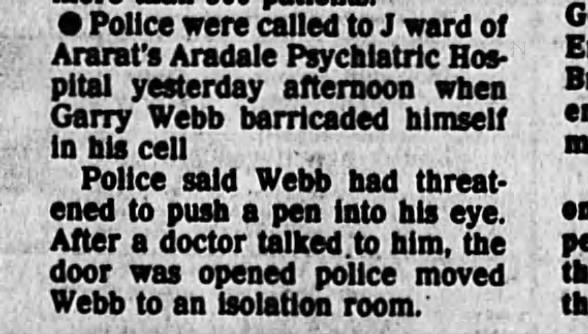
Garry WebbGarry Webb Tue, Dec 18, 1990 – Page 1 · The Age (Melbourne, Victoria, Australia) · Newspapers.com
Username morbid curiosity wrote in 2009 on the Australian paranormal.com website, "My husband was grabbed on the leg is J-wards old bluestone cell block in Garry David Webb's old cell. The next day he had 5 bruises in that same spot where he was grabbed, one thumb and 4 fingers. Fascinating place." David didn't die here, but is some essence of his spirit here? People also claim to have heard a voice shout, "Get out!"

One of the criminally insane here was George Leondieu. He ended up in J Ward in the 1950s after murdering a man who made a homosexual pass at him. George truly was mentally ill and had both delusions and paranoia. Since I mentioned the homosexual thing, I should point out that people could be locked up here all the way into the 1950s for being gay.

J Ward wasn't just a facility for men. Women and children were here too and there is even a "Family Cell" that can be seen on the tour. Lorna Banfield and Roberta A. Daly meticulously searched through old newspaper archives to get to the heart of the stories of women who spent time here. I wanted to share some of their stories. From previous episodes featuring old gaols and specifically those sent to the penal colonies in Australia, a number of people were sent away for very petty crimes or things we might not even really consider crimes today.

Ellen Belser and her children were charged and convicted after breaking into a store and stealing. The official charge was vagrancy and in 1863 they were sent to the Ararat Gaol to serve a two month sentence. The newspaper reported, "The unfortunate woman is paralysed and unable to do anything for the support of herself or family. We understand an effort is being made to get the woman and children into a Melbourne Benevolent Home." The court finally decided to send her to a Melbourne Home. Ellen Jenkins was jailed simply for having no visible means of support. She was sentenced to three months and with no one to care for her children, the two were sent with her. After she got out, she was sent back to jail for drunkeness. This time at least, her kids were sent off to an Industrial School. Janet Mary Ann Pett was charged with drunkeness and sent off to the Ararat Gaol for a few days, which was not unusual for her. She had been here before. This time would last for 8 days in 1863. Two glasses of colonial ale got to Helen Jane Vaughan and as a Sergeant Dillon testified he heard her "utter one of the most disgusting tirades of obscenity it was ever his lot to listen to." She was sentenced to a month at the gaol. Unfortunately, she would later murder her husband in a drunken fight and she was back at the gaol.

These were just a few examples of what women were jailed for and the fact that their children joined them, except for that last one with murder. But more troubling were women like an inmate only known as McLeod. Physicians described her as a "wretched creature, painfully vacant and idiotic" and that there was no hope for her. She was said to eat dirt and suffer from hallucinations and this deemed her a dangerous lunatic. The second Governor was John Gray and his wife Christina was put in charge of the women. The gaol would have only four governors in its 26 years and most of the punishment was hard labor for both men and women. When the gaol became J Ward, women were still imprisoned here with the men. These women were at least accused of real crimes of abuse and murder. One of these women was Mrs. Davis, who was the daughter of Henry Morgan, one of the inmates executed here.

With stories of executions and around 13,000 people dying at the asylum, it is no wonder that this location is considered to be so haunted. The mortality rate was four to five inmates a week. If a contagious disease like TB broke out, that rate skyrocketed. Peter Dunn was a caretaker. He said that typhoid ripped through at one time after patients from the upper levels would throw their feces into the downspouts and water running down from rain. Add in that daily life was a mix of the mundane and the horrific and this place was somewhere no one wanted to go. The Victorian asylums were declared the worst in the British Empire. Add in that an executing gaol was once here and that the criminally insane were kept here and these dark corridors clearly lend themselves to ghost stories. The typical stories of cold spots are told here, but then there are also the claims of feeling cold hands reaching out and touching as if a spirit is asking for help in much the same way this person probably did in life. Disembodied screams are heard throughout the asylum.

I mentioned earlier that there were four governors of the gaol. The final one was a man named George Fiddimont. I couldn't find much on him, but apparently he was giving a group a tour of the gaol in 1886 and as he neared the bottom of a flight of stairs, he suffered a widow-maker. This was near the Old Underground Kitchen and to this day, visitors and guides hear footsteps up and down those stairs when no one is on the stairs. A young spirit boy named Stuart is also encountered here. A former cook occasionally joins him. No one is sure if Stuart had been a patient or a worker.

Peter Dunn claims to have had no experiences when he worked there. He said people would tell him about having strange sensations, but he thinks they just make for good stories. But is there something unexplained going on here? It's enough that at least one tour guide who was a skeptic is now a true believer. He has seen things, felt things and even smelled things that he could not explain. Another guide describes the building as very dark and he claims that on a good night, he'll get around forty screams from visitors. One group of paranormal investigators had been to Aradale eight times to investigate. On the last visit, one of the members fell to the ground flailing around and yelling, "You bastard get off me." When they pulled his shirt down, they found a bite mark on the back of his neck. They took him to an area with better light and looked again and the bite mark was gone. Weird!

The covered bridge leading into the Men's Ward was high enough that people could jump for a final escape from their life in Aradale. Women get a lot of attention in the Men's Ward. Nurse Kerry was a mean nurse and for some reason her spirit has stayed on here at Aradale. Visitors claim to see her full-bodied apparition giving them an icy stare. Shadow figures are seen darting around corners and passing the Superintendent's Office might leave you with a bitter taste in your mouth. A former superintendent killed himself with poison in the form of Prussic Acid. This is hydrogen cyanide. The ghost of an older patient named Old Margaret is said to have returned to the building where she spent most of her life after she died. She is said to be one of the saddest ghosts in the building.

One of the crazier stories to come out of J Ward is the story of an inmate who was murdered and dismembered in the Governor's bathroom. It is for this reason that people believe a demonic force has taken up residence in the bathroom. The feeling inside is oppressive and visitors claim the evil is palpable.

Ghost tours are offered, some of which are several hours and offer investigation as part of the package.With a place that claims to have had more deaths than nearly all other buildings on the continent of Australia, it is no wonder that this asylum is claimed as one of the most haunted places in the world. Is the Aradale Asylum haunted? That is for you to decide!

Thursday, February 14, 2019

Ep. 291 - Jackson Square in New Orleans

Moment in Oddity - Times Beach, Missouri
Suggested by: Jim Featherstone

Times Beach was a town founded in 1925 near St Louis, Missouri. I say "was" because this town was abandoned in 1983. Before the residents had to flee for their lives, Times Beach had a population of 2000.It's origin story is rather unique as its founding and growth were tied to a promotion by the St Louis Star-Times newspaper. The purchase of a lot in this town included a six month subscription to the newspaper. The wealthy of Missouri used this as a summer residence area, hence the beach part of the name. Eventually through the years, the town became home for the lower-middle class, but it was a popular destination along Route 66. The roads in the town were mostly dirt and created a bunch of dust, so in 1971 Russell Bliss was hired to oil the streets. But he sprayed more than just oil on those streets. Northeastern Pharmaceutical and Chemical Company, Inc had asked a company called IPC to discard toxic waste for them and they hired Bliss to do that. Hmmm, he must have thought. Where could I put this toxic waste? His answer was to mix it with the oil he was spraying on the roads. That toxic waste contained high levels of dioxin. Eventually the scandal was uncovered and the government sued in 1980. Some people left and a flood in December 1982 caused an evacuation of the town. The people were told to not come back because of the dioxin, but one elderly couple refused to leave. The town stood as an eerie abandoned ghost town for years and was demolished in 1992. A full clean-up followed and that toxic abandoned town is now a state park that celebrates the famous Route 66 and that, certainly is odd!

This Month in History - Alan Shepard Golfs on the Moon

In the month of February, on the 6th, in 1971, Alan Shepard hits golf balls on the moon. Shepard had become the first man in space in 1961 and this was his return trip aboard Apollo 14, which had launched on January 31st. This mission followed the nearly-catastrophic Apollo 13 mission. The Apollo 14 was the third mission to land on the moon. Shepard had to rig himself a golf club using a head he had brought with him and attaching it to a sample collector handle that resembled a fancy butteerfly net used for collecting rocks. Shepard told viewers, "Houston, while you're looking that up, you might recognize what I have in my hand is the handle for the contingency sample return; it just so happens to have a genuine six iron on the bottom of it. In my left hand, I have a little white pellet that's familiar to millions of Americans. I'll drop it down. Unfortunately, the suit is so stiff, I can't do this with two hands, but I'm going to try a little sand trap shot here." It was hard swinging in the spacesuits, but Shepard managed to connect and send the golf balls flying because of the Moon’s lower gravitational force. The balls flew at least 200 yards. The Apollo 14 astronauts did get back to their task of exploring the lunar surface and they collected 100 pounds of rocks before returning home February 9. A fun fact about that rock collecting is that Earth's oldest rock was found on the surface of the moon. The astronauts at the time didn't know that, but recent research found this to be the case and the theory is that the rock ended up on the moon after an impact billions of years ago launched it all the way to the moon.

Jackson Square in New Orleans

Jackson Square is a magnet for visitors to New Orleans. Centuries of history are represented in the square and this history includes shipping, trade, artists colony, pirates, war and executions. The beautiful St. Louis Cathedral is a popular subject for photographers and Cafe du Monde is a must stop for some world famous beignets. New Orleans is considered one of the most haunted cities in the world, so it should come as no surprise that this iconic area of this historic city is home to many ghosts stories. Join me as I explore the history and hauntings of Jackson Square!

This is another location that I have personally visited. Jackson Square itself is a park with a prominent statue of Andrew Jackson at its center, thus the name. It is one of the only areas in the French Quarter that has grass, but this is not much consolation for dog owners looking for a spot for their dogs to relieve themselves as dogs are not allowed in the park because it is home to a cluster of stray cats. The square is on the Mississippi River, on Decatur Street, between the Jax Brewery Shopping Mall and the French Market, and bordered by key buildings like the St. Louis Cathedral,   Café Du Monde, Muriels, the Cabildo and leading off into Pirates' Alley. Jackson Square was not always known by that name. Long before Andrew Jackson became a war hero during the Battle of New Orleans, this area was called Place d’Armes.

When Louis H. Pilie, a landscape architect from France, designed the layout of New Orleans in 1721, he centered it with this one-block common open market area that originally overlooked the Mississippi River's port across Decatur Street. This location made it perfect for shipping and commerce and it was also used as a military parade ground by both the French and Spanish depending on which country had control of the colonial administration. The square became even more of a central hub with the addition of the St. Louis Church, that would become St. Louis Cathedral after it was rebuilt following the Great New Orleans fire of 1788, and the Governor's Mansion known as the Cabildo. So the seat of government and a church were here. And the Place d'Armes would become the scene of the Louisiana Purchase. The territory land deal was signed in 1803 at the Cabildo and gave the United States 827,000 square miles of land stretching from the Mississippi River to the Rocky Mountains. The Cabildo would later become city hall and be used for court cases.

Since Place d'Armes was a public meeting area, it makes sense that public executions would be hosted here. These were conducted throughout the 18th and 19th centuries. The German Coast Uprising was the largest slave revolt in America and took place in 1811. Following that, three slaves were hanged at the square and the heads of several of the rebels were put up on the city's gates. The Battle of New Orleans took place on January 8, 1815 and was a huge American victory over the British with Brevet Major General Andrew Jackson leading the American forces. A woman named Micaela Almonester Pontalba was a baroness who was the wealthiest woman in New Orleans and she would lobby for and finance a redesign of Place d'Armes after the Battle of New Orleans into what it is today with an iron fence, gardens, benches and walkways and a new name in honor of Andrew Jackson.

Rabbit Hole: Now that I've mentioned Baroness Pontalba, let me take you down the rabbit hole to talk about her for a few minutes. Her father had become very wealthy working with real estate in New Orleans. When her father died, her mother married her off to a prominent cousin who gave her the baroness title. His family was only interested in her money and got her to sign papers giving her husband control of all her financial dealings. She eventually wanted to divorce and as she fought for separation in 1834, her father-in-law became enraged. He shot her point blank with a pair of dueling pistols at the family chateau in Paris. He hit her four times in the chest and she lost some fingers on a hand, but she survived. Her father-in-law killed himself that evening with one of the dueling pistols. She eventually did get her separation and a New Orleans civil law judge ordered the restitution of her property and she got her money back. She went on to build the Pontalba Buildings on Jackson Square and died in 1874 at the age of seventy-eight.

The area around the square has changed over the years. The streets were closed to traffic to allow for pedestrian traffic and paved with slate flagstone. An open-air artist colony now thrives here with artists using the iron fence to display pictures. Musicians play in the streets and horse-drawn carriages launch from here for tours of the city. The Spanish Colonial Cabildo is now a museum housing unique artifacts, historical documents and revolving displays. The Presbytere is on the opposite side of the cathedral and was designed in 1791 to match the Cabildo. It was originally called Casa Curial or “Ecclesiastical House” and used as housing for the Capuchin monks, but went on to be used for commercial purposes until 1834. The building became a courthouse at that time and eventually in 1911 became a museum, which it is today. Most of the other buildings have apartments on upper floors and shops and restaurants on the street level. The St. Louis Cathedral still serves as a church.

Clearly, these buildings have seen much history and much tragedy. New Orleans oozes with paranormal energy and Jackson Square seems to be a hub for it with many of its flanking buildings claiming to house spirits. Let's take a walk around and see what we find!

Muriel’s Restaurant – One of the best restaurants in town sits at 801 Chartes Street, on the corner of Jackson Square. Food offerings include Louisiana specialties like Jambalaya, Gumbo and other southern fare. The building was refurbished to its former mid-1800s glory and opened in March of 2001 as Muriel's. The history of this property reaches back to 1718. A young French Canadian named Claude Trepagnier moved to New Orleans and was awarded the lot where this building stands. He built himself a cottage, which soon became worth a lot of money when Jackson Square was laid out as the hub of the city. Because of its proximity to the port, there is a possibility that the cottage was eventually used for housing slaves before they were auctioned. Around 1745, the Royal Treasurer of the French Louisiana Colonies named Jean Baptiste Destrehan, bought the property. He tore down the cottage and built himself a mansion. His son inherited the home in 1765, but eventually he lost the home when the family money ran out and it was sold at auction.

Pierre Phillipe de Marigny purchased the residence in 1776 and used it as a home in the city when he visited from one of his plantations that is today known as Fauberg Marigny. On March 21, 1788, the Great New Orleans Fire broke out. The blaze burned 856 of the 1,100 structures in the French Quarter, which included the buildings around Jackson Square and part of de Marigny’s mansion was burnt. The Spanish quickly rebuilt opting for bricks over wood. *Fun Fact: The French had used cypress to build everything because it was the only wood termites didn't eat there.* Marigny sold the damaged home to Pierre Antoine Lepardi Jourdan who returned the mansion to its original grandeur. Unfortunately, Jourdan was a gambling man and in 1814 he wagered his beloved home in a poker game and lost it. The loss was too much for him to bear and before moving out of the home, he hanged himself on the second floor.

Julien Poydras, the President of the Louisiana State Senate and a Director of the Louisiana Bank, moved into the house in 1823, but died a year later. His family stayed on in the mansion until 1881 and sold to Theodore Leveau. The Civil War had hit the Poydras families interests hard as was the case for many plantation owners and much of the wealth had shifted from the French Quarter to the American Sector in the Garden District and Uptown. Leveau kept the house for a decade and sold to Peter Lipari who was an orange baron of sorts. He refurbished the building to its present look. It then housed a series of commercial businesses, most of which were saloons. Frank Taormina bought the building in 1916 and ran it as a pasta factory and grocery store and a restaurant called The Spaghetti Factory until 1974. From 1974 to 2000, it was a Chart House Restaurant and then it became Muriel's Jackson Square.

During all of this time, the spirit of Jourdan stayed with the building and Muriel's has embraced their spirit even setting up a Seance Lounge in the area where Jourdan hanged himself. Employees claim that his specter does not make appearances, but instead is seen as a glimmer of sparkly light wandering around the lounge. He spends most of his time in the Seance Lounges on the second floor. Employees and patrons have witnessed objects moving on their own in the restaurant and whichever ghost is hanging out in the Courtyard Bar, it is pretty mischievous and likes to throw glasses from behind the bar at a brick wall 12 feet across from the bar. I say "whichever ghost" because there are those that believe multiple ghosts haunt the building. And some previous owners did die in the house. Paranormal investigations have been conducted over the years  and disembodied voices have been heard and shadowy figures have been seen. In the Seance Lounge, distinct knocks on the brick wall have been heard as a type of communication. EVP of a female was captured as well. Muriel's not only makes it known that they have a ghost, they always keep a table reserved for Mr. Jourdan and  set it with bread and wine.

Le Petite Theatre du Vieux Carré – Le Petit Théâtre Du Vieux Carré is located at 616 St. Peter Street just off Jackson Square. The theater has called this home since 1922. It doesn't look like a typical theater, but it fits in with the style of New Orleans with wrought iron around its second floor balcony, black shutters and red brick. Le Petit was founded as an amateur theater group in 1916. As it grew in popularity, it was able to purchase the lot on the corner of St. Peter and Chartres Streets. The original building on this lot was built by Don Josef de Orue y Garbea, who was the head accountant of the Spanish Royal Finance Office and Army. Much of the structure was destroyed in the great fire. Three small buildings replaced the destroyed part. The theater removed them and incorporated the rest of the 1790s colonial building on the corner, which kept it with a Spanish Colonial style. Through its nearly century of production, the theater has been known as one of the leading little theaters in the nation. Facing financial trouble, the theater sold to New Orleans restauranteur Dickie Brennan and he opened a Creole Restaurant in part of the space and retired the theater's debt and it continues to put on productions to this day.

As is the case with nearly every theater, this one claims to have a spirit or two running around. There are claims that an actress named Caroline who worked in the theater in the 1930s is here in spirit. She apparently took a tumble over the railing to her death in the courtyard below. She was wearing a white wedding gown as her costume and so she is seen as a Lady in White. There is another ghost nicknamed "The Captain" who enjoys watching productions from his balcony seat. I'm not sure how he ended up here, but investigators claim he was sweet on an actress at the theater.

I really enjoyed the Haunted History Tours in New Orleans and this is the first one I recommend to people when they ask. It is one of the originals and was founded by Kalila Smith. He wrote, "New Orleans Ghosts, Voodoo and Vampires, Journey into Darkness" and in it he talks about a visit to the theater.He actually had his wedding there. He is sensitive and he felt as though there were several entities in the building and EMF readings were very high. Psychics who visited the building told Smith that although there is sometimes the smell of burning flesh in the theater, none of the spirits seem to belong to fire victims. The spirits mainly seem to belong to actors who have returned.

Faulkner House Books – Faulkner House Books is located at 624 Pirate’s Alley, just off Jackson Square, behind the Cabildo and opposite St. Louis Cathedral’s rear garden. The bookstore is owned by attorney Joseph J. DeSalvo Jr. and named for William Faulkner, the American author and Nobel prize laureate. When he wrote his first novel, he was staying in this house in 1925. The house was built in 1840 by the widow of Jean Baptiste LeBranche. The site had previously been home to the French Colonial Prison. It is Faulkner's spirit that is said to haunt the building. People claim to have seen his full-bodied apparition at a desk and the smell of his pipe has been detected.

Pere Antoine’s Alley – Antonio de Sedella was a Capuchin friar known to his flock as Pere Antoine. He was a controversial figure who was strong in his Catholic beliefs. He would help anyone in need whether they were poor, prisoners or slaves. In 1805, he was suspended over a dispute with the vicar-general of Louisiana, but he was so beloved by the people that they elected Pere Antoine their parish priest. The vicar-general's hands were tied and he remained the priest until his death in 1829 at age 81. St. Anthony's Garden behind St. Louis Cathedral was named after his namesake saint and was dedicated in Antoine's memory and St. Anthony's Alley was renamed Pere Antoine Alley for the priest. And it is in this alley where his restless spirit is said to still roam. Visitors to the alley claim to see Pere Antoine’s ghost in the early morning hours, clad in Capuchin black and sandals. Others have seen his full-bodied apparition in St. Louis Cathedral.

Haunted New Orleans Tour's website reported: "One recent account tells of a local woman who was rushing through Pere Antoine’s Alley on a rainy afternoon. Tottering on high heels, she tripped on one of the uneven alley flagstones and fell straight into the arms of a black-robed man with a white beard and surprised expression. He said nothing as he helped her gain her balance; when the woman turned to thank him, the man was gone. The woman further claimed that a sense of overwhelming peace came over her that afternoon and she fully believes she encountered not a ghost, but a saint."

St. Louis Cathedral – St. Louis Cathedral is a beautiful and stunning piece of architecture. This is not the original structure. This is actually the third version of the cathedral, which was originally called St. Louis Church and was named in honor of the French King Louis IX, the Saint King. It later became the cathedral and today is actually anointed as a basilica, but is sill referred to as a cathedral. The first structure here was a simple wooden structure built in 1718. The next church was built from brick and stood 1727 until 1788 when it burned in the Great Fire. The Spanish rebuilt much of what is seen today. Pope Pius declared it a cathedral in 1793. A central bell tower was added in 1819. This was designed by architect Ben Henry Latrobe, who also designed the White House. A renovation was started in 1850 because a larger cathedral was needed. The central tower collapsed, causing the whole cathedral to be redone, loosing much of the original Spanish architecture. However, the new design was solid and beautiful, creating a house of worship that has endured over 150 years!

St. Anthony’s Garden is located behind the Cathedral and its original purpose was as a burial ground. The bones were re-interred in St. Louis Cemetery #1 on Basin Street. Or at least, that is the story. And although this was meant to be a beautiful, peaceful garden, it eventually hosted illegal, deadly duels. After the Civil War, the site became just a garden. Both the garden and the cathdral are said to be haunted. Pere Dagobert hangs out here as well. His apparition has been seen walking with his head lowered down the aisles after worship. The ghost of Madame LaLaurie has been seen in the Cathedral and people believe she is here because she used to worship here in the early 1800s . That's strange since she didn't die here. 

The Cabildo - As stated earlier, The Cabildo was once the seat of government and the name translates as Council. It not only was the scene of the signing of the Lousiana Purchase, but the landmark case Plessy v. Ferguson was decided in 1896 that rules that blacks were equal, but separate. The 1762 Treaty of Fountainebleau passed Louisiana from the French to the Spanish and this made the French angry since the trade had been an act of War during the French and Indian War. The French rebelled and the Spanish sent General Don Alejandro “Bloody” O’Reilly to put an end to it. He brought 2,000 troops with him in 1769 and killed the first Frenchman he came across. O'Reilly told the leaders of the uprising that he would like them to join him for a meal at the Cabildo and that he would work with them to settle the dispute. Instead, he handcuffed all the men and led them to the intersection of Esplanade Avenue and Frenchmen Street where he executed them all. And speaking of executions, the Cabildo hosted executions in its inner courtyard. Today, the Cabildo is part of the Louisiana State Museum, housing hundreds of early colonization and 19th-century artifacts including a bronze death mask of Napoleon Bonaparte.

Staff at the museum claim to have had strange experiences, particularly when working in the off hours. They have reported being touched or tapped on their shoulders and finding no one behind them when they turn around. Strange sounds and shadows have also been reported. There are still jail cells in the rear of the Cabildo and this is where most of the activity takes place. Visitors have reported seeing the spirit of a British soldier, who was hanged here because he had been a spy during the Battle of New Orleans. His spirit is seen wandering throughout the building.

An anonymous person wrote on the Haunted Nation website: "My ghost encounter there was actually in the front of the building on the second floor in the long foyer that runs the entire length of the building. I was walking through towards the room with Napoleon's death mask and felt a tug on my left shoulder. I assumed it was my daughter and slapped at the hand on my shoulder. Again my shoulder was tugged hard and I slapped again and said "Stop it!". And turned to confront my daughter. There was no one in the entire front foyer. I was totally alone. Something made me speak out "I know you are there, and it's OK." I then hurried off to find my family. I could not speak about it until we left the building. I felt followed for some time in the museum. I was a non-believer until that happened."

Pirate's Alley - Pirate's Alley is situated between St. Louis Cathedral and the Cabildo. Early in the day, the alley is quiet and seems to honor the posted signs that read: "Quiet: Church Zone." At night, the old lampposts light the way and the alley is filled with noise pouring out from the Pirate’s Alley Cafe and Absinthe House. This street was first laid out in the late 18th century and was called Rue Orleans and was always meant to be an alleyway. It was originally unpaved, but cobblestones were added in 1830. So why is it called Pirate's Alley? Legend claims that the infamous pirate Jean Lafitte worked out of this alley. It was in this alley that they say Lafitte made a deal with Andrew Jackson, that if he helped get Lafitte's brother Pierre released he would aid General Jackson in the fight against the British during the Battle of New Orleans. But the idea that a pirate would operate out of an alley next to the church is pretty improbable.

But then why do people claim to see the apparition of Jean Lafitte in the alley? Is it him or is it another pirate by the name of Reginald Hicks? Heicks had been kidnapped as a boy by pirates and he grew up in their ways. He traveled with Lafitte to New Orleans and fell in love with a girl there named Marie Angel Beauchamp, a beautiful French Creole girl. She got pregnant and Hicks insisted that they get married. The only minister they knew was a German man doing time in the Old Parish Prison. They begged the prison guard to let the minister marry them and it was done by the iron gate along Pirate’s Alley. Hicks was later killed in the war and it is said that his spirit returned to the place of his marriage. People have claimed to hear wedding bells early in the morning and the sounds of ghostly laughter in the alley. Ghostly male singing is heard in the alley as well and some believe it is Father Pere Dagobert visiting this alley too.

Jackson Square is a must see for the visitor to New Orleans. Besides the beauty of the park, the architecture here is fabulous and full of history. And apparently, possibly full of ghosts. Are Jackson Square and its surrounding buildings haunted? That is for you to decide!

Thursday, January 31, 2019

Ep. 290 - Return to the Queen Mary

Moment in Oddity - Humpty Dumpty Cannon
Suggested by: John Michaels

Humpty Dumpty is one of those fun nursey rhymes we all remember from childhood. Humpty Dumpty is this giant egg that has facial features and seems to be alive, which is weird enough. For some reason, he's sitting up high on a wall, falls and breaks and nobody can put him back together. I hate to ruin all your childhood memories, but apparently Humpty Dumpty was not an egg after all. He was a cannon. How did we get an egg from a cannon? Well, the nursery rhyme never said he was an egg. It would be Lewis Carroll's book "Through the Looking-Glass" where we would get that idea because the illustrator depicted Alice talking to an egg on that wall. The real Humpty Dumpty was a devastating heavy cannon used during the English Civil War in 1648. it was placed on the church of St Mary-at-the-Wall to protect Colchester. It was destroying the Parliamentarian forces when a cannon shot blasted into the wall under the cannon, bringing it down. So there was the great fall and all the King's men were not able to lift the heavy cannon back up onto the wall and get it to work again. Why did they call a large cannon Humpty Dumpty? Because rotund men of the time were referred to as Humpty Dumpty. So now you know that Humpty Dumpty was not really an egg at all even though that's what we were lead to believe all these years and that, certainly is odd!

This Month in History - Frisbees Enter the Toy Market

In the month of January, on the 23rd, in 1957, Wham-O bought the rights to the Pluto Platter, which became the Frisbee. The original flying discs were probably invented by the Greeks, but it would be Walter Morrison and his wife that would devise the first light flying disc. This first version was a cake pan they tossed back and forth on a beach. After serving during World War II, Morrison and a partner produced the first plastic flying discs in 1948. Eventually, Morrison designed an even better model and called it the Pluto Platter. He sold the rights to Wham-O, which is a toy company that has brought us such treasures as the Hula Hoop, Slip'N Slide, Hacky Sack and Silly String over the past 70 years. The founders of Wham-O decided to call the disc "Frisbee" because college students at Yale University had been throwing pie tins from Frisbie Pie Company around on campus. The company redesigned the frisbee giving it more rim thickness and mass and this made it more controllable. The Frisbee was inducted into the National Toy Hall of Fame in 1998.

Return to the Queen Mary

We first featured The Queen Mary all the way back on episode 13 in November of 2014. I had the opportunity to visit this magnificent ship recently (January 2019) and so on this episode, we revisit the history and hauntings and share our own experiences from visiting the ship. Construction on the liner began in 1930 under John Brown & Company and was named for King George V's wife Queen Mary. It would serve under various capacities over the decades and find its final home in Long Beach, California where it now serves as a hotel. Historical tours are offered as well as ghost tours and investigations. Join us as we board the Queen Mary and seek out her elusive spirits!

The Queen Mary sailed from 1936 to 1967. The article that ran in the Daily Telegraph when the Queen Mary launched said that the ship would "carry British maritime supremacy to still greater heights." And the ship was very fast. In fact, it won the Blue Riband in August 1936, which was awarded to the fastest ship to cross the Atlantic. She lost it the following year, but got it back the next year and held it until 1952. The Queen Mary had onboard kennels and these were used once by Elizabeth Taylor for her French Poodle Teeny in 1947. The ship also had a music studio, nurseries, libraries, beauty salons, a lecture hall, two swimming pools, a garage for 36 cars and telephone connectivity to all over the world. The kitchens were large enough to serve 50,000 meals a crossing. There was also the technological marvel of a map in the dining room that featured the Atlantic Ocean and a crystal model of the Queen Mary that moved on the map according to where the ship was located. The turbo generators on the Queen Mary could power a city of 100,000 people.

William Stark had been an employee on the ship and one night after he got off his shift, he went to get some gin. He noticed a burning when he drank his drink, but he ignored it thinking the alcohol was unusually strong. When his shipmates joined him, they immediately could smell that something was wrong with the gin. A steward had poured some excess tetrochloride into an old gin bottle. Stark had not smelled it because he had a cold. When his crewmates found out and told Stark, he just laughed it off. He didn't seek medical attention. Since he wasn't immediately sick, he just went to sleep it off. He fell ill later that night and was found in a coma in the morning. He died two days later and received a burial at sea. Stark is said to haunt the ship now. A tour guide was taking a group through and they recorded an EVP telling them to, "Get out!" People think that Stark is just trying to keep people away from the bridge.

(Queen Mary Ghost Story Elevator) The piano in the Starboard Lounge features the Lady in White on this ship. The piano is original to the ship. She seems to be attached to the piano. She is usually seen as a full-bodied apparition next to it or dancing near it. The piano had been moved from another deck and this spirit followed the piano. A picture was taken of her in the middle of a hallway and she has also been seen in the Queen's Salon, which has a stage. A tour guide was playing a piano for his tour group one night and a person in his group caught the ghost in a photo as he played. They believe this woman was a war bride brought over after the war. This woman probably was not met by her husband when the ship got to port in New York. She maybe killed herself in sorrow or returned later in life after her death to a place where she had lost her love. There is also a Lady in Red on the ship.

Room A023 (Queen Mary A023) Classes of ride were according to smoothest ride versus decks. The center was for the more wealthy. Tuck in service was offered, which was stewards going to rooms to tuck people into bed real tight so they wouldn't fall out at night. One flight of stairs near the front of the ship, third class staircase, was very steep and when there were high seas that stairway would go from 45 degrees to almost 90 degrees. People were thrown on it and a few did die. (Queen Mary Third Class Staircase) The Third Class Nursery is said to be haunted. People hear children's voices in there even though this has not been a nursery for decades.

B340 is most haunted room on the ship. So many complaints about activity caused the Queen Mary to shut the room off from service for a decade. After ghost hunter TV shows went in, interest skyrocketed, so the room was remodeled and opened to the public in April on Friday the 13th. Guests have to sign a waiver to stay overnight. Activity included drawers opening and closing on their own and the water shutting on and off by itself.

We went down to the Isolation Ward for those sick with infectious disease. Along the walls are lists of all the passengers who died on board and what they did from. There were also lists of all crew who had died. On another wall were several lists of stowaways. They would be kept in a separate area of the Isolation Ward. Some of the names had stars next to them and this meant that they were able to wire home to get family to pay for their passage. Some people feel emotions down here like anxiety and fear and guides think this is because two of the stowaways committed suicide before reaching port. On our way to this area we passed a set of creepy looking stairs leading down to some boarded up looking doors. This was the cold holding area for desserts like cheesecake and such. This would also serve as cold storage for dead bodies. And in case you think this is a thing of the past, cruise ships still do this if someone dies on board. (Queen Mary EVP 1)

The Pool is considered the most active area of the ship. The most famous spirit here is known as Jackie. (Pool story) (Queen Mary EVP 2 Intro) (Queen Mary EVP 2)

Imagine if you will that you have climbed on the elevator leading down to the bowels of the ship, the Boiler Rooms. The elevator bounces up and down as it calibrates for weight. We ride down 36 feet and the doors open. (Here is the sounds from inside the Boiler Rooms) You look up and see these cat walks all over above you. Maybe a foot wide. Can't even imagine walking along those, so dangerous. The boilers were even more dangerous. The men who worked down here, worked in four hour shifts. They would walk around with wooden sticks in front of them to reveal leaks because they could not see steam leaks with their eyes. There would be an indication that there was a leak, but no location. The steam was so hot and pressurized that it would slice the stick in half. One man was down here and he was getting ready to leave his shift. As he approached the area where they clocked out, a pipe burst and knocked him from the platform and he fell to the floor of the boiler room. The fall probably didin't kill him, but the steam most certainly did. Workers would whistle to each other or knock on pipes to communicate with each other. Disembodied or phantom whistles or knocks are heard. Footsteps on the catwalks are heard as well. Henry is the ghost down here and he is the most malevolent spirit on board. He scratches and pushes people. Some of the guides wonder if he is just trying to warn people and keep them out of the boiler room because clearly we don't work here. So maybe he is just trying to protect people.

The water-tight doors of the Queen Mary were built with lessons in mind from the Titanic. The doors on the Titanic compartmentalized the water, but were not truly water-tight. The Queen Mary would sail with the doors sealed tight when it served during war time just in case it was hit. They were sealed at other times through the years when the ship encountered rough water. (Story of Door 13)

When the Queen Mary arrived in Long Beach, CA in 1967, it was agreed that she would be decommissioned and so all of her twenty-seven boilers were dismantled, along with both turbo generator rooms and the forward engine room. Three of her four massive propellers were also removed as a part of this process. The one that is left is in a specially-built box and still attached to the ship. You can see the screws which are 18 feet in diameter. The propeller weighs a total of 32 tons and is made of manganese bronze. Another propeller is on display near the entrance of Carnival Cruise Line's parking structure on the other end of the property. It used to be mounted in the Queen Mary Seaport Village but was moved a few years ago due to renovations. A third propeller is located behind the second one. The fourth prop is located at the Los Angeles Maritime Museum in San Pedro, CA.

The Queen Mary is a gorgeous ship that I recommend you make time to visit at some point in your lifetime. It carries you back to a bygone era and just maybe something from the past will make itself known to you. Is the Queen Mary haunted? That is for you to decide!

Thursday, January 17, 2019

Ep. 289 - The Colosseum

Moment in Oddity - SS Warrimoo at International Date Line
Suggested by: Breanne Sanford

You've probably heard of the International Date Line. If you haven't, the International Date Line is an imaginary line that defines one day from the next and is located halfway around the world from the prime meridian, about 180 degrees east of Greenwich, London. And it zigzags from the North Pole to the South Pole. When you cross the International Date Line from west to east, you subtract a day, and if you cross the line from east to west, you add a day. A very curious thing happened at the International Date Line on December 31 in 1899. The SS Warrimoo, which was a passenger steamer, was making its way from Vancouver to Australia. The navigator had just figured out where the ship was located by using the stars and he went to tell the captain, whom realized that the coordinates the navigator gave him meant that the ship was approaching both the International Date Line and the Equator.  The captain called all the navigators together and had them recheck everything and once he was sure they were indeed at this position, he called for the engines to be slowed. At midnight, the SS Warrimoo lay on the Equator at exactly the point where it crossed the International Date Line and the captain quickly announced to everybody what an unusual thing was happening. The forward part of the ship was sitting in the Southern Hemisphere, while the back was in the Northern Hemisphere. That meant the boat was in two seasons, summer and winter. That wasn't all. The date in the rear of the ship was December 31, 1899 while the date in the forward part of the ship was January 1, 1900. And notice the years: 1899 and 1900. So the SS Warrimoo was in two different seasons, two different months, two different days, two different years and two different centuries all at the same time and that, certainly was odd!

This Month in History - Robert Clifton Weaver Becomes First Black Cabinet Member

In the month of January, on the 18th, in 1966, Robert Clifton Weaver was sworn in as the first black cabinet member in U.S. history. President Johnson had assumed the presidency in 1963 after the assassination of President John F. Kennedy and he won election to the office in 1964. In 1965, he created the new agency, Housing and Urban Development more commonly known as H.U.D. He appointed Weaver to be its secretary making him the first black to be appointed to a US cabinet-level position. Weaver attended Harvard and eventually obtained a doctorate in economics in 1934. He would first step into politics with President Roosevelt and serve as an informal advisor on his Black Cabinet. He served as a State Cabinet member in new York and eventually joined President Kennedy's administration as Administrator of the Housing and Home Finance Agency. Weaver was perfect for the HUD secretary because he had been dealing with substandard housing for People of Color since 1930. He wrote an article entitled "Negroes Need Housing" after the Stock Market Crash. Weaver went on to become president of Baruch College and then a professor at Hunter College in New York. He died at the age of 89 in Manhattan in 1997.

The Colosseum

Rome is a city that is believed to have had some kind of human existence within it for at least 10,000 years. This city would rise from a place of little stature to one of the greatest empires ever to exist. Amazing structures would be built under that empire. The Colosseum in Rome, Italy was an architectural marvel, but also a place of immense human and animal suffering. People would come from all over to witness amazing feats by human gladiators and to witness the tearing apart of other humans at the hands of wild animals. This was considered sport at that time and the remnants of this activity and the residue left behind has imprinted spiritually on The Colosseum. Tales of hauntings are rampant and this structure is said to be one of the most haunted locations in all of Italy. Join me as I explore the history and hauntings of The Colosseum!

The founding of Rome is something of legend. The city of Rome is named for Romulus. Romulus had a twin named Remus. The legend around these boys is that their mother was Rhea Silvia who was the daughter of Numitor, king of Alba Longa. Numitor's younger brother, Amulius, had deposed him and he wanted to make sure that no grandchildren from Rhea could ascend to the throne, so he forced her to become one of the Vestal Virgins. The war god Mars was taken with Rhea though and got her pregnant with Remus and Romulus. When Amulius found out about this, he ordered the babies to be drowned in the Tiber River. A trough was made and placed on the river, but rather than sink, it floated away. It hit land where Rome would eventually be built. The legend then claims that the boys were suckled by a she-wolf and then fed by a woodpecker. Both of these animals were said to be sacred to Mars, so the thought is that he sent them to take care of his children. A herdsman eventually found them and raised them. The young men, killed their great-uncle and restored their grandfather to the throne. The two founded Rome and Romulus built a city wall. When Remus jumped over it, Romulus killed him. Romulus would go on to rule and then disappear mysteriously leaving the Romans to claim that he became a god.

The legend is interesting and the image of babes suckling under a she-wolf is famous, but the truth is more like a bunch of little villages coming together into a great city that eventually fell under the rule of kings for nearly 250 years. In 509 BC, an oligarchical republic was established, but there was a lot of struggle between the aristocracy and the small landowners. Rome would go to war over and over and conquer many areas, but internal strife would continue. Between 60 and 53 BC, the first Triumvirate was formed that eventually would see Julius Caesar as sole leader of Rome with a Roman Senate that generally opposed him. Caesar was assassinated and his son Augustus would become the first emperor in Rome.

Rome had grown from a small town to a powerful empire. Caligula, Claudius and Nero would follow as emperors and this golden era of Roman rule by emperors would continue until 192 AD. Other emperors would follow, but Rome was in decline. By 410 AD, the bloated Roman Empire began its collapse. The system was broken and unsustainable because it was becoming far too expensive. What was left of Ancient Rome is just ruins today. And among these ruins is one of the most magnificent man-made structures I have had the pleasure of visiting in person and that is the Roman Colosseum.

This structure was officially known as the Flavian Ampitheater. The name Colosseum is thought to have been derived from a gigantic bronze statue of Nero that was adjacent to the ampitheater and known as Colossus. And for those who don't know, the word ampitheater described the shape of The Colosseum. Most theaters were not in the round, they were semi-circular. An ampitheater was the bringing together of two theaters to make this circular shape. The Colosseum was commissioned around A.D. 70-72 by Emperor Vespasian of the Flavian dynasty as a gift to the Roman people. The site had been where Nero had built a personal palace for himself known as the Golden Palace. This was a reflection of the decadence of Nero until a fire burned it down in 64 A.D. Vespasian and his two sons would be emperors who would tone down the excesses of the Roman court, restore Senate authority and do more for the welfare of the Roman people. Building the Colosseum was one such gesture of good will. It would take only ten years to build the massive structure and it was dedicated by Vespasian’s son Titus in 80 A.D. The grand opening stretched out over 100 days. These days were filled wild animal fights and combats between gladiators. The ampitheater could hold up to 50,000 people and not only could they witness bloody fights to the death, they could watch mock sea-fights. This was accomplished by filling the arena with water, which was a technical marvel at the time.

Another technical wonder of The Colosseum was a retracting cover that could protect from the sun and the rain. When you look up to the upper walls, you can still see the structures in place that were used to hold this awning. No one knows who the architect of the Colosseum was or even if it was only one person or a group of men. The arena was set to measure 300 x 180 Roman feet. A Roman foot was around a half inch shorter than a full foot. The ideal ratio of the period was considered to be 5:3. The measurements for the ampitheater are interesting in that the width of the arena, equaled the height of the external facade. There is a harmonious rhythm to the structure that is seen in the three storeys of superimposed arches with Tuscan, Ionic and Corinthian columns and then a fourth storey had Corinthian pilaster strips and windows. The Colosseum was built from marble-veneered travertine and had four storeys of seating. Our modern use of multiple entrances that are numbered and separate assigned sections began back with The Colosseum, so it really was the first stadium. The upper classes had the best seats with the commoners and women in the topmost sections or nosebleeds as we like to call them. (I personally think the balcony seats are the best anyway.)

The decor on the outside featured gilded bronze shields and arches filled with painted statues of emperors and gods. There were two grand entrances, one at each end of the minor axis, that were used by the emperor and other members of the elite ruling class. Inside, the ceilings were painted stucco and the walls were polished marble slabs. The closest seats were raised two meters above the ground and there was a safety fence to protect spectators. And they were all packed in like sardines. Ans what they witnessed was a level of cruelty we can only try to fathom. The sand on the arena floor was usually dyed red to hide the presence of blood. The floor was above a system of tunnels and trapdoors that were an engineering marvel. Trapdoors would flip open to allow animals to enter the arena. Down in these tunnels, it was completely dark. The air was dank. This is where the slaves, gladitors and animals were kept as they awaited almost certain death. Initially, these tunnels were not a part of the Colosseum that opened under Titus. His brother Domitian had this underworld area built.

So how exactly did they get the animals from the tunnels up into the trap doors that would get them into the arena? There were a series of winches and the capstans that teams of slaves would have to work together to get hoisted up from the basement to the main arena. There are still bronze fittings in the basement's floor. There were a variety of games that took place here with the most well known being gladiator fights. Now when I say gladiator, that's a very generalized term because there were many types of gladiators. There were gladiators who were thracian, secutor, retiarius, or bestiarius and each had their own armor and weapons. Imagine different forms of martial arts. The term gladiator is taken from the word for the Roman sword gladius. They would all swear this oath before entering the arena, “I will endure to be burned, to be bound, to be beaten, and to be killed by the sword.” Types of gladiators can be found here: http://www.vroma.org/~bmcmanus/arena.html

Chariot races were occasionally conducted in the Colosseum although much of the time they would be staged at a place like Circus Maximus. There were animal hunts that obviously were horribly one-sided. There were dangerous animals such as lions, tigers, bears, elephants, leopards, hippopotamuses and bulls, so they at least had a chance, but defenseless animals were also used like deer, ostriches, giraffes and even whales. Hundreds, sometimes even thousands of animals, were butchered in a single day. Another main event at the Colosseum was the killing of Christians. The Romans were polytheistic and didn't like the religion of the monotheistic Christians. Christians would be arrested and brought to the arena where they would be placed out in the open and await attacks from wild animals that were unleashed on them. Sometimes they were shot with arrows and sometimes they were even roasted over a fire. 

The Colosseum had a long run, being used for nearly 400 years. After it stopped being used, it fell into disrepair and parts of it were dismantled over time to be used as building materials. Stones from the Colosseum can be found at the cathedrals of St Peter and St John Lateran, the Palazzo Venezia and the defense wall on the Tiber River. Today, there is only about a third of the original structure still intact. And the main reason for even what is left to still stand is because the Catholic Church protected it. This was considered a sacred place since so many Christians were martyred here.

The cruelty and death that happened here has left behind a myriad of emotional residue and probably attracted negative entities. And that makes for a good environment for hauntings. 400,000 people died here and probably a million animals. Those animals can be heard today through disembodied growling. There are other unexplained sounds like those of a crowd of people cheering and yelling. There are disembodied screams and the sounds of gladiator battles. Night guards claim to hear weeping in the vault area. And the vault area is supposedly the most active part of the Colosseum.

There are plenty of full-bodied apparitions too. One of the most popular is a Roman soldier that still guards the Colosseum. He is seen in full armor and holding his shield. The weird thing is that he is colorless save for his shirt, which is red. Spirits have also been seen walking up and down the stairs. Several visitors and staff claim to see people sitting in various seats around the arena. And several have been seen and heard in the tunnels, some of whom look like gladiators waiting to come out to fight and probably die.

And there are those who claim to have been touched. Many claim that the touch feels like a shove or push. And there are cold spots even in the middle of August. One area that is notorious for cold spots is where the Romans placed their bets on the outcomes of the various competitions.

So much pain breeds emotional residue. Fear feeds the negative. Did the fear and pain and death leave behind hauntings? Is The Colosseum haunted? That is for you to decide!

Thursday, January 3, 2019

Ep. 288 - Tutwiler Hotel

Moment in Oddity - Alien Hand Syndrome
Suggested by: John Michaels

Have you ever felt like you are out of control of your body? Or at least a part of your body? I'm sure many of you have found yourself suffering a nervous twitch in a muscle or eyelid or some other weirdness. Now imagine that it is a limb that you have no control over. There are people who experience their limbs acting seemingly on their own and they feel helpless to stop it. This condition is referred to as Dr. Strangelove Syndrome or Alien Hand Syndrome (AHS). The part of the body most often affected is the left hand and mpst commonly, a person having an issue with AHS will find their hand reaching out and grabbing objects without them actually wanting to manipulate the object. It just happens on its own. And the sufferer usually has to use the hand they have control of to stop the other hand from doing what it is doing. This would seem quite comical, like something from the vaudeville stage, if it weren't a real condition. Most cases of AHS occur in people whom have had the two hemispheres of their brain surgically separated. Sometimes the affliction results after a stroke, infection, aneurysm, migraine or brain surgery. Alien Hand Syndrome certainly is odd!

This Month in History - Zulu War Begins

In the month of January, on the 12th, in 1879, the Zulu War began. This was a war between the British Empire and the people of Zululand in South Africa. The British troops were lead by Lord Chelmsford and the Zulu were lead by the man who became their king in 1872, Cetshwayo. The Zulu were unwilling to submit to British rule and Cetshwayo formed an army of 60,000 men. The British also wanted the Zulu to provide labour in the diamond fields of Southern Africa. The British led two invasion during the war that lasted for nearly six months. The Zulu had early success, but the second invasion ended with a decisive defeat of the Zulu. Nearly 7,000 Zulu were killed during the war. Cetshwayo was the last king of an independent Zulu Kingdom and infighting would split those left after the war. Cetshwayo died a few years later.

Tutwiler Hotel (Suggested by: Jonathan Geisel)

The Hampton Inn and Suites in Birmingham is an upscale hotel with a long history. This is the former Tutwiler Hotel and the former Ridgely Apartments. This was not the original Tutwiler Hotel. That one was built in 1914 on a different spot and eventually demolished in 1974. The Tutwiler was built in a grandiose style to attract the steel industry to come to town for conventions. This worked and Birmingham soon became a convention destination. The city felt the loss of the hotel when it was demolished and so it was decided to renovate the historic luxury Ridgely Apartments and reopen it as the new Tutwiler Hotel. And it is this location where the namesake for the hotel is reputedly still hanging around in the afterlife. Join me as we explore the history and hauntings of the Tutwiler Hotel.

In episode 142, we featured the Sloss Furnaces, which are located in Birmingham. In that episode, we talked about the city of Birmingham and how it became a center for industry after the Civil War based on the fact that iron ore, limestone and coal were abundant here. As a symbol of that industry, the city made a 55 foot cast-iron statue that was displayed at the St. Louis World's Fair in 1904. They named it Vulcan and today it can be found in its own park and has recently been refurbished. Vulcan is the second-tallest metal statute in America, after the Statue of Liberty. Birmingham was founded in 1871 by the Elyton Land Company. The shareholders of this company were the founders of Birmingham and included southern entrepreneurs. It would only make sense that an entrepreneur would want to build a hotel to convince the American Iron and Steel Institute to have its annual convention in Birmingham. That entrpreneur was Robert Jemison, Jr.

Robert Jemison, Jr. was said to be the greatest real estate developer of Birmingham’s 20th century and a local paper called him “Mr. Birmingham.” And just a brief list of the places he built, backs up this claim. These locations include Mountain Brook Club, Mountain Brook Village, Empire Building, Stallings Building, The Old Mill, Elmwood Cemetery, Redmont Gardens Apartments, Mountain Brook Grammar School, Mountain Brook Riding Academy, the Newberry Building, the Ridgely Apartments and the original Tutwiler Hotel. Jemison was born in Georgia in 1802. In 1826, his family moved to Alabama and he joined them. He turned his eyes to politics and served in the Alabama state legislature from 1840 to 1863. He was a Confederate States Senator from 1863 to 1865. Jemison made most of his money from his plantations and he owned over 100 slaves across six plantations. Obviously, the Civil War hit his interests hard and he lost his mansion and many other businesses. That didn't stop him from continuing to want to build things and in 1913, he came up with a plan for the Tutwiler Hotel.

There was a lack of “adequate modern hotels” in the city of Birmingham at that time. But obviously, Jemison was in need of major capital. He approached George Crawford, president of the Tennessee Coal, Iron, and Railroad Company, and asked him to become the president of the hotel company. Crawford said he would as long as Jemison would oversee the finances and construction for this new hotel. Once that was set, the two men knew they needed to find someone with money. They went to see the head of the Tutwiler Coal and Coke Company, Major/Colonel Edward Tutwiler, (served in Confederate army during Civil War) whom had also once been the superintendent of several of the Sloss Furnaces' mines. They were hoping he would invest in the hotel and he agreed to the tune of $1,850,000. Tutwiler asked that the hotel be named for his family. Another investor was W.P. Harding, but apparently not at a high enough level to have the Harding added to the name.

A lot was found on the southeast corner of 20th Street and 5th Avenue North and the contracting firm Wells Brothers & Company of New York City began construction in 1913. The design was created by two architects, W.L. Stoddard and W. Welton, and was unique in that there were no rooms that were completely in the interior. All bedrooms were on the outer side of the building so that ample sunlight would stream inside. There was a large beautiful lobby with balconies overlooking it from two mezzanine levels. There were two entrances to the lobby; one was a marble public corridor that was at the center of the 20th Street facade, and the other was a ladies’ entrance on the 5th Avenue side. Originally there were 343 rooms and eight large rooms that opened to make the “Grand Ball Room” which could accommodate 1,200 people. The United Hotels Company became the lessee of the hotel and they brought in trained employees and furnished the hotel when it was completed in 1914.

More than 8,000 people dressed in their formal wear turned out for the grand opening. The Tutwiler would become famous for hosting big events like a press conference for Charles Lindbergh and actress Tallulah Bankhead’s post-wedding bash and other celebrities and politicians over the next 60 years. Before long it was known as an "Outstanding Hotel of the South." Birmingham became a convention city thanks to the hotel and the Tutwiler did indeed host the American Iron and Steel Institutes convention.The hotel even managed to weather Birmingham's decision to become a dry city in 1915 and turned the hotel's drinking bar into a milk bar. (On a side note, I decided to Google milk bar and Tutwiler to get an idea of what exactly was served at a milk bar. My results educated me on the fact that there is a Tutwiler Prison in Alabama and that female inmates have a lactation room designated for them there.)

The beauty of the hotel eventually faded and by the 1960s it was becoming rundown. A facelift was attempted, but the hotel just paled in comparison to the other buildings in the downtown area around it. In 1974, The Tutwiler was imploded to make room for the First Alabama Bank. For the next twelve years, The Tutwiler Hotel was absent from the city. In 1985, the city of Birmingham was awarded the Urban Development Act Grant that gave them $895,000. They combined this with $12 million in private funding and was spearheaded by Temple Tutwiler III, Major Tutwiler's great grandson, to go forward with a plan to renovate the Ridgely Apartments and convert them into the new Tutwiler Hotel. As stated earlier, Robert Jemison had also built this building. The Ridgely Apartments were originally a 9-story luxury apartment building at 2021 Park Place near Linn Park. The project was developed in 1913 by Jemison and Tutwiler. The building is made from brick with limestone and terra-cotta details and was designed by Tennessee-born J. E. R. Carpenter. The new Tutwiler opened for business in 1986. The hotel underwent another even more extensive renovation that was completed in 2007 at a cost of $9.2 million. There are 149 rooms with 53 suites, a fitness center, signature restaurant and business center. This renovation was undertaken by hotel developer Bill Murray of Integral Hospitality Solutions. Interwest Capital now owns the hotel and is managed by New Orleans-based HRI Lodging and known as the Hampton Inn & Suites Birmingham-Downtown-Tutwiler.

And that is where the story would end for the Tutwiler, except for those nagging claims of a ghost in the hotel. It would seem that Major Tutwiler was not willing to let go of the buildings that were a part of his history. The Ridgely Apartments may not have been the original Tutwiler, but they had a connection to him other than him just funding the building of them. Tutwiler lived in the luxury apartments. And it would seem he has decided to stay and perhaps he feels even more at home since the building took on the name of the Tutwiler Hotel. Guests and staff have all told storeis of experiences with a spirit that most believe belongs to Tutwiler. In 1995, a bartender claimed to have many experiences. He had gotten in trouble with management after they claimed that he had left the lights on in the bar for over a week. He was stunned when they called him in for a lecture about proper lock-up procedures. He said that he always turned the lights off when he left. That evening he flicked off the lights, but returned a little later to make sure they were off. He found them on. He turned them off again and returned later to find them on yet again. This happened four times that evening. And then it happened for five nights in a row. Then the weirdest thing happened. When he returned to check the lights on the sixth night, he found a multi-course meal with wine and candles waiting for him.

From that point on, the staff have taken to running through a ritual to appease the spirit of Major Tutwiler. The staff address the ghost of Major Tutwiler every night at closing with the words: “Good night Major! Please turn the lights and stove off, and don’t make a mess!” No one has found a multi-course meal waiting for them again and the lights generally remain off throughout the evening. But Tutwiler may not be the only spirit here. Guests report hearing knocking on their doors in the middle of the night, usually on the sixth floor. These knocks are usual loud and rapid and when guests go to the door, they find no one there. This ghost has been nicknamed The Knocker and is believed to be a male spirit because only women staying in a room alone have had these knocking experiences. But I've read other accounts that claim a young girl is responsible.

Kim Johnston, founder of SCARe, Spirit Communications and Research of Alabama, who has investigated The Tutwiler, said,  “I can confirm there is a little girl’s spirit who haunts several floors there. We caught audio of a little girl saying ‘knock, knock’ in a sweet little voice.” During World War I, a family lived on the sixth floor—a father, mother and little girl. The father was a soldier and killed in battle. Shortly after, the mother died of tuberculosis. That left the little girl an orphan. It’s possible the child ended up in a nearby orphanage, which burned down soon after and there is the theory that she died in that fire and then returned to her former home. Edward Wolfgang Poe who runs the Birmingham Historic Touring Company said, “Staff have seen on security cameras a little girl in a long dress and pigtails skipping up and down the halls on the sixth floor. They see people walk by without acknowledging her. Some have seen her turn and walk into a room without opening a door.”

So is the spirit of Major Tutwiler here? Are there other spirits poking around this historic building? Is the Tutwiler Hotel haunted? That is for you to decide!

Thursday, December 20, 2018

Ep. 287 - The House of the Seven Gables

Moment in Oddity - Three Cages on St. Lamberti Church Spire
Suggested by: Kim Gasiorowski

For almost 500 years, St. Lamberti Church has had some rather odd objects hanging from its spire. They are a reminder of a terrible time when an Anabaptist Rebellion rocked the German city of Münster. The Anabaptists were a Christian sect that held the belief that only willing baptism as an adult could get a person into Heaven. Because of this belief, they were not only considered to be heretics, but their children were said to be unsaved. They also believed in a communal form of government where wealth should be shared equally. Even though Catholics and Lutherans were at odds during this time in the 16th century, they both were against the Anabaptists. A preacher in the city named Bernhard Rothman didn't like the Catholic control of the city of Munster and he joined the Anabaptists and preached their ideals from his pulpit at St. Lamberti Church. The angry citizens supported the Anabaptists and many Catholics and Lutherans fled, fearing for their lives. Rule under the Anabaptists led to polygamy, the burning of all books except the Bible and Corporal punishment was meted out for trivial offenses against the new hierarchy. In June of 1535, Catholic Bishop von Waldeck gathered a mercenary army and laid siege to the city. They succeeded and arrested three rebel leaders: Jan Matthijs, an Anabaptist preacher from Leiden in the Netherlands and his two closest followers, Bernd Knipperdollink and Bernd Knechting. The three men were tortured and mutilated before being killed. Three iron cages were fashioned, big enough for the men's bodies and these cages were hung from the spire of the St. Lamberti Church as a warning to any other would-be rebels. The remains were left in the cages for 50 years. In 1800, the original tower was demolished and rebuilt and the cages were put back in place where they remain today and that, certainly is odd!.

This Month in History - Unabomber Kills First Victim

In the month of December, on the 10th, in 1985, the Unabomber killed his first victim. Bombings by the Unabomber began in 1978, but he wouldn't kill anybody until 1985. Computer store owner Hugh Scrutton would be that first death. Scrutton found a package in the parking lot of his store. He was killed when he opened it. The bomb was sophisticated and meant to do great harm as it was filled with nails and splinters. The FBI had already been looking for the domestic terrorist for several years as he had already sent or planted several bombs at this point. This search would be the longest and most expensive in FBI history. The Unabomber was finally identified and captured in 1996. He was Ted Kaczynski and it would be his brother David who would tip off the government after recognizing his brothers writing style and opinions in the Unabomber Manifesto after it was published in newspapers. Kaczynski was sentenced to life without parole. In total, he injured 23 people and killed three. The name Unabomber was created by the FBI and was an acronym created from University and Airline Bomber.

The House of the Seven Gables (Suggested by: Nicole Cardarelli)

Most of my adult listeners have probably read something written by classic author Nathaniel Hawthorne. Nearly all schools require a reading of "The Scarlet Letter." Hawthorne also wrote other classic stories and one of those books is "The House of the Seven Gables." Within the pages of this volume is a ghost story. Hawthorne himself claimed to be a skeptic, but even he had some experiences. And the house he wrote about was not a fiction. It is a real home that can be found in Salem, Massachuesetts. Apparently, it's not just the novel that claims that the location is haunted. Visitors and staff to the now museum, claim to have had experiences they cannot explain. Join me as we explore the beliefs of Nathaniel Hawthorne and the history and hauntings of The House of the
Seven Gables!

In July of 2017, I did a bonus episode for the Executive Producers of this podcast that featured the Boston Athenaeum. This was an exclusive membership-only library and many classical authors were members. These were writers like Henry David Thoreau, Henry Wordsworth Longfellow and Nathaniel Hawthorne. In the BonusCast, I detail a supernatural experience that Hawthorne claimed to have one day while in the nation's oldest library. He published this account as "The Ghost of Doctor Harris." What made this experience compelling to me is that like myself, Hawthorne claimed to be mostly a skeptic when it came to ghosts.

Salem, Massachusetts was home for Nathaniel Hawthorne. He was born here on July 4, 1804 and his family had a long history here dating all the way back to the Salem Witch Trials. In fact, one of his ancestors, John Hathorne, was an unrepentant judge during the trials. Hawthorne went to college and published his first work in 1928, but he needed to find a real job to pay the bills and he ended up at the Salem Custom House. There he met a man named William Baker Pike who was a Swedenborgian Spiritualist and he would discuss with Hawthorne his experiences of communicating with the dead. The author once wrote to Pike that "I should be very glad that these rappers are, in any one instance, the spirits of the persons whom they profess themselves to be; but though I have talked with those who have had the freest communication, there has always been something that makes me doubt." So Hawthorne was basically like most of us: an open-minded skeptic. Although he took this stance with his belief about ghosts, it did not prevent him from exploring these themes in his writing and this brings us to his novel "The House of the Seven Gables."

"The House of the Seven Gables" is a Gothic novel that strongly influenced H.P. Lovecraft. Lovecraft said of the work, "It is one of New England's greatest contributions to weird literature." The work was published in April 1851 by Ticknor and Fields of Boston and features a story that follows the lives of the Pyncheon Family of New England. The House of the Seven Gables is their ancestral home that was built on land seized from the original owner, Matthew Maule, by the patriarch of the Pyncheon Family. Maule was accused of witchcraft and hanged, but he called down a curse on the Pyncheon Family before he died. The tale explores themes dealing with guilt, witchcraft and the supernatural. Alice Pyncheon is driven mad by a spell and dies from shame. She comes back to haunt the ancestral home. The spirit of the land owner, Matthew Maule, also haunts the house in the story. This home exists in real life and actually was a place Hawthorne knew well because it belonged to his cousin Susanna Ingersoll. The home is also known as the Turner-Ingersoll Mansion and perhaps Hawthorne got his inspiration for writing about the house in his novel being haunted because the actual house reputedly was said to be haunted.

The House of the Seven Gables is one of the largest timber-framed mansions in North America still on its original foundation and its building dates all the way back to 1668 when it was built for Captain John Turner I. He had purchased the lot from Widow Ann Moore. The Turner family was one of the most successful maritime families in New England. They would influence the future maritime traditions in the colonies and this would spread into several areas including trading, fishing and mercantilism.  What one sees today is not this original house. The original part of the house was small, built around a central chimney. There were two rooms over two rooms. Around 1680, Turner was able to expand the house with two additions. One of these additions was the Great Chamber that had high ceilings and large windows. The other added a gable to the house and a kitchen lean-to.

His son, John Turner II, would inherit the house when he was only nine-years-old as his father died young. He added Georgian style to the house that included wood paneling to the walls of the dining room, parlor and Great Chamber. The wood work was then painted in the modern palettes of the time. John Turner III would be the final Turner to own the home. After the Revolutionary War, he suffered great business losses and came to a point where he could no longer maintain the home and needed the money from its sale to pay off his debts.

Captain Samuel Ingersoll was a wealthy ship captain and he purchased the Turner House in 1782. Ingersoll liked the boxy Federal home style, so he had four of the gables removed as well as the kitchen lean-to. His daughter was Hawthorne's second cousin, Susanna, and she inherited the house when the Captain died in 1804. The cousins had a twenty year age difference, but that didn't keep them from becoming close friends. Hawthorne dined at the house on a regular basis and loved the stories that Susanna would tell him about the house. He loved the unique look of the house because it had seven gables. Susanna died in 1858 and the house passed to her adopted son Horace Connolly. He stunk at business and ended up losing the house to creditors in 1879. The house would fall into disrepair for awhile and nearly became a tenement. In 1883, the Upton Family purchased the home and used it as both a residence and business. This family would be the ones to come up with the idea of offering tours of the house. They were already a family of entertainers with Henry O. Upton being a well-known musician who taught dance lessons around Salem and his wife, Ida, was a well-known artist. His children taught music and oratory. His wife created a souvenir for people to purchase after tours that she called a “Witch Cup.”

The Uptons moved to the Salem Willows neighborhood and decided to sell the house. Caroline Emmerton was a philanthropist and preservationist and she bought the house in 1908. She founded The House of the Seven Gables Settlement Association, which assisted immigrant families settling in Salem. Emmerton hired architect Joseph Everett Chandler to restore the house. Chandler was a major proponent of the Colonial Revival architecture and he specialized in historic preservation. Emmerton hoped that by using the house for tours and as a museum, she could raise funds for her settlement programs. Emmerton modeled the house after the novel as well. The Secret Stairway was added at this time. She purchased the Hooper-Hathaway House and Retire Beckett House and moved them to the property. Eventually, Hawthorne's birthplace was moved here too. Tours are run on a daily basis.

When the staff is asked if the House of the Seven Gables is haunted, most say they have never experienced anything strange. But I personally believe that a skeptic like Hawthorne would not have included ghosts in his story about the house had he not been inspired by stories shared by his cousin. It seems like common sense to me that she had experiences or heard stories of experiences and Hawthorne was in the house enough to have his own as well. Plenty of visitors claim to have seen apparitions or felt something unexplained. There are stories of at least five ghosts here.

Susanna Ingersoll loved this house and her spirit still seems to be attached to it. Her full-bodied apparition has been seen in the house. Visitors claim to see her looking at them out of windows when they are touring the gardens. Another ghost is said to be the spirit of a young boy. He resides in the attic and is heard playing up there. There are the sounds of disembodied footsteps and laughter. It was thought that the Turner's servants lived in the attic and it is set-up today with a child's rocking chair and sleeping mat. Did one of the servant's children die up there?

There is another personal account that claims that Hawthorne's son's spirit has been seen. Lisa from Long Island wrote, "I decided to take a tour of the House of the Seven Gables property, also known as the Turner - Ingersoll Mansion located at 54 Turner Street. On that property now sits the birth home of American author Nathaniel Hawthorne, which was actually moved from Union Street onto Turner Street." While on the tour, she snapped a photo outside and in this picture, you can make out the picture of a young boy in the shrubbery. Another spirit said to be haunting this house is a woman who is doing the work of a seamstress. She is seen sewing and walking in the house.

Some claim that there is a residual haunting on the secret staircase. The apparition of a black man has been seen going up and down on the stairs. The only issue with this is that the stairs are fairly newer having been built in 1908. People claim that they feel they are being watched. Could it just be the eyes of the portraits throughout the house that seem to follow people?

Are the tour guides pretending that there is no ghostly activity because they don't want that reputation for the house? With so many different spirits being identified, it would seem that there must be some kind of activity going on. Or is it just that Hawthorne wrote about ghosts and people have projected this onto the house? Is the House of the Seven Gables haunted? That is for you to decide!