Thursday, July 26, 2018
Ep. 268 - Hauntings of the Cumberlands
Moment in Oddity - Telling of the Bees
Many of us are very aware of just how important bees are to our world. We may fear their stinger, but it would be much more fearful to live in a world without bees. Where would we be without honey, wax and pollination? In Medieval times, bees were held in even higher esteem and were thought to have a special intelligence in regards to the mysteries of the cosmos. Bees were highly prized and could be found kept at monasteries and manor houses, where they were cared for as a part of the community and family. Their behavior was watched closely and if the bees were seen swarming, they were given special attention. If the swarm was around a dead branch, a human death was imminent. A group of bees flying into a home meant that a stranger would soon call. Good luck was coming if the bees rested on a roof. Communities were very careful about their dealings with each other and emotions because they found that discord could cause the bees to stop producing honey, die, or fly away. Because of all of this the tradition of the “telling of the bees” was started. Bees would be kept informed about everything important in a keeper's life like marriages, births and journeys. One of the most important rituals in the "telling of the bees" was in regards to death. If the bees were not put into mourning after being informed of a death, it was believed they might fail to thrive or leave their hives. In order to put the bees in mourning, a keeper would need to drape the hives with black crepe fabric and leave a piece of the funeral bread nearby. Then the keeper would sing pleasantly to the bees about who had died and how it happened. These songs became rhymes that were shared across Europe and eventually made their way to America. We should all treat bees with respect and harvest their honey sustainably, but the idea that we should tell the bees all about our major life events, certainly is odd!
This Month in History - Legionnaires Disease Outbreak Starts
In the month of July, on the 23rd, in 1976, the Legionnaires Disease outbreak starts. The disease is named for the group of men who came down with it in the late Summer of 1976 in Philadelphia, Pennsylvania. The American Legion opened its annual three-day convention at the Bellevue-Stratford Hotel in Philadelphia on July 21 with more than 2,000 Legionnaires in attendance. Three days after the convention ended Ray Brennan, a 61-year-old retired US Air Force captain and an American Legion bookkeeper, died from what was believed to be a heart attack. A couple days later, another Legionnaire named Frank Aveni died of what looked like a heart attack. Six more Legionnaires died and officials finally took notice. Within a week, more than 130 people, mostly men, had been hospitalized, and 25 had died. It was discovered that this was a cluster of a particular type of pneumonia caused by the Legionella pneumophila bacteria.
Hauntings of the Cumberlands (Suggested by: Jamie Wolfe)
Williamsburg, Kentucky is said to be the "Gateway to the Cumberlands." This area is nestled in the foothills of Daniel Boone Country. It's part of Whitley County with the Cumberland River running through it. Another city in this county is Corbin, which has stories of its own including Satanic activity. On this episode, Jamie Wolfe shares many legends and ghost stories from the Williamsburg and Cumberland Gap area in Kentucky. These include University of the Cumberlands, Highland Cemetery, The Independent School, Cumberland Inn, the Bird Man, the Mulberry Black Thing and Cumberland Falls. Join us as we explore the history and hauntings of the Cumberlands.
University of the Cumberlands
Jamie attended the University of the Cumberlands, which was originally called Williamsburg Institute. The college was founded on January 7, 1889. This was a religious institution established by the Mount Zion Association, which were representatives from 18 eastern Kentucky Baptist churches. This started just as one building, but in 1907 the school bought the three buildings of Highland College. The name changed to Cumberland College in 1913. The name Cumberland comes from the Cumberland River, Cumberland Falls and the Cumberland Gap. Because this was a religious establishment, the rules on campus are very strict. Jamie explains that they are not allowed to close doors and they must keep feet on ground when a male is in their rooms.
There are several ghosts at this location. Gillespie Hall is considered the residence hall of choice for freshmen women and was dedicated as Johnson Hall on February 11th, 1894. On ghost story goes, "Long ago, a young girl went to Cumberland College. If you have ever heard of the school, you know that it is a somewhat strict, private Christian institution. Anyway, the young girl got pregnant while on campus and knew that if anyone found out, she would be shamefully dismissed. Thus, she committed suicide by hanging herself on the third floor of Gillespie Hall. Long after this, a girl was staying in room 316 (?) and she was engaged. One day, she sat her engagement ring down on a desk and left the room. When she returned, she could not find the ring anywhere. She searched and searched until finally she found the ring in a trash can. The incident happened multiple times. It is also said that, even thought the room is locked up, the light will sometimes be on in that room and the girl who died will show herself to other girls in the dorm. She will not talk but stand on the third floor. You can talk to her and everything and she will not disappear and such but she will vanish after you walk by without a sound." Jamie recounts the story for us.
Mercurial1101 wrote, "My friend unfortunately saw the one in Gillespie. She spoke with her and everything and the girl didn't say anything. When my friend turned around, the girl was gone."
The Ruby Gatliff Archer Hall opened in 1966 and houses more than 150 female students. It is rumored that a room on the first floor is haunted. The cause of the haunting is unknown. It is reported that posters fall off the wall no matter how much they're taped up, alarm clocks will go off at midnight despite them being set for a different time, cd players will come on by themselves, also different objects within the room will become misplaced inexplicably. Jamie has experienced it.
The Slain Robbery Victim's Ghost
Cumberland Falls
This waterfall is located in the Daniel Boone Forest in Cumberland State Park. Jamie tells us about the very cool moonbow phenomenon here.Lover's Leap has led to hauntings.
Jamie also shared about Highland Cemetery, The Independent School, Cumberland Inn, the Bird Man and the Mulberry Black Thing.
This area along the Cumberland River that is home to Whitley County seems to have many ghost stories connected it. And the legends are fun too. Is this area of the Cumberlands haunted? That is for you to decide!

Thursday, July 19, 2018
Ep. 267 - Fort Mifflin
Moment in Oddity - The Sin-Eaters
There was a rather peculiar tradition that started in southern England that was meant to free a dead person from any sin they may have committed. Upon the death of a person of prestige, a certain outcast from the edge of the village would be brought to the home. This person was an outcast because they were thought to carry the sins that they ate. You heard that right. These people were known as sin-eaters. The ritual usually consisted of a body or casket being carried out of a home and past the sin-eater. The deceased's family would pass a bowl of beer, a loaf of bread and a sixpence to the sin-eater over the body of the dead person. The sin-eater would say an incantation and then eat the food. Sometimes the ritual would take place inside the home. A plate of salt was placed on the chest of the departed and then a loaf of bread was placed on top of that with a mug of ale next to that. The sin-eater would whisper over the body and consume the food. This whole ritual signified that the sins of the dead person had been eaten away. They could then pass on to Heaven and be saved from walking the earth as a spirit or even as something undead. The 1926 book Funeral Customs by Bertram S. Puckle reads, "Professor Evans of the Presbyterian College, Carmarthen, actually saw a sin-eater about the year 1825, who was then living near Llanwenog, Cardiganshire. Abhorred by the superstitious villagers as a thing unclean, the sin-eater cut himself off from all social intercourse with his fellow creatures by reason of the life he had chosen; he lived as a rule in a remote place by himself, and those who chanced to meet him avoided him as they would a leper. This unfortunate was held to be the associate of evil spirits, and given to witchcraft, incantations and unholy practices; only when a death took place did they seek him out, and when his purpose was accomplished they burned the wooden bowl and platter from which he had eaten the food handed across, or placed on the corpse for his consumption." Believing that someone could eat away the sins of another human, certainly is odd!
This Month in History - Dymaxion Car Goes into Production
In the month of July, on the 12th, in 1933, the first three-wheeled, multi-directional Dymaxion car was manufactured in Bidgeport, Connecticut. Architect, engineer and philosopher Buckminster Fuller designed the car as part of his goal to live his life as “an experiment to find what a single individual can contribute to changing the world and benefiting all humanity.” Fuller first sketched out the car in 1927. It was part aircraft, part automobile with wings that inflated. Fuller asked his friend, the sculptor Isamu Noguchi, to make more sketches of the car and the final design was an elongated teardrop with a rear third wheel that lifted off the ground. There was also a tail fin. The name Dymaxion was a combination of the words “dynamic,” “maximum” and “ion” and was a name Fuller used as his own personal brand. Under this brand he created not only the car, but the geodesic dome and the Dymaxion house, which was made of lightweight aluminum and could be shipped by air and assembled on site. Production began on the Dymaxion car in Bridgeport with the final car being made of ash wood, covered with an aluminum skin and topped with a painted canvas roof. The engine was in the rear, much like the Volkwagen Beetle. It could reach a speed of 120 miles per hour and average 28 miles per gallon of gasoline. The car went on display at the Century of Progress exposition in Chicago. Production of the car went downhill after that when investors backed out after professional driver Francis Turner was killed driving the car during a demonstration. In 2008, the only surviving Dymaxion was featured in an exhibit at the Whitney Museum of American Art in New York City that was dedicated to the work of Buckminster Fuller.
Fort Mifflin (Suggested by and research by: Drea Hahn)
Fort Mifflin stands on Mud Island as a reminder of a time when the original capital city of our new nation, Philadelphia, was in need of defense. The British commissioned the fort in 1771, but it would be the Americans who would finish the construction. The fort would witness the greatest sea battle of the Revolutionary War. Hundreds lost their lives here during that war. When the Civil War raged, the fort served as a Confederate prison. This kind of history lends itself to paranormal activity and there are many stories of a variety of ghosts walking among the casements and barracks. Join me and listener Drea Hahn as we share the history and hauntings of Fort Mifflin!

Fort Mifflin, or as it was known at the time, Fort Island Battery, was commissioned in 1771 and construction started along the Delaware and Schuylkill Rivers by the British. They wanted to protect their very prosperous port, which the Quaker William Penn had left without defense. The problem was that there were not enough funds to complete construction and the project was abandoned with only the east and south walls completed. Once the American rebels declared their independence, Benjamin Franklin formed a committee, The Philadelphia Committee of Public Safety, and they restarted construction on the fort and finally completed it in 1776. They named it Mifflin after it’s first commander, General Thomas Mifflin. who eventually became the first governor of the state of Pennsylvania.

In 1777, Fort Mifflin would be the scene of the greatest sea battle of the Revolutionary War. The British bombarded Fort Mifflin with a barrage of cannonballs that would damage a large portion of the fort and leave hundreds of men dead. This was called the Battle of Mud Island. A couple of decades would pass before the fort was rebuilt. French architect and engineer Pierre L'Enfant had designed the plans for Washington, D.C. and President John Adams directed him to supervise the reconstruction of Fort Mifflin. The oldest existing complete structure is the blacksmith shop, which was built during this reconstruction in 1802. The fort was used again during the War of 1812.
During the Civil War, the fort served as a prison for Confederate soldiers and Federal prisoners from 1863 to 1865 and were housed in Casemate #1. After the war, the army discontinued using it as an active fort. It was used again during World Wars I and II when the Army stationed anti-aircraft guns there to defend the nearby Fort Mifflin Naval Ammunition Storage Depot and the United States Philadelphia Naval Shipyard. After 1954, the fort fell from use as a military post and the federal government deeded it to the City of Philadelphia. Restoration efforts began in the 1960s. The United States Army Corp of Engineers set up shop at Fort Mifflin and so it is now considered the oldest active military base in the United States and the only base in use that pre-dates the Declaration of Independence.
Jacob the Blacksmith
There is a small blacksmith shop on the site (photo). The story is that the blacksmith had an ongoing argument with the fort’s commander. Jacob wanted to keep the back door to the shop open while he worked. It’s said that you can hear a hammer hitting an anvil around the building, but when you go in all goes quiet. It’s also said that the door keeps opening on its own. Last time I was at the fort, I got curious about this. I don’t want to burst any bubbles. The door is on very well-oiled hinges and easy to move. The ground in the area is bumpy and uneven, so there is a chance that the building is just on a slant and the door swings open. I’m visiting again in November and will check it out.
TAPS (Ghost Hunters if you want to check out the episode) investigated in 2008 and reported a sense of dread in the building.
 |
| Blacksmith Shop - photo courtesy of Drea Hahn |
There is now electric lighting throughout the fort and all the buildings. Entity is seen walking on the 2nd story balcony of the barracks building (built around the War of 1812). He appears in the evening, at twilight, carries a long pole with a flickering light at the end, and is lighting the lamps that would have hung on the balconies. The figure is pale and barely discernible.
Revolutionary War Soldier and Tour Guide
A friendly man dressed as a Revolutionary War soldier who will take you on a tour around the grounds. Visitors complimented the site on the excellent docent…the only problem is that no costumed staff were working that day. Or nobody on staff who matches the description.
Thought is that he was one of the men who died during the bombardment.
Can’t speak to this because when we’re there, the entire fort is filled with soldiers.
The Screaming Lady
This spirit is attributed to Elizabeth Pratt. Dale Kaczmarek and his team, Ghost Research Society (www.ghostresearch.org) have a great report of their investigation online. They summarize the story “Elizabeth was married to an officer and her daughter, who lived with them at the fort, fell in love with and wanted to marry an enlisted man. Elizabeth could not accept this and disowned her daughter. The daughter died of typhoid fever before they could reconcile, which threw Elizabeth into a deep depression. She hanged herself over the balcony of the second floor [of the Officer’s Quarters]. It is true that screams have been heard in the area of the Officer’s Quarters. TAPS/Ghost Hunters captured an EVP in this area that sounds like a child asking for “mommy”. The police have been called out several times to investigate the screams.
The true story of Elizabeth Pratt is much more tragic. She was a real person and the wife of a Sargent Pratt stationed at the fort. However, the family never lived in the Officer’s Quarters because those weren’t built yet. The family lived in another part of the fort, a spot that does have quite a bit of reported activity. The fort used to have a cemetery (it was moved at some point) and internment records confirm that Elizabeth had two children. One, a son born at the fort, died on July 20, 1802 as an infant. The other is a daughter who died on December 6, 1802 – the records include a note that she was a “child” and this indicates that she was 12 y/o or younger when she died. Elizabeth herself died on February 11, 1803. All three are thought to have died of yellow fever, annual epidemics of which were common during those years. Yellow fever is spread by mosquitoes which would be prevalent in the shallow moat and swamps around Fort Mifflin.
 |
| Where Screaming Lady is Heard - photo courtesy of Drea Hahn |
Probably the person you will hear about most often. The stories vary. In all, it goes that he was a Civil War deserter, traitor, and murderer. He was captured and held at Fort Mifflin until he was hung on gallows built in the middle of the fort. Once again, the truth is much more tragic. Howe was a private with a local Pennsylvania regiment during the Civil War. He was very highly esteemed by his superiors and today would be what we call a war hero. After he was injured at the Battle of Fredericksburg (VA), he and some other men were told to go to the hospital in DC to recuperate. When they reached the hospital, there was no more room. Howe left his companions and went home to PA to recover. One of his ailments is listed as “inflammation of the bowels” which might have been dysentery, an awful condition marked by severe abdominal cramps and frequent, bloody, diarrhea.
When the local Union officers found out about this, they went to Howe’s home to arrest him. The men hammered on the door, Howe fired two shots out of the window, and the men fled. Howe did not know that he had fatally shot one of the men. Several days later he was arrested and taken to Fort Mifflin to stand trial. He was charged with desertion and murder, found guilty, and sentenced to death by hanging. During his time at Fort Mifflin he was held in an underground cell. He was executed at the fort on August 26, 1864. He was 24 years old at the time and has the distinction of being the only person ever executed at the fort. He has been associated with an entity called “The Faceless Man” who is seen mostly in and around Casement 5. Why Faceless? At the time it was customary to put a bag over the head of the person you were hanging. I’m thinking it was to spare the audience the sight of someone choking to death, which could take several minutes and be grotesque.
This might be a case of mistaken identity. In 2006, Wayne the fort caretaker, was moving the grass. The rear wheel of the riding the mower started sinking. He got the mower un-stuck and did a little bit of digging to figure out what the hole was all about. He found steps leading down and into the side of the fort. Excavations revealed stairs, then a short underground hallway, then a small room, and then a slightly larger room. So, imagine a stone room about the size of a walk-in closet that leads into a second room about the size of a large bathroom. It’s thought that this was the original powder magazine (aka. storage) for the fort and that charges and torpedoes were made here by the soldiers. If there was an explosion, it would be contained. We also know that this is where William Howe was kept. And we know this because he wrote his name on the wall.
 |
| Howe's Name on Wall - photo courtesy of Drea Hahn |
A crouching figure in the cornerOne of the investigators sensed a cold spot. He looked through a vent shaft into the larger room (it looks like a small window opening) and saw a face with blond hair and scraggly beard.
Hearing footsteps
Flashlight and camera malfunctions
The air thickening, hearing breathing, footsteps, and scratching.
A feeling of not being alone.
EVP in the room caught “the boss wants it deeper”. It was later revealed that Casemate 11 was refurbished in 1861, as part of this the floor was dug up in order to make the room deeper.
EVP in the room caught “Can I get some water?”
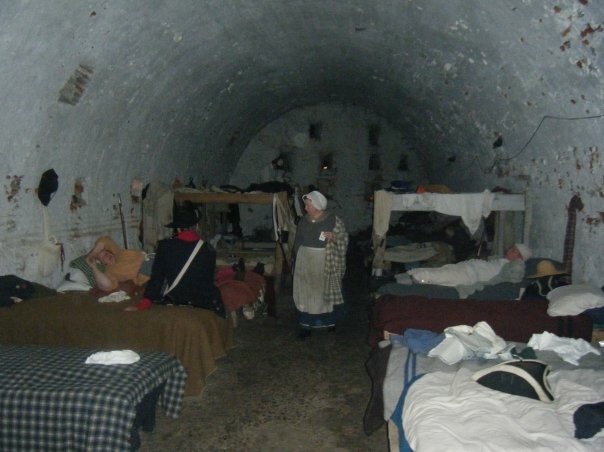 |
| Casement 11 - photo courtesy of Drea Hahn |
In addition to these, people have reported disembodied voices of children, men, women, dogs barking. The figure of a “sad man” walking on the road toward one of the gates. The scents of fire and bread baking (might be leftover from reenactments so take it with a grain of salt). Also, “People have been touched, pushed, pulled, and sometimes restrained”. The bathroom another odd area. TAPS/Ghost Hunters reported seeing a shadowy figure near the ladies’ room. This is one of the fort’s old buildings that has been converted into modern bathrooms and a gift shop.
Drea says, "I’ve been to the site over 10x, usually in November when it’s cold. The ladies’ room is one of the few places with heat - a nice place to change clothes, or get dressed in the morning, or duck into just to warm up a bit. I always get the creeps there and a feeling of being watched. A few times, just outside the ladies’ room in a little hallway leading to the outside I’ve turned around and expected to see someone, but there was nobody there. Not a big scaredy-cat and used to walking around sites at night, but this is just one of those places where I bring a buddy."
A lot of activity especially is reported in the Casemates. Reports are of pale outlines, shadows, faceless men in confederate uniforms walking in this area. Camera problems. Feelings of not being alone. Given the history as a prison, misery, and number of deaths in this area it makes sense. This is where two of my experiences happened. Entity known as The Faceless Man is reported, usually in Casemate 5. When TAPS/Ghost Hunters visited their thermal camera caught a heat signature, as if someone was sitting on one of the beds, but there was nobody there. For a long time, it was believed that this was the spirit of William Howe because he was thought to have been held in this casemate. But with the discovery of Casemate 11 we can’t be sure. Drea shares an experience she had with a friend here:
"When we visit for a history event, the re-enactors live in the fort and stay for the whole weekend. We usually arrive Friday night, my group stays in one of the large casements, and leave on Sunday afternoon. I’ll share a photo, so you can get the idea. At an event a few years ago, I was walking from the bathroom back to our casemate. It was a Saturday morning and to go back you go along a flagstone path/sidewalk, then into the casemate tunnel, you go around a bend, and then the casemate door is on the left. Since it was morning, before the site opened to visitors, I didn’t have my cap and hat on yet. Thanks to an experiment with Clairol, what I did have was long blonde hair. I came around the bend and was slowing down to open the door to the casemate when I felt a hard yank on my ponytail. So hard that you almost fall backwards. I turned around ready to smack whoever did it, but nobody was there. I got the chills. While collecting information for this podcast, I read that there are reports of an entity in that area that seems to have enmity for blond haired women. Great. So, for any of you blonde listeners who would like to give it a go and let us know what happens."Fort Mifflin has a rich history and it is nice to know that it continues to have a living history. With all the reported paranormal activity, it seems to have a dead history as well. Is Fort Mifflin haunted? That is for you to decide!
 |
| Photo courtesy of Drea Hahn |
 |
| Photo courtesy of Drea Hahn |
 |
| Photo courtesy of Drea Hahn |
 |
| Photo courtesy of Drea Hahn |
 |
| The Casement Drea Overnighted In - photo courtesy of Drea Hahn |


Thursday, July 12, 2018
Ep. 266 - Colonial Williamsburg
Moment in Oddity - Largest Baby Ever Born was 23 Pounds
Anna Haining Bates was a woman born in Canada who became famous because she was considered a giantess. She was sixteen pounds at her birth in 1846 and grew to the height of 7 feet 11 inches. She eventually joined the sideshow circuit and met her husband Martin van Buren Bates. He himself was a tall man and stood 7 feet 9 inches. They traveled in circus troupes together and separately. Eventually Anna became pregnant and gave birth to an 18 pound baby girl. Unfortunately, the baby died at birth. Anna became pregnant again while touring in the summer of 1878 and this baby grew to be even bigger, as if having an 18 pound baby was not enough. The baby was born on January 18, 1879 and Anna lost six gallons of fluid when her water broke. He only survived 11 hours. That little baby boy made his imprint on the world though in the form of a Guinness World Record. He was the largest newborn ever recorded, at 23 pounds 9 ounces and nearly 30 inches tall. His feet were six inches long. That record still stands today. His father wrote, “He was 28” tall, weighed 22 lbs and was perfect in every respect. He looked at birth like an ordinary child of six months.” The baby is buried, along with his parents, at Mound Hill Cemetery in Seville, Ohio. A baby weighing nearly 23 pounds at birth sounds not only rather painful, but it certainly is odd!
This Month in History - Enigma Code Broken
In the month of July, on the 9th, in 1941, the Engima Code was broken. The Enigma machine was Germany's most sophisticated coding machine. The machine was originally designed for use in business by Dutch inventor Hugo Koch, but the Germans adapted it to make an unbreakable code. The Enigma allowed an operator to type in a message that would be scrambled by three to five notched wheels that contained the alphabet. The receiver would need to know how the notched wheels had been placed to decipher the coded message. German code experts continued to make the machine more complicated. Parts of the code were broken by a group of British mathematicians and other problem solvers early on, but it wouldn't be until July that they achieved a true breakthrough. It is believed that this breaking of the code helped to shorten the war. Not only did the Allies manage to hide the fact that they had broken the code so that they could continue to decipher German war plans through the rest of the war, no one knew anything about it until 1974.
Colonial Williamsburg (Suggested by: Lloyd Dierker)
Colonial Williamsburg is part of America's historic triangle. Today, it is a historic area that features a look back into the America of colonial times just as the struggle for independence was sparking. Visitors can watch artisans ply trades from the past and visit dozens of historic buildings that have been restored to their eighteenth century charm. This is a place where one can walk in the footsteps of our Founding Fathers and experience the reality and uncertainty of the times that earlier Americans lived under, both free and slave. In any city with this much history, there is bound to be talk of a ghost or two. And there are many here with fascinating stories of pirates, poisonings, suicides and war. Many of the historic buildings have ghost stories attached to them. Join me as I explore the history and hauntings of Colonial Williamsburg.
Williamsburg was originally known as Middle Plantation. The settlement was founded in 1633 about halfway between the York and James Rivers. The town started to rise to prominence when Bruton Parish was built in 1683 and the College of William and Mary was charted in 1693. This college is the second oldest college in the United States, right behind Harvard. Francis Nicholson was lieutenant governor from 1698 to 1705 and he platted out the town of Williamsburg. He was experienced in this in that he had helped design Annapolis. The principle axis was a 99-foot-wide central avenue known as Duke of Gloucester Street. Homes were allotted a half acre and most were built from wood and then painted white with either a gambrel roof, A-frame roof or a hip roof. Each home had at least one chimney and shutters on the outside. Most of the public buildings were made from brick that was made locally. It was in 1698 that Williamsburg became the capitol of Virginia when the state house in Jamestown burned.
The city was officially incorporated in 1722. The ideas of freedom and revolution had a birthplace in Williamsburg. After Britain passed the Stamp Act in March of 1765 to help foot the cost of the French and Indian War, the colonists became enraged. Their gripe was that they were being taxed without representation and it was a fair assessment as people who lived in Britain had representation. Virginians believed that only the Virginia General Assembly could tax them. The other colonies felt the same. A fiery orator named Patrick Henry started giving speeches and one of those was in Williamsburg. When older legislators accused him of treason he said, "If this be treason, make the most of it." A crowd in Williamsburg forced the stamp collector to resign. Virginia's burgesses passed five resolutions condemning the Stamp Act. The seeds of revolution were fomented. Williamsburg would host parts of the Revolutionary War and was even occupied for a time by General Cornwallis of Britain.
And it is this timeframe in which Colonial Williamsburg seems to be frozen. The historic area stretches across 301 acres and features 88 original buildings that have been restored and many more than have been rebuilt, most of them on their original foundations. I remember fondly visiting when I was a kid. It was educational and fun to watch the various artisans ply their trades from blacksmithing to candlemaking to sewing and so much more. The people all dressed in period clothing and played their character to the fullest, pretending to not know about modern conveniences. The buildings were wonderful to explore. Little did I know as a kid, that many of these buildings harbored spirits. Let's venture through this historic place and see what ghost stories we may find.
King's Arm Tavern
You can't have a haunted historic town without having at least one haunted tavern. Colonial Williamsburg has more than one. The first is the King's Arm Tavern. Some may not be aware, but during colonial times, a town could be fined if it did not have a tavern. Jane Vobe opened the original tavern that was here on February 6, 1772. She used slave labor to run the place, but was said to be a "good" master who made sure her slaves got an education and were baptized. One of the first ordained black ministers was Gowan Pamphlet and he had worked at the tavern. When he left that job, he became pastor at the First Baptist Church, which was founded by both enslaved and free blacks. They had originally had to meet in secret in the woods, but were given use of a carriage house on Nassau Street by a man who was moved by their prayers and singing. Vobe's main customers were politicians and other government officials and it is said that both Washington and Jefferson stopped by the tavern on occasion. The King’s Arms Tavern was very important during the Revolutionary War as military folk and politicians gathered there to talk strategy.
King’s Arms Tavern is reputedly haunted by the ghost of a woman named Irma who had worked and died at the tavern. She was killed in a bad fire that was ignited by a dropped candle. For this reason, when candles seem to go out on their own in the tavern, people credit Irma with doing it. She is said to be a friendly spirit. Tavern employees claim that she helps them out on occasion and that they regularly thank her for her help and wish her a good night every evening.
Raleigh Tavern
Another reportedly haunted tavern is the Raleigh Tavern, which opened in 1717. The one that stands here today is not the original. That one burned to the ground in 1859 and was replaced by a couple of stores. They were demolished during the restoration and the Raleigh was rebuilt in its former footprint. Like the King's Arm, this was a tavern that saw a lot of action, but it also had a darker side. Slaves were auctioned on its steps and there are rumors that the skull of Blackbeard was used as a punchbowl. Could it have been the secret society that met here in the Apollo Room, that used the punchbowl? Painted above the mantel in the Apollo Room is the tavern's motto, "Hilaritas Sapientiae et Bonae Vitae Proles," which means "Jollity, the offspring of wisdom and good living."
The haunting that is reported here definitely seems to be residual and it features a party atmosphere. People walking outside the darkened tavern at night claim to smell the distinct scent of tobacco smoke and to hear laughter and music playing from harpsichords. When people walk up to the windows, they see nothing inside. No light filters from a back room. The tavern is empty.
Bruton Parish Church and Cemetery
The Bruton Parish Church was part of the Church of England. The brick building was constructed in 1683. After the Boston Tea Party, worshipers gathered here for a day of fasting and prayer. Many colonial leaders including Washington worshiped at the church. The church served as a hospital during the Civil War. The cemetery that surrounds the church has graves from the 17th century through to the 20th century and one mass grave for around 100 Confederate soldiers. One of those buried here is Reverend Scervant Jones. He is buried here with his first wife who died during childbirth. Before she passed, he proclaimed his undying love for her and that he could never love another woman. He asked her to wait for him in Heaven. He left town for three months after her death and returned with her headstone and...a new wife. While he was away, people reported seeing his wife's ghost walking around the cemetery and even sitting in a church pew. After the reverend's return, his wife's spirit seemed to turn angry and people would see her crying and wailing. The church has a haunting as well that involves the church organ playing by itself. The curtains inside the church flutter and move without explanation as well.
Another ghost story told about the church and cemetery involves two security guards. The story goes, "Late one night, two Colonial Williamsburg Security guards were sitting in their patrol car, and saw a man walking up from the palace green along the road towards the church. He was described as a tall, shadowy figure dressed in cardboard black suit with a vest. He had a strangely elongated neck, but what surprised them most was that he had red, glowing eyes. As security was watching, they saw him duck behind this tree and the brick wall. They assumed that he must have used the tree to jump over the wall, and entered the cemetery in search of him. When they entered the church cemetery, he had vanished. They looked all around, but couldn’t find him. They thought they heard the sound of the church door closing, and believed the man somehow made his way inside the church. When they arrived at the main entrance, it was locked. Determined to catch this intruder, they unlocked the door and entered the church. As they allowed their eyes a chance to adjust to the dark, they heard a strange sound: it was described as being sort of a whoosh-‐thud, whoosh-‐thud. Once they turned on their flashlights, they could clearly see what was causing the noise: the hymnals were seen to levitate up from the church pews, fly across the room, and hit the wall. Needless to say, they decided to flee the church!"
The Ludwell-Paradise House
The Georgian styled brick Ludwell-Paradise House was built in 1755 for Philip Ludlow III. Ludlow owned the Green Spring Plantation in James City County. He traveled often to London and he eventually died there in 1767. The house was then inherited by his daughter Lucy. She was married to a man named John Paradise and they lived in London, so they rented the house out. Paradise died in 1795 and he had ran up so much debt before that, that he left Lucy destitute and she had to return to Williamsburg. Lucy had been a member of London’s social elite, so she expected to be treated accordingly in Williamsburg. She was very eccentric, walking the streets like a member of royalty greeting everybody. And she bathed a lot for the time. People began to whisper that she was insane and in 1812 they had her committed to the Public Hospital for Persons of Insane and Disordered Minds. She was locked away for two years. And then she committed suicide.
The house is haunted by the spirit of Lucy some say. One of the primary unexplained experiences is the sound of water either running, splashing or dripping when no water is on. It sounds almost as though someone is taking a bath. Perhaps Lucy bathed so much because she suffered from OCD and thus washed her hands and arms incessantly. The haunting seems to be residual in nature.
The Nicholson House
The Nicolson House was built sometime between 1751 to 1753. The house was built on land owned by the famous planter and lawyer Mann Page. His son had sold the parcel of land when Page died in 1730. Cabinetmaker James Spiers was the first to take over the lot, but he later sold it to a tailor named Robert Nicolson. He made a good deal of money from his tailor business, which also operated as a post office and general store. The house Nicolson built was two stories with a fireplace and bedrooms on the first floor. He rented out some of the rooms and one of the renters was violinist Cuthbert Ogle. It is his spirit that is said to haunt the home. People claim to have been touched on the shoulder or to hear scratching noises.
The Wythe (With) House
Next we have the Wythe House, which was built for George Wythe as a gift from his father in law. Wythe was a signer of the Declaration of Independence and served in the House of Burgesses. He knew everyone who was anyone and was said to have quite an influence on Thomas Jefferson. He became the first professor of law at the College of William and Mary after the War. Wythe died from poisoning. His grandnephew had been staying with him and was what we would call in our vernacular, a deadbeat. He ran up huge debts and he decided that he would kill his uncle so that he could inherit his money. Unfortunately for the nephew, Wythe held on long enough to figure out what happened and to write his nephew out of his will. The only witness to the crime was Wythe's cook, a slave whom Wythe had freed. She couldn't testify since she was black and the nephew went unpunished.
Another owner of the house was the Skipwith family, Ann and Sir Peyton. Ann got into a very public fight with Peyton at a ball being held at the Governor's Palace. She accused him of having an affair with her sister. She ran home and took her own life in the master bedroom. Visitors claim hear the sound of a woman in heels running up the the stairs in the home. The apparition of a female in a ball gown has been seen as well. This is usually in the bedroom or near the stairs. The room where she died is said to occasionally have the scent of lavender and the closet door opens and closes on its own. There are people who test the spirit here by walking up to the closet door and loudly proclaiming, “Lady Skipwith, Lady Skipwith, I found your red shoe!” The spirit of George Wythe is also said to haunt his former home for an obvious reason, since he was murdered and never received justice. It is said that he returns to visit each year on June 8, the day of his death. Guests who have stayed in his former room have claimed to feel a firm and cold hand press down on their foreheads.
College of William and Mary
Reverend Dr. James Blair set sail for England in May of 1691 to ask King William and Queen Mary to grant a charter for a college to be founded in Williamsburg. They granted the charter in 1693 and the college was named for them, The College of William and Mary. The first building was constructed in 1695. One of the buildings that still remains a part of the college is the Wren Building. It was named for the famous London architect Sir Christopher Wren in 1931. The building was designed by Thomas Hadley and is said to be the oldest college building still standing in America. The structure was here before the founding of Williamsburg. The many purposes it served included a school for Native Americans and from 1700 to 1704, the Virginia General Assembly used the building while the state Capitol was under construction. A fun fact about the building is that Thomas Jefferson was not a fan and wrote in his "Notes on the State of Virginia" that the Wren was a “rude, misshapen pile which would be taken for a brick kiln. The genius of architecture seems to have shed its maledictions over this land.”
The building suffered a series of fires and later served as a wartime hospital and it is for this reason that the building just may be haunted. Apparitions of soldiers have been seen roaming the hallways from both the Revolutionary War and the Civil War. Disembodied footsteps are heard echoing through the building. Sir Christopher Wren is said to haunt his namesake as well, though no one knows why. A spirit matching his description has been seen pacing the floors. The spirit of a soldier is said to patrol the third floor. The students who see him most frequently are those pulling all-nighters. Ghostly legends are told here as well. There is a bridge that is said to either reward or curse collegiate sweethearts. This bridge is behind the Crim Dell and if lovers kiss at its peak it is said that they will marry and live happily ever after, but if they break up a curse is placed on them that can only be lifted by one pushing the other off the bridge. A legend about the statue of Lord Botetourt, an 18th century Virginian Colonial Governor, claims that if it is touched it will grant good grades to students.
Another building on the campus is called "The Brafferton" and it is the second oldest building on campus and was built in 1723 and is southeast of the Wren Building. This building was used for the instruction of some of the Native American boys, who arrived malnourished and many became ill and died. Their spirits are said to be trapped in the building and are restless as they seek to escape. The boys were said to not be happy to have been brought here and many would have liked to escape when they were alive. On foggy nights, ghostly boys are seen running through the Sunken Gardens.
The Phi Beta Kappa Memorial Hall has a haunting that is reputedly of a girl who was going to be the lead in a play, but she died while visiting home. A new lead was chosen and one night while she was practicing alone, she saw the dress she was supposed to wear for the show sitting upright in one of the audience’s seats. There is a ghost in St. George Tucker Hall that is said to belong to a girl who hanged herself in the third floor bathroom in the 1980s. It’s said that her ghost will visit students who are pulling all-nighters and ask them how their exams are going. If they answer that their exams are going well, she’ll scream and throw a fit until the student leaves.
Hangman's Road and the Public Gaol
Hangman’s Road is a road that sets just off from Colonial Road and is exactly what it's name indicates, a route from the Public Gaol to the gallows. The Gaol was ordered by the General Assembly in 1701 and construction was completed on the brick structure in 1703. There was an exercise yard that was twenty square feet and the property was surrounded by a ten-foot wall. All sorts of people found themselves in the gaol, not just criminals. Some were debtors, others were mentally ill. Punishment was harsh here and involved whipping or branding and there were many executions. Some of these executions were of members of Blackbeard's crew. Fifteen of his men found themselves in the Williamsburg Gaol after Blackbeard had been captured and killed. Thirteen of them were hanged on the gallows and their bodies left to rot in iron gibbets along the road. Another man held here was the Lt. Governor of Detroit, Henry Hamilton. He had paid Native Americans for the scalps of Americans.
The spirits that haunt the jail reputedly include the family of Peter Pelham, who was a gaoler here and lived in a section of the gaol with his wife and children. People claim to hear conversations between two women and have seen the ghostly image of a child playing. Haunting sounds are heard here as well that include slamming doors and creaking floorboards. Haunting experiences are had on the Hangman's Road as well that include the sound of an old wooden wagon traveling down the street. Other eerie sounds are reported.
Bassett Hall
Bassett Hall is one location here that is unique in that it is staged as it appeared in the 1930s when the most famous owners of the property, John D. Rockefeller, Jr. and his wife, lived here. This is a two-story eighteenth-century frame house. It's white with black shutters and surrounded by gardens. Philip Johnson, who was a member of the House of Burgesses, built the home between 1753 and 1766. The home was later purchased in 1800 by Burwell Bassett who was Martha Washington’s nephew. He was a member of the Virginia House of Delegates from 1787 to 1789 and served on the Virginia State Senate from 1794 to 1805. The property would function as boarding house and tavern and exchange hands until the Rockefellers bought it in 1936. The Rockefellers had to do extensive restoration to the home, which was damaged by fire after lightning struck the structure. *Fun Fact: General Custer spent 10 days here after the Battle of Williamsburg to attend the wedding of a West Point buddy who was Confederate John Lea. Lea was engaged to the daughter of the owner of Bassett Hall at that time.*
The Battle of Williamsburg happened near the property and that may be why it is rumored to be haunted. Tourists who visit the hall claim to hear disembodied voices and some have felt cold spots that defy explanation.
The Orrell House
The Orrell House is believed to have been built in the 1850s, but historians are unsure who initially owned the home that is today an inn. The house is two-stories and built as an almost perfect cube by its dimensions. James Orrell purchased the house in 1800 and the house is named for him. He lived there for about 20 years and then it passed through several hands.
The inn apparently has some ghostly chills in store for guests. One family had the following experience according to Steve Erickson, who is the general manager of the Colonial Houses-Historic Lodging. A family was watching television in the living room when they heard water running upstairs.The father went up to investigate and found that a faucet had been turned on. He assumed one of the kids had left it on. He went downstairs to scold whomever had left it on when he suddenly heard the water running again. The family had another fright when the father went to the bathroom. The drinking glass that had been in the medicine cabinet was now shattered across the floor, “as if it had been thrown.” The following morning, the bathroom was found strewn with toilet paper.
The Peyton Randolph House
Our next stop is the Peyton Randolph House. This house was built by William Robertson in 1715 and then later purchased by John Randolph who was considered the colonies most distinguished lawyer. He was even knighted for service to the Crown. The home has been restored and is actually three buildings, two of which are connected to each other. An east wing is more like an outbuilding. The main center part of the house is two stories and burgundy colored clapboard in style. There is a hall with a large roundheaded window and a grand staircase that connects single rooms on each floor. When John died, he left the home to his wife and then his first born son Peyton, for whom the home is named. Peyton went to law school and served as attorney general, served in the House of Burgesses and was eventually elected Speaker of the House in 1766. Peyton had a brother named John and the Revolutionary War would fracture the family. Peyton was a Patriot, while John Jr. sided with the Crown. Leading revolutionaries from Virginia met at the Peyton Randolph House before going on to Philadelphia. A little fun fact is that the Randolphs' cousin was Thomas Jefferson and he inherited the library Peyton had built and those added with his books were part of the formation of the Library of Congress. Peyton was said to be the "father of his country" before that title was given to George Washington. He died in 1775. The house was auctioned off after his wife's death. It is interesting to note that Peyton died in Philadelphia and his body was pickled in a barrel for the trip back to Williamsburg.
There seems to be several spirits in the home and this home is said to be the most haunted in Williamsburg. One belongs to a young soldier who stayed here when a family named Peachy owned it. They owned the home in the 1820s. The soldier was staying at the house while he studied at the college, but he fell ill and eventually died in the home. People who visit the home claim to hear heavy booted feet wandering through the halls and to see the apparition of a young male. The Peachys housed French General of the American Revolution Marquis de Lafayette when he returned to Williamsburg in 1824. He claimed to experience something unexplained and wrote, "I considered myself fortunate to lodge in the home of a great man, Peyton Randolph. Upon my arrival, as I entered through the foyer, I felt a hand on my shoulder. It nudged me as if intending to keep me from entering. I quickly turned, but found no one there. The nights were not restful as the sounds of voices kept me awake for most of my stay.”
One guest who stayed here in the 1960s said, “I was resting comfortable when awakened by the peculiar feeling that someone was tugging on my arm. Naturally, I assumed I was dreaming, so I rolled over and went back to sleep. A short while later, I was being shaken violently! As my eyes adjusted to the darkness, I could see that I was completely alone. I darted out of bed and ran as fast as I could. I didn’t even go back to collect the things I’d left behind.” There have been many claims through the years of violent shaking and tugging. Another spirit here is our lady in white. She is said to be an older, friendly woman who wears a white flowing gown. And a young girl who died in a fall down the stairs or out a window still seems to have her essence lingering here.
A security guard who was watching the house became trapped in the basement. He a terrifying growl behind him and felt something grab his legs and his feet felt as though they were firmly rooted to the floor.The shutter doors that he was going to exit out of, slammed shut on their own and his flashlight turned off. He grabbed his radio and called his lieutenant for help. When the man arrived, he had to pry open the cellar doors. At that same moment, the security guard was released by whatever had been holding him. He quit the following day. Other activity that has been reported are strange knocking sounds and furniture moving on its own. The Peachy family had a son die in the house and the sound of children laughing when no children are present has been heard. The second floor is said to be the most haunted and people claim that something has tried to push them down the stairs.
An alarm once went off at the east wing of the house. Security couldn't find a key to the house, so they entered through a window. They thought perhaps there was a fire inside, but they found no smoke or flames, but they did find a fire extinguisher resting in the middle of the floor, its contents completely emptied around it in what looked like a controlled circular pattern. They searched the house for intruders and found no one. They also never found the pin to extinguisher. No residue was found underneath the fire extinguisher, nor on its bottom and there were no footprints through the discharged spray.
Colonial Williamsburg is a must stop for anybody visiting this area of Virginia. A chance to be immersed in the eighteenth century is hard to find. And for those of us that love the darker side of history, Williamsburg offers a lot of stories and what could be lots of haunts. Are these historic buildings in Colonial Williamsburg haunted? That is for you to decide!
Thursday, July 5, 2018
Ep. 265 - Legends of Taiwan
Moment in Oddity - Ballet Fans Eat Taglioni's Ballet Slippers
Marie Taglioni was one of the most famous ballerinas in the world. She was born in Sweden to Italian choreographer Filippo Taglioni. In 1822, Taglioni made her debut as a ballet dancer in Vienna and people went crazy for her. Before long, she was famous across Europe. She introduced the era of romantic ballet and launched the image of the ballerina in a long, white tutu with point shoes. Women wanted to copy her hairstyle. Her most famous role was in La Sylphide at Paris Opera, which was a ballet created by her father. The ballet was set in Scotland and featured forest fairies and witches and Taglioni wore transparent fairy wings. The ballet was so popular that La Sylphide dolls were made. Even Queen Victoria had a La Sylphide doll. Taglioni left the Ballet of Her Majesty's Theater in 1837 and joined the Imperial Ballet in Russia. The Russians loved her and she had a huge following of balletomanes. Balletomanes were male fans of female ballerinas. Like super fans. These guys were so crazy about the ballerina that they bought her point shoes from her last performance for two hundred rubles. They had an issue though. How would the group of them be able to share the shoes and pay homage to their favorite ballerina? Now, you've probably heard of people drinking champagne from women's shoes, so you might think that perhaps they passed them around for a toast. But you would be wrong. This group of Balletomanes cut those slippers into pieces, cooked them, covered them in a special sauce and...ate them! Being so enamored by a ballerina that you eat her ballet slippers, certainly is odd!
This Month in History - Thurgood Marshall Born
In the month of July, on the 2nd, in 1908, the first black man on the U.S. Supreme Court, Thurgood Marshall, was born. Justice Marshall was born in Baltimore, Maryland and went to Howard University School of Law. In 1934, he began working for the Baltimore branch of the National Association for the Advancement of Colored People (NAACP). He began using the judiciary at this time to help get equal rights for people of color. Marshall spent much of his career arguing and winning several cases that struck down legalized racism in the lead up to the Civil Rights Movement. In 1954, he won the Brown v. Board of Education case. This case ended racial segregation in public schools. President Lyndon B. Johnson nominated him to the Supreme Court of the United States in 1967. He served for 24 years and retired in 1991. Justice Clarence Thomas replaced him.
Legends of Taiwan (Suggested by: Whitney Zahar)
The island of Taiwan is located between the Philippines and Japan, about 100 miles off the coast of China. The small island is inhabited by many people who were escaping from the mainland of China, a country that claims to be sovereign over the island. Many nations have held control over Taiwan over the years, from the Dutch to the Spanish to the Japanese to the Chinese. This is a land of indigenous groups that each seem to have their own mythical story of origin and there are many haunted locations. Join myself and listener Whitney Zahar, who lived in Taiwan for a time as we share the history, legends and haunts of Taiwan.
Immigrants from the Pacific Islands were the first to inhabit the island of Taiwan. The Chinese arrived in the 1400s and over the next hundred years, an influx of Europeans came, mainly from Portugal. It was the Portuguese that named it Ilha Formosa or "Beautiful Island"in 1517. The Dutch and Spanish followed, but by the 1660s, the Chinese had returned and ousted the Dutch. The Chinese held it for two centuries until the Japanese invaded in 1895. The island would be ceded to China after World War II. Taiwan has faced an uncertain political future from that time with China refusing to recognize it as a sovereign nation and Taiwan claiming to be an independent country.
Tigress Witch
There is a strong belief in different spirits in Taiwan and many of these spirits are considered to be gods and goddesses. Others were thought to be witches and ghosts. There was the SunGod, MoonGod, EarthGod, RockGod, TreeGod, and animal gods and goddesses. When it came to animals, there was a belief that some of them could trabsform into human form and then hunt humans in that form. A woman lived in the mountains with her two daughters. She left fortown one day and instructed her girls to lock the door and open it for no one. The two daughters did as they were instructed, but later, someone came to the door and began to knock loudly. The girls were afraid when they heard the knocking.Then they heard someone call out, "Open the door, open the door! I am your mother." The sisters moved closer to the door and said: "You are not Mama; you wouldn't be back so soon." But the person knocked harder and called out louder: "I am your Mama. l thought you would be scared, so I came back quickly to see you."
Unfortunately, the girls opened the door and saw that the person at the door was not their mother. The woman standing there had hair white as snow and her face was wrinkled like a cat. The woman claimed to be their great-aunt who hadn't visited in a long time. Never mind that she claimed to be the mother originally. The girls invited her in and led her to one of the rooms tosleep for the night. One of the sisters joined her in the room. The other girl awoke at midnight and went to check on her sister when she heard strange noises coming from the room that she was sleeping within. The sounds reminded her of someone chewing roasted peanuts or a dog chewing a bone. The sister asked the aunt what was making the noise. The aunt answered, "Oh, I am chewing some ginger roots; they are very hard, hot, and bitter, not for children to eat." The girl insisted that she get some ginger roots and the aunt tossed over a piece, which turned out to be the finger of the girl's sister. It was then that the young girl realized that they had let the Tigress Witch into their home. The girl tried to escape, but the Tigress Witch called out, "You will be my breakfast. How can I let you go; you might try to sneak away!" The girl was clever and answered, "If you don't want me to escape, why don't you tie a rope to my leg; then I will have no way to escape." The Tigress Witch tied a rope around her leg and held it while the sister went to the rest room. The smart girl took the rope off her leg and tied it to a water container and escaped out the window.
The Tigress Witch realized she had been tricked after some time had passed and she tracked the girl to a tree and proceeded to start chewing the trunk. The girl called down, "Great-aunt, you don't have to chew the tree trunk so hard. I am willing to come down to let you eat me. The only problem is that I am so hungry that if you eat me now, I will become a Hungry Ghost, and I will forever follow you and torment you. If you boil a bucket of peanut oil for me, I'll fry some birds here and eat them. When my stomach is full, you can then eat me without any worry." The Tigress Witch thought this was a very wonderful idea, so she boiled a bucket of peanut oil and sent it up to the girl. After awhile, the girl called out, "I am ready to jump down now. Open your mouth." When the Tigress Witch heard this, she opened her mouth widely, thinking that she would be eating the child. Instead, the foolish Tigress got a whole mouthful of boiling peanut oil and died.
In this story, you heard mentioned the Hungry Ghost. Stories of Hungry Ghosts are prominent in Taiwan and the people there even celebrate the Ghost Festival. In their culture, the fifteenth day of the seventh month in the lunar calendar is called Ghost Day and the seventh month is observed as the Ghost Month. This is a time when ghosts and spirits arise from the lower realm. Whitney describes the celebration of the Ghost Festival.
There are at least seven well known haunted locations in Taiwan and we touch on each one. Are these locations haunted? That is for you to decide!
 |
| The Tagalong |
Thursday, June 28, 2018
Ep. 264 - Haunted Asbury Park
Moment in Oddity - Napoleon Attacked by Bunnies
In July of 1807, Napoleon decided he wanted to celebrate the signing of the Treaties of Tilsit with a rabbit hunt. The treaty ended the war between the French Empire and Imperial Russia. The job of organizing the hunt fell to his Chief of Staff Alexandre Berthier. Berthier collected a group of hundreds of rabbits and invited the military's biggest brass to an outdoor luncheon followed by the hunt. The rabbits were kept in cages along the grassy field. When Napoleon announced that he was ready to begin the hunt, the bunnies were released. The hunt was on! But it wasn't on for Napoleon and his band of merry military men. It was on for the rabbits. Rather than fleeing for their lives, that pack of bunnies turned on their aggressors. The main target was the Emperor himself. The pack of bunnies swarmed his legs and started to climb up his jacket. The little furballs started attacking other members of the party and despite the mens' best efforts to beat back the demonic bunny horde with crops, sticks and muskets, the attack would not stop. Retreat was called and Napoleon ran to the safety of his carriage. The rabbits continued after him and started to breach the carriage. This called for a full on retreat. Napoleon's carriage pulled away and the bunny attack stopped. Apparently, the issue was that Berthier had bought farm rabbits rather than capturing wild ones and these tamer bunnies associated people with food instead of danger. The idea that Napoleon may have faced his greatest defeat resulting in retreat, from a group of bunnies, certainly is odd!
This Month in History - Jacques Cousteau is Born
In the month of June, on the 11th, in 1910, undersea explorer Jacques Cousteau was born in France. He graduated from France’s naval academy in 1933 and was commissioned a second lieutenant. Cousteau served in World War II as a gunnery officer and later joined the French Resistance where he did espionage work, which eventually saw him awarded the Legion of Honour for his espionage work. He began conducting experiments with underwater filmmaking during WWII. He loved the ocean and underwater diving. In 1943, Cousteau and French engineer Émile Gagnan developed the first fully automatic compressed-air Aqua-Lung, which was a scuba apparatus. Cousteau also helped to invent underwater cameras and the diving saucer, which was an easily maneuverable small submarine for seafloor exploration. He is best known for his Emmy Award winning television series, The Undersea World of Jacques Cousteau, which premiered in the U.S. in 1968. He died in 1997 from a heart attack.
Asbury Park (Suggested by and Research Help: Melissa Edwards)
In honor of Pride Month, listener Melissa Edwards suggested featuring Asbury Park in New Jersey. This is a hot spot for the LGBTQ community and is one of the smaller cities located on the Jersey Shore. This beach is ranked the sixth best beach in New Jersey and began attracting the gay community in the 1950s. In 1999, a gay discotheque called the Paradise Nightclub, opened near the beach and The Empress Hotel, which opened in the 1960s, is New Jersey's only gay-oriented hotel! The music scene in Asbury Park is thriving and a place that has launched the careers of rockers like Bruce Springsteen. There is a paranormal underbelly here though, with a history of tragedies and spirits stuck in place. Join me and Melissa as we share the history and hauntings of New Jersey's Asbury Park.
New York brush manufacturer James A. Bradley developed the Asbury Park area in 1871 and the city was named for Francis Asbury, the first American bishop of the Methodist Episcopal Church in the United States. Bradley paid $90,000 for the property. The development of the town was progressive for the time. Electrical lighting, rather than gas, was installed by the Atlantic Coast Electric Company. There were trolley systems, an artesian well and pavilions along a boardwalk. The setting was perfect for tourism and people flocked to the shore area. More than 600,000 people vacationed there every year arriving via the New York and Long Branch Railroad from New York City and Philadelphia. One of the things that tourists got to enjoy were Steeplechase amusements that were built in 1880 by Coney Island impresario George C. Tilyou (Tilly you). One of the remnants of this bygone era is the Tillie face, which is a somewhat creepy iconic image. *Rabbit Hole* Tillie is a large male face with a really broad smile and black period-styled hair. He is the mascot of Asbury Park. His origins can be traced back to Coney Island and is said to be based on George's brother Edward. No one knows for sure if the face is suppose to represent a leering sexual face or just a fun smile. Leslie Worth Thomas was the artist who painted the original Tillie in Asbury Park. The Palace Merry-Go-Round was installed by Ernest Schnitzler at the corner of Lake Avenue and Kingsley Street in 1888 and other attractions were added through the years. This all became known as Palace Attractions.
The Convention Hall and Casino building was built in 1929 in the Beau Arts style by architect Warren Whitney of New York and drew visitors for shopping, gambling, movies, theater, and concerts. And the concerts that were held here featured an array of jazz and blues and rock entertainment from John Philip Sousa and Arthur Pryor in the early days to Bruce Springsteen, Bon Jovi, Southside Johnny, The Clash and The Ramones in the modern era. This wasn't the only place music was making history. There were clubs all along Springwood Avenue on the city’s Westside and this is where Count Basie, Lionel Hampton and Billie Holiday performed.
Not all of Asbury Parks history is flashy fun and great music. Disaster would come with the wreck of the ocean liner SS Morro Castle on September 8, 1934. The fiery wreck beached itself just yards away from the Asbury Park Convention Hall. As hard as it is to believe, the city turned the wreck into a tourist attraction. The SS Morro Castle was a luxury cruise ship named for the Morro Castle fortress at Havana Bay. The ship launched in 1930 and it would not sail for for very long. On the night of September 7, 1934, the captain of the Morro Castle, Robert Willmott, had dinner in his cabon, complained of stomach problems and died of what appeared to be a heart attack. In the early hours of the next morning, a fire was detected in a storage locker within the First Class Writing Room on B Deck. The fire was strong and had the entire ship engulfed in 30 minutes. A single SOS signal made it out before the wires were burned through and the wheelhouse lost the ability to steer the ship shortly after that. Passengers and crew abandoned ship when the only choice was to jump or burn. Only six of the ship’s twelve lifeboats were launched. The lifeboats could hold a total of 408, but only 85 passengers made it into them. Many people died from impacting the water as they jumped. The abandoned Morro Castle drifted ashore and stopped in shallow water off Asbury Park.
The fire had burned the hull out and continued to smolder for two days. The ship was declared a loss and 135 passengers and crew had lost their lives. While the ship sat waiting to be scrapped, it became a tourist destination. They even sold stamped penny souvenirs and postcards. An inquiry followed the disaster and Chief Radio Operator George White Rogers was declared a hero for sending out a distress signal even though he had no order to do so and his life was in danger. Later, however, Rogers came under suspicion for having started the fire. This happened when he came under suspicion of having tried to kill a police colleague with an incendiary device. His crippled victim, Vincent ‘Bud’ Doyle, spent the better part of his life attempting to prove that Rogers had set the Morro Castle fire as well. Rogers was later convicted of killing some neighbors for money and he died in jail. The cause of the Morro Castle fire was never determined.
From Melissa: "I can say the word TITANIC and mostly if not everyone will immediately know what I am talking about, even it is just a scene of Jack and Rose on the bow of ship but very few people will have any clue what I am talking about when say the name Morro Castle. The SS Morro Castle is the Titanic of the Jersey shore that came ashore in Asbury Park as a towering inferno on September 7, 1934. The SS Morro Castle is just not your run of the mill shore shipwreck, it is an intriguing story of murder, arson, rum running, cowardice, heroism and possible psychopath thrown in for good measure.
In 1934 The USA was in the throws of the Great Depression and Prohibition was still in full effect. Rest and relaxation was not at the top of anyone’s list, nevertheless, the Asbury Park was still an obtainable haven for those looking for a brief escape. For those that were better off there were opportunities for a more luxurious escape. As mentioned previously Prohibition was still effect, however, there was a loophole and those with the financial means would take advantage of this would be to board a luxury passenger liner like the SS MORRO CASTLE and take advantage of freedoms that international waters provided just a few miles offshore.
In 1934, the SS MORRO CASTLE was a 4-year-old luxury passenger liner that would shuttle the elite from New York to Havana Cuba. With lessons learned from the Titanic disaster that occurred a mere 22 years earlier safety was paramount in the construction of this ship. The Morro Castle was not only practically sink proof but all fire proof. On September 7, 1934 she, her 538 passengers, and their return cargo of tanned and treated animal hides were approaching their final destination on their return from such a junket. As was customary on the last night prior to docking in their homeport, there would be a grand party for all those aboard, on last hurrah before returning to everyday life.
How could a state of the art 4 year old ship could burn barely six miles off shore, it actually has to do with a lawsuit. Just a year to prior to the ship’s demise, during a routine fire drill, water leaked from a fire hydrant. A passenger slipped on the water, injured her ankle, and was awarded a settlement of $25,000.00. During this time the yearly salary for a dentist was $1000, this left the ship line in quiet a predicament. No one knows if the Captain or the ship line that gave the order, but from that point on there were no more fire drills or lifeboat drills aboard the Morro Castle. As mentioned previously there was a cargo of treated leather hides aboard that gave off a foul odor that would trigger the fire alarms and the air ventilation systems would circulate the smell, since passengers complained therefore the fire detection system on the ship was shut off.
Much like a modern day cruise, passengers would don their finest for the Captain’s that evening, however prior to the commencement of the evening’s events the beloved Captain Robert R. Willmott, was found dead from an apparent heart attack in his cabin. I have actually heard his cause of death was listed as “indigestion,” which at that time was one of the catch all phrases for a death of an unknown origin. Due to this the events for the night were cancelled and guests retired to their cabins for the evening.
It is said that upon his death the captain’s body was placed in a refrigeration unit, however, when the wreck of the Morro Castle was cleared and the Captain’s remains were brought ashore they were located in a different area and all that was left could be contained within a small box the size of a suit case. Speculation surrounded circulated that the Captain’s body may have been moved or tampered with in an attempt to cover a potential murder or poisoning. Due to the nature of the Captain’s remains an official autopsy could never be conducted so we will never really have an answer to the actual cause of death.
Chief Officer William Warms became the acting captain for the remaining length of voyage. It is said that William Warms did the best he could given the circumstance. As if the recent events were not enough a full-blown gale or what we would now refer to has a nor ‘ester or tropical storm began to pick up. Thus, making the task of guiding the Morro Castle to port even more daunting for Barnes.
This tragedy is truly incident after incident of bad luck or Murphy’s Law. The Morro Castle’s cabins and most of the interior was built entirely of wood, picture the same style as the Titanic, with would deck floors, wood paneled walls and décor. We think about it today and it doesn’t seem to make any sense but it is because incidents like the Morro Castle tragedy we have learned.
It was also customary at the time for the crewmembers to constantly paint the ship’s hulls and decks. They would start at the bow and go to the stern and work their way back at fourth. They used paints that were oil based. In the sun the paints would sometimes melt or soften due to the heat we can kind of see where this is going. In the late night / early in the morning on September 8th, William Warms was alerted that a fire had broken out in a hidden storage area in the library of the ship. Not knowing the actual extent of the fire due to the location and the lack of training the crew received Warms sent a small staff to deal with the fire the lack of sufficient response would ultimately prove to be fatal. Due to the construction of the ship and the presence of many different accelerants the fire ripped through the ship, leaving the staff with little more choice than to run through what parts of the ship they could access, yelling for passengers to put on their life jackets and make their way to the deck. Many passengers were dead before they were even made aware of the fire as they were trapped below decks or overcome by heat and fumes.
Here is where things take another bizarre turn. Chief Engineer Ebon Abbott, became the right hand man of the now captain William Warms. Minutes into the rescue effort he was observed hoping aboard a life bottom and ordering it lowered with only 8 other passengers aboard. He would later be prosecuted and jailed for his actions.
Now William Warms was left to depend on Chief Radio Officer George Rogers as their only hope for assistance and rescue. These radio officers were outsourced at the time and the background checks where not done the way they are now a days. George Rogers had an extremely questionable past included incidents of pyromania, assault, and severe anti social behavior. Despite hi talents as a radio operating crew claimed that Rogers was difficult to work with and would fight regularly with coworkers. It is thought that George has been given noticed that this would be his last voyage when he docked due to his inability to work well with others. This decision would have been that of Captain Willmott, therefore leading many to believe that perhaps his death was not an accident and the incidents that surrounded the Morro Castle Disaster was not just an ill fated series of unfortunate events but rather a cold and calculate mass murder.
George Rogers was given the order to issue an SOS on behalf of the ship. Rogers waited an entire 38 minutes before sending out the plea. This would prove to the death sentence for the Morro Castle. You can look at pictures of the wreck and get a sense of actually how hot and intense the fire was. It twisted metal and the decks. The paint was completely burnt away and even the glass that provided the porthole windows melted in the blaze. The heat from the blaze warped the deck cross beams emitting a haunting moaning sound that would come to haunt the area until this day.
Staff and crew members worked tirelessly to fight the blaze in an attempt to save the ship and its crew while they waited for assistance that was mortally delayed by George Roger. Crew members would pass hoses from one deck to another to try and quell the flames. However it would all be in vain, because once the fires reached the engine room, the engine ceased to operate. As a result the ship lost its ability to pump water and its ability to fight the fire. As mentioned earlier there was a nor ‘ester that was coming at the ship from the north and for whatever the now Captain Warms continued to steer the ship directing into the storm and gale force winds. This only fueled the blaze. Some say that the Captain was still trying to make port in New York on time; others still remained puzzled to this day. The temperatures onboard the deck of the ship became so hot that it was melting the soles on the shoes of the crew and passengers leaving those onboard with very little option other than to jump from the ship and swim towards shore.
Due to the ongoing storm authorities struggled to send out rescue boats, local fisherman took it upon themselves to make their way to the struggle vessel and ended up saving more lives than official could. A local family, the Bogan’s, (I went to school with a Bogan who was a member of this family) who still have a marina in Brielle voluntarily went out and saved 67 people in their boat the Paramount. These actions were what responsible for saving most of the passengers the lifeboats that came ashore where launched either half full or chock full of crew members, in shame many crew members tried to mask their identify but their white and black clothing gave them away.
The wreckage trail for the Morro Castle stems from Spring Lake about 6 miles away to its final beaching area in Asbury Park. Original salvage efforts were made by attempting to tow the Morro Castle to New York. These efforts failed when the tow lined snapped cause the ship to drift to its final resting place in Asbury Park beached right outside of Convention Hall.
The bodies and the victims started washing up along the shore. While the crew that escaped were labeled as cowards as they came ashore. The crew that stayed aboard including George Rogers were hailed as heroes.
Despite it being the end of the tourist season, 100s of thousands of people came to Asbury Park to see this burring ship. Bodies were laid out in the convention center as a makeshift morgue. People would pay to come in a view the bodies as they waited to be identified. The city tried to cut a deal with the ship owners to keep the ship at the shore because it was great for business. However, as the cargo of hides in the hull began to rot it was decided to have it removed because the stench was simply overwhelming. The loss of the SS Morro Castle and those that perished was not in vain. Due to this tragedy the law was changed that in a disaster an SOS had to be sent out immediately. Guidelines were also put into place limiting the amount of wood and flammable materials including oil based paints that could be used on ships. Mandatory fire drill and lifeboat drills were also introduced.
As the dust and fanfare settled authorities searched for answers and suspicions immediately fell on George Rogers. Despite his checkered past and his failures through the ordeal, his role in the death of the Captain and the fire were never proven. Rogers used his role in the Morro Castle incident to further his career. He was hired by the Bayonne Police department to help set up their wireless communication systems between headquarters and their patrol vehicles. He then had a problem there where he was not getting along with members of the force. His supervisors found him odd and when questioned about his role and involvement in the disaster would often give replies and statements that were synonymous with that of an arsonist who may have set the blaze. It was said that George may have felt that he said too much and he ended up rigging a heating element to his supervisor’s fish tank to explode when it was plugged in. As a result the police supervisor broke his leg, lost part of his arm and received other injuries. George Rogers was charged with attempted murder and was jailed for his actions. When he was released George got in an argument with his neighbor over money that the neighbor had lent George. Instead of paying the neighbor back George decided it was easier to bludgeon the neighbor and his daughter to death. George Roger was sentenced to prison where he died taking his answers and insight with him. The mystery of the Morro Castle may never be solved, therefore making it one of the Jersey Shore’s most infamous shipwrecks.
I have heard many tales of people experiencing different types of paranormal activity in this area. There is even a local paranormal store that runs regular ghost tours of the area. I myself have several experiences in several different locations in the town but one of the striking really didn’t hit home until much later. This was before I really knew anything about the Morro Castle. I look back on it now and it was probably a stupid idea but one night in the summer my friends and I went down to the beach to watch an epic summer lightning storm. We started out sitting in the care and we got braver and ventured out to the sand. It was intensely hot, there was that weird stillness and electricity to the air that often accompanies these time of heat/electric storms. We watched as there were those flashes of lightening that turn the sky purple and for a brief second make it look like noon time. After a few of these, I began to smell the scent of smoke. I asked one of my friends if they smelled it. It didn’t smell like cigarette or cigar smoke and the area of the beach that we were on was further away from bars and crowd area. My friend said maybe it was a grill or bonfire. I shrugged it off as the storm began to intensify we made our way back to the car. I kept looking over my shoulder at the balcony area of Convention Hall that juts out of the water and kept seeing these strange shapes my mind almost like when you see shapes in the clouds, kept trying to make logical sense of what I was seeing because I was not even sure of what I was seeing. I kept trying to tell myself it was a large bird or a flag or kite or something from a concert attached to a wire blowing it the wind and water. I didn’t think of it too much after that.
It wasn’t until many years later when I was visiting the boardwalk with my adoptive Family Peter and Ginny. When they were dating they would take summer trips to the boardwalk and thought it would be special to bring them down there again. Peter has a gift to tell stories and I enjoyed hearing him tell stories of the shops and rides as they were in the 30s and 40s when he was child. We walked down to Convention Hall stopping by the monument that now stands commemorating the Morro Castle disaster. Peter starts to tell us the story of how he came to see the ship when it was still burning explaining how it was mere feet from the shore. He watched as they attached cables from the balcony area of the convention hall to the ship to secure the ship in place and shuttle fireman and crew people to and from the ship. As he continued his story my jaw fell further rand further to the floor. He mentioned that smoke was still billowing for days and that is all you could smell up and down the boardwalk and far inland. He said that the people would swing from these pulley chairs like a kite stuck in the wind. Just like that I got this cold chill that ran down my spine and instantly all the experience from those years ago came back and hit me like a ton of bricks. In a few seconds Peter was able to make sense of one of the strangest experience of my life. I am convinced that the smells and shadows I saw that day were shadows of the Morro Castle Disaster.
Science tells us that energy can neither be created nor destroyed; energy can only be transferred or changed from one form to another. I believe that with an area like Asbury Park, one that has seen and hosted so much, it would only be likely that the energy of past events has been absorbed into the foundation of the area and show themselves on occasions when the time and atmosphere are right."
Palace Amusements closed in 1988 and it was demolished in 2004. Much of the town fell into disrepair. Asbury Park has been reinvigorated in recent times, but there are many remnants from the past still here and it would seem that there are spirits from the past still here as well. We will look at several locations.
The Stephen Crane House
The Stephen Crane House belonged to the author who wrote “The Red Badge of Courage” and is located at 508 Fourth Avenue. Something people may not know is that he also wrote an article called “Ghosts on the New Jersey Coast” for the New York Press in 1894. This story was inspired by his experiences at Asbury Park and features a tale of the ghosts of two lovers on a beach in Deal, an angry Revolutionary War-era Brit looking to kill fishermen on Long Beach and an elderly laughing woman in Barnegat Light. Crane was born on Mulberry Place in Newark in 1871. He came to Asbury Park with his family when he was twelve and his father died shortly thereafter in 1880. In 1883, his mother would move them all into a home called "Arbutus Cottage." It was a wooden framed home and took its name from the little blue flower groundcover known commonly as mayflower.
Crane went off to school, but he spent every summer since he was a teenager gathering news stories in and around Asbury Park for his brother’s news service. He left Asbury Park in the summer of 1892 for a bohemian life in New York City, after he wrote his first novel, “Maggie, a Girl of the Streets”, a dozen short stories, called “The Sullivan County Tales”, and scores of newspaper articles. He returned to the family house and Asbury Park in 1896, but eventually left to write for several news syndicates, covering the Greco Turkish War, and then the Spanish American War. He died of tuberculosis on June 5, 1900. He was only 28 years old. Arbutus Cottage remained in the Crane family until 1899 when it was sold to a man from Newark. The home has seen several owners and incarnations, from private home to boarding house. Through the 50s, 60s and 70s, Archie and Florence McCorkindale owned the house and named it “The Florence.” It fell into disrepair after that time and was set to be demolished in 1995. Tom and Regina Hayes saved it when they bought it for $7,500. They restored the house and turned it into a museum.
The house is reputed to be haunted and TV’s Ghost Hunters even investigated the location for one of their episodes. Grant and Jason recorded what sounded like disembodied singing during their 2010 visit. People who have visited the house claim to see full-bodied apparitions and to hear ghostly voices, mostly of children laughing or crying. There are also claims that a poltergeist is here and it has been known to hit visitors on the head with fireplace tools. A legend claims that a woman lived in the house alone and allegedly went mad in the dilapidated home. People said that the spirits made her go crazy. When she was moved out, people found that every available inch of wall space was covered with angry writings and phone numbers of politicians. It is in this room that a disembodied voice has been heard saying "hello" more than once. Kathy Kelly wrote, "Asbury Park's Ghosts and Legends" and she describes experiences from a ghost hunt as, "The third story of the house, currently unfinished and uninsulated attic storage space, had actually been used as some rather sad living quarters for later residents of the faded "hotel"—and rumors have long circulated of deaths that have occurred up there. One of the most often told stories of the Crane House is of a ghostly woman who has been seen gazing from the window of the attic 'tower'."
The carriage house is also said to be haunted. Workmen tell stories of feeling threatened by mysterious falling objects while working in there. A visitor claimed to see a full-bodied apparition brandishing a gun once. Doors have mysteriously opened and closed on their own in both houses and are found to be either locked or unlocked without anybody remembering having done either to the doors. Chairs scrape across floors in the middle of the night, pictures fall off walls and a cat that has lived in the house has been intrigued by an antique closet door that's creaked open when she stopped and stared at it.
Asbury Lanes
Melissa shares some haunting experiences people have had here.
Paramount Theater and Convention Hall
The Paramount Theater and Convention Hall has its own ghost described as an African-American naval officer who hangs out on the boardwalk right outside. Kelly claims that, “I’ve had three different people, three different times of year, come in an describe the same thing. He glided through the crowd and nobody seemed to notice him and nobody looked his way.”
Synaxis
Synaxis is a restaurant located at 660 Cookman Ave. This location was the scene of the disappearance of a young girl in 1910. Ever since that happened, strange things have been reported at this spot, even after becoming the restaurant. Asbury Park police officers had viewed the figure of a young girl in the windows of Synaxis long after the eatery had closed for the night. Police found the building to be empty. Employees who worked in the joint when it was known as Harry’s Roadhouse recalled apparitions prowling in the liquor cabinet. Melissa shares her own personal experiences. One former bartender said she witnessed a small girl weakly voicing her desire to go home. After fainting, the bartender awoke to find only her boss in the building. The structure was once a boarding house that likely served as a hideout for the killer and the young girl during her final hours and that may be why she is haunting this location.
Interesting Historical Event with Shark Attacks on Jersey Shore
Between July 1 and July 12, 1916, during once of the hottest summer’s on record for the time, five people were attacked along the coast of New Jersey by sharks. The first major attack occurred on Saturday, July 1 at Beach Haven, a resort town established on Long Beach Island off the southern coast of New Jersey. It was there that Philadelphian vacationer Charles Vansant, was fatally mauled while swimming. Fellow beachgoers originally believed that he was calling for his dog but lifeguards would soon discover that Vansant had has his thigh torn off. He died soon thereafter at a local hotel. Despite the tragedy the public remained virtually unaware of the incident and no efforts were taken to warn or protect the public despite countless reports from sea captains of large sharks spotted off the surrounding coasts.
Five days later, on July 6, 28-year-old Charles Bruder, who worked as a bellhop for the local Essex and Sussex Hotel was attacked while swimming in Spring Lake and died in the lifeboat as he was rowed to shore. His legs had been bitten off. It was still believed at this time that sharks were not dangerous and suggestions were made that giant sea turtles and killer whales were to blame. Experts at the time remained skeptical that another attack could take place, and due to concerns for local business and the tourism dollars that could be lost if there was mass hysteria did very little to discourage bathers.
Four days later two more deaths would take place 30 miles north of the second attack in an area known as Matawan. 11 year old Lester Stillwell was swimming with his friends off a steamboat dock; in a brackish creek about 8 miles inland from the Atlantic Ocean, when he disappeared. His friends ran from the water to get help. Stillwell suffered from epilepsy, it was originally assumed that he suffered an attack. So townspeople rushed to the water’s edge and began a search. 24 year old Stanley Fisher, was one such person who dove in and located little Lester’s body at the bottom of the creek. As Fisher attempted to bring Lester’s body to the surface, he too was attacked. Stanley Fisher was rushed via train to Monmouth Memorial Hospital where he later succumbed to his injuries.
However, the tragedy of the day did not end there. Less than 30 minutes later, 12 year old Joseph Dunn was swimming off of Wycoff dock when he too was attacked. Joseph was pulled from the jaws of the shark by his older brother and a friend, Dunn was rushed to a hospital in New Brunswick, New Jersey where he recovered. Dunn is the only survivor of these 12 days of terror on the Jersey Shore.
These final incidents spurred a massive shore wide shark hunt, beach waters were roped and caged off in efforts to protect the swimmers. A $100 reward was offered to the fisherman who landed the “man eating shark.” Locals took to the waters with boats, poles, shotguns, and even dynamite in an attempt to reclaim the beaches. During this time several large sharks were landed, and even some that authorities claimed contained human remains in their stomach contents. Although there is no concrete evidence to support that the shark guilty for the five deaths was ever actually caught.
Popular belief at the time was that the Great White Shark, was guilty for the deaths, these assumptions have gone on to spur the public’s obsession with the dubbed man eater, even going on to influence movies such as the 1975 blockbuster film JAWS. It is now believed that the shark was more likely a bull shark due to its ability to survive in ocean and brackish waters. However the public’s obsession has never waned.
Melissa said, "I have always considered myself a history buff first and foremost. I appreciate the art of storytelling but get the most enjoyment out of a story if it is true. I consider myself lucky to have grown up in an extremely historic area on the Jersey Shore, I am proud of my hometown and take any chance to let inquiring minds know that we are more than just Bruce Springsteen and nightclubs. We have a history stemming back to the prerevolutionary eras, even prehistoric with which fossil deposits all over. I also consider myself an extremely spiritual person and find myself to have empathic tendencies and am sensitive to feelings and energies around me. The story and my experience that I want to recant has personal and sentimental importance to me. It was one of those situations whose importance and reality didn’t really hit me entirely until much later."
Asbury Park has some great stories and history. Have tragic events at the Jersey Shore location led to hauntings? Is Asbury Park haunted? That is for you to decide!
Subscribe to:
Posts (Atom)