Sunday, July 30, 2017
HGB Ep. 214 - Legends of the Balkans
Moment in Oddity - Mysterious Sinkholes of Mt. Baldy
We know sinkholes in Florida. Every so often, a piece of the Earth just opens up here and swallows houses and not long ago a whole resort high-rise fell into a sinkhole about 5 miles from our house. But Florida is not the only state plagued with these mysterious sinkholes. On the south side of Lake Michigan, in Indiana, one can find the "wandering dune" that rises over 100 feet. The dune is techniquely known as Mt. Baldy and tourists flock to it for the wonderful view of the Chicago skyline. Years of tourists treading over the grass that held the sand in place had trampled the grass and it no longer kept the dune from traveling. Quickly, the sand started moving and it was heading for the park’s parking lot. The park service closed the dune and replanted grass. Before the grass could firmly root, a six year old boy was walking on a part of the dune when he completely disappeared in 2013. It was quickly surmised that the dune had somehow swallowed the boy. It took three hours to locate and rescue the boy alive. Scientists were fascinated and decided to study what had happened because this was no ordinary sinkhole. Most sinkholes have some kind of water at their base that washes away that base causing the dirt to cave. This sinkhole had no water. Geologists tried everything to figure out what caused the phenomenon and were shocked when two more sinkholes opened up. Up to this date in 2017, the bizarre sinkholes remain a mystery and that certainly is odd!
This Month in History - The Bonus Marchers Evicted and Shanty Town Burned
In the month of July, on the 28th, in 1932, the Bonus March eviction in Washington, D.C. occurred. The Bonus March was led by General Douglas MacArthur, Major Dwight D. Eisenhower and Major George S. Patton. Six years after the end of World War I Congress enacted a bill to benefit the men who had served and survived during the war, but incomprehensibly the bill made the payout available in 1945. Many of these veterans were understandably upset, but the 1920s were prosperous and they made due. Then the Great Depression hit and these veterans became desperate and they needed that bonus money. The men organized a march of 15,000 on Washington, D.C. in May of 1932 and they called themselves the "Bonus Expeditionary Force." They did more than march. They decided to stay until they were paid and they built a shanty town out of scrap wood and iron. The House put forward a bill to give the Bonus Marchers their benefit, but the Senate voted against it. Congress then adjourned, but the marchers stayed. On July 28th, President Herbert Hoover ordered a force of tanks and cavalry under the command of General MacArthur to disperse the marchers and destroy their camp. The veterans were driven out and the shanty town was burned. The veterans would finally get their pay in 1936, nine years early, after Congress overrode a veto by President Franklin Roosevelt.
Legends of the Balkans (Suggested by listener Chris Klimovitz)
The Balkans historically has been a place of violence and for this reason, its borders are very fluid. The main countries that generally are accepted as a part of the Balkans are Albania, Bosnia and Herzegovina, Bulgaria, Croatia, Montenegro, Slovenia, Serbia, Kosovo, Romania, Macedonia and parts of Greece, Turkey, Italy and Hungary. This Peninsula of land is named for the Balkan Mountains, which in Turkish means "a chain of wooded mountains." The superstitions and legends of the region are rich. The legends that people are most familiar with from this region are those regarding vampires, but there is so much more here. Our listener Chris Klimovitz, who has been living in Albania, returns to the podcast to share his first-hand accounts of the legends surrounding cemeteries, witches and ghost in the Balkans.
After listening to Chris, it is clear that people living in the Balkan Peninsula are still a very superstitious people. Is there some truth behind these legends? Are there hexes and can the Evil Eye protect you? What of cemeteries? Should we be careful about pointing at tombstones? How do you feel about these legends? That is for you to decide!
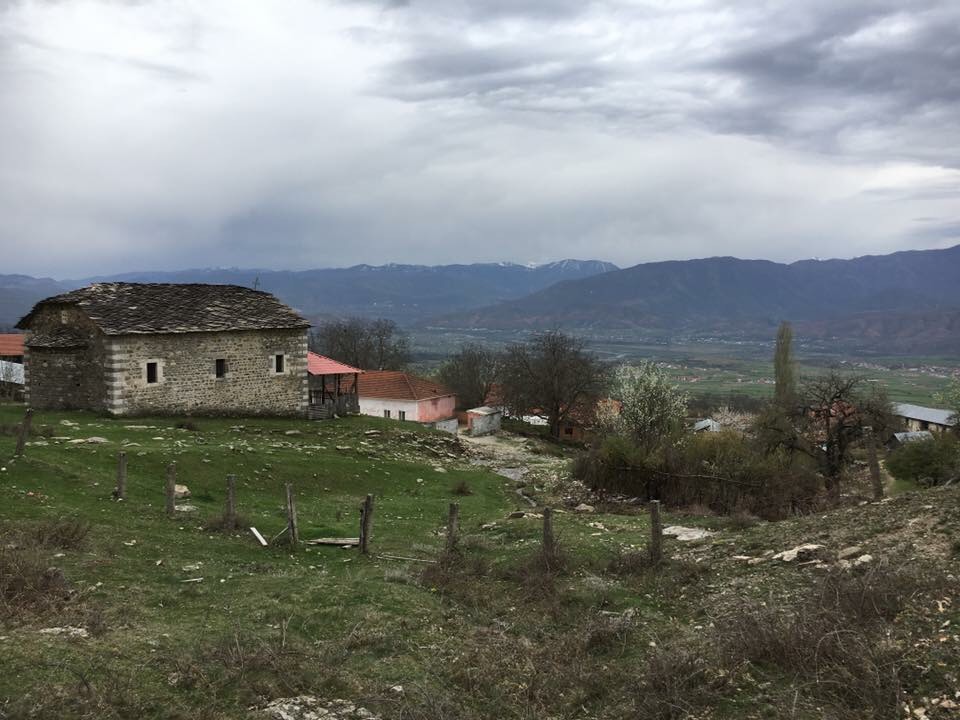
Chris provided us with the following pictures from the area of Albania where he is living. He wrote, "These are some photographs from the old Byzantine era churches that date back to the 1200-1300s. All the pictures are from the neighboring villages to Peshkopi, Dibër County, Albania. The village is named Kerçisht. Over time the church and graves have been relatively abandoned but are starting to get some TLC. These churches are the ones that are said to protect the Korabi region of where I live in Albania. The hillside oversees the border between Albania and Macedonia and valley in the one picture is said to be part of where vampiric ghosts and witches abode. The people that live in this region take superstition seriously and the churches while enigmatic are respected. The graves are of old ethnic Macedonians and Bulgarians from the time of the Ottoman Empire and after Albania's independence in 1912. It is also said that a battle occurred here during the Byzantine empire and some of the knights are still buried around here, as well as some gold. War did occur here for certain, between ethnic Albanians and the Ottoman forces in the mid/late-1800s, and during the two World Wars.
Monday, July 24, 2017
HGB Ep. 213 - Manhattanville College
Moment in Oddity - Man in Black Ghost Warns of Austin Dam Break
In the town of Austin, Pennsylvania, the Bayless Pulp & Paper Mill built a dam in 1909 to help power their facility. The dam was built across the Freeman Run in a very shoddy manner. It should have been at least 30 feet thick, but to cut costs, the company made it only 20 feet thick. The dam quickly bowed under the weight of water. In 1910, a strange man in black started appearing at the railroad depot in Austin. He looked so strange that railroad workers took to calling him a ghost. He was very tall, dressed all in black and would appear and disappear mysteriously. He was said to crawl between cars and run over the tops of them. Soon the townspeople were all talking about the Austin ghost as well. Then on September 30, 1911, the Austin Dam broke, killing at least 78 people. The Honesdale Citizen wrote in an article that published on October 9, 1912, "About a year after the arrival of the ghost, the huge dam broke, with the awful result that will always be remembered by those who witnessed the horrible scenes. In their great misfortune, following the flood, the Austin people who fortunately escaped with nothing valuable but their lives, forgot about a little thing like a ghost; and the ghost must have been scared out by the dam talk or lost its life in the flood." Was the Man in Black truly a ghost and was he a portend of coming disaster like the Mothman and the Gray Man? Or was this just a sneaky transient hanging out in the railroad cars who was indeed killed in the great flood? We will never know, but one thing is for sure, his timing certainly was odd!
This Month in History - Modern Bikini Introduced to Public
In the month of July, on the 5th, in 1946, the modern day bikini was introduced by French engineer Louis Réard at Piscine Molitor, a popular swimming pool in Paris. Micheline Bernardini modeled the bikini, which got its name from the Bikini Atoll, where post-war testing on the atomic bomb occurred. Bikini- like garments had been worn by women in antiquity, but such swim wear was considered risque in the 1940s. French women loved the design, but much of the public and religious organizations found the outfit to be scandalous. The bikini finally gained some traction when contestants in the first Miss World beauty pageant wore them in 1951. Actress Brigitte Bardot wore one on the beach at the Cannes Film Festival in 1953 and based on the attention she received, more actresses took to being photographed in bikinis. It eventually caught on and is, of course, wildly popular today. French fashion historian Olivier Saillard remarked that the bikini became popular because of "the power of women, and not the power of fashion."
Manhattanville College (Suggested by listener Bailey Pollack)
Manhattanville College is a small liberal arts college in New York. The college began as a Catholic women's school, but through the years it not only moved from its original location, but moved to co-education. The land where it sits today in Purchase has European settlers arriving as far back as the 1600s. The main point of interest on the campus is the original castle-like mansion known as Reid Hall. The structure induces shudders and is home for legends and a really creepy picture of some children. There are tales of ghostly nuns, cold spots, weird music and truly terrifying presences on the campus. Join us and our listener Bailey Pollack as we explore the history and hauntings of Manhattanville College!
The history of the campus dates back to the 1600s when the Siwanoy Tribe lived here under Chief Shanarocke. He sold the patch of land to John Budd of Long Island who built a gristmill on the eastern end of the plot. No official claim was filed with the government, so in 1695 a Native American named Pathungo reclaimed the land. he later sold it to John Harrison with the caveat that he could still harvest the whitewood trees on the land for canoe building. The area was known as "Harrison's Purchase" after that time. Quakers settled the plot in 1724. Today, the hamlet is named Purchase and it is part of the town of Harrison. *Fun fact: The Pepsi headquarters in Purchase is on the former Blind Brook Polo Club and Amelia Earhart flew her plane from the polo grounds.*
Ben Holladay was a business tycoon who co-owned the Ophir Silver Mine in Virginia City, Nevada and had invested in the Pony Express and Overland Express Coaches. He decided to build his mansion in 1864 on the land of the future campus and he so loved the West that he had bison shipped in from Wyoming and elk from Colorado. Wild flowers and trees from the West were planted and the stream was stocked with trout. People took to calling the estate "Buffalo Park," although Holladay had named it Ophir Park. Holladay built a chapel on the grounds in the Norman Gothic style for his wife's family and that chapel still stands today in the Ohnell Environmental Park on campus. The year 1873 brought tragedy in two ways. Ann died and Holladay lost his fortune in the Silver Panic that year.
John Roach owned Ophir Park for a little over three years, but did nothing with it, so the owner of the New York Tribune, Whitelaw Reid, bought it in 1888. He and his wife Elisabeth filled the mansion with the latest advances in technology, which included a telephone and electric wiring. Frederick Law Olmsted was hired for the landscape design. A month before the Reids moved into the mansion, a fire completely gutted the home. They were undeterred and decided to build on a grander scale using stone quarried from the property. The mansion was finished in 1892 and renamed Ophir Hall. The reception hall was covered in yellow Numidian African and Georgian pink marbles. There was a beautiful stained glass window above the front staircase and furniture from the country estate of a member of the house of Napoleon III was shipped from France. Further inside the home came an English style design in both Elizabethan and Renaissance.
Whitelaw Reid was away from the estate for much of the time he owned it, working as an ambassador and also running as vice president of the United States. He died in 1912 before a new wing that was being built was completed. In 1931, Mrs. Reid died and the doors of Ophir Hall were closed. The estate was gorgeous and filled with wonderful things, so it was a very sad time for the property. Their son, Ogden, died in 1947 and much of the estate was placed on the market. The local board fought about what to do with the property, but they were positive that they would not allow it to be turned into a shopping center. Soon it would become home for Manhattanville College.
The Academy of the Sacred Heart was founded as a Catholic boarding school for girls in 1841. Its first home was a three-story house on Houston Street on Manhattan's Lower East Side. In 1847, the academy relocated to an area north of New York City, near the village of Manhattanville. In 1917,the academy was chartered as a college and it took on the name Manhattanville College because of the village there. Two hundred and fifty acres of the Reid estate were purchased by Manhattanville in July of 1949 and the college was relocated. In less than a year and a half, everything was transferred and new buildings were built. The campus has around thirteen buildings in total. There is the Benzinger Dining Hall, Kennedy Gym, Founders Dormitory, Brownson Hall/Music Building, the library, Spellman Hall, O'Byrne Chapel, Dammann and Tenney Dorms, faculty housing, Berman Center and the Reid Castle became the administrative building.
Benzinger Hall was under construction during the Korean War and so the use of steel in building was heavily restricted. The college had to go to another plan and they ended up using prestressed concrete girders, which had only been used to build pressure pipes and bridges before. This worked so well that prestressed concrete girders became commonplace in construction. In 1971, the college became co-educational. Right before that, the Reid mansion was named Reid Hall and by 1974, it was on the National Register of Historic Places. The college has thrived and graduated thousands of students. It also has a reputation for being haunted.
Lauren Ziarko is Manhattanville’s Archivist, and she says that most of the stories and legends are just that, a bunch of stories with no historical fact. She said, “Unfortunately there is no truth to them, there have been no mysterious crimes, murders, sightings, etc. in the castle history. It is just spooky rumors that students like to pass on.” That being said, a campus security officer named Rich Biscardi told the following story, "Several years ago when the Manhattanville Cheerleading team was practicing in the West room, after practice, the girls all went to grab their phones and watches and realized that all of their time pieces had frozen, like time literally stopped until they left the west room.”
A freshman was walking on campus late one night and was passing the old small chapel behind the college and claimed, “I heard weird country music. I was really curious so I ventured inside. There was a buzz sound and then the music went back to normal. There was no one in there.” There are reports that nuns haunt the cemetery where they are buried and one nun in particular haunts Spellamn Hall. “It was three in the morning when someone tried to barge into the room. It was a strong force trying to open the door,” a resident reported. She said it was terrifying and many people believe the nun was just making her nightly rounds to check on the children.
A freshman had a scary experience at the graveyard: “I was walking by the grave yard late at night when something in the bushes kept following me. I looked around and nothing was there. But it felt real and scary.” She tried to take several photos, but all of them came out blurry. Another student took a picture in the graveyard a few years ago and to his surprise a figure appeared in the background.
Is Manhattanville College haunted? That is for you to decide!
Tuesday, July 18, 2017
HGB Ep. 212 - Preston Castle
Moment in Oddity - The Taos Hum
Taos, New Mexico is nestled in the middle of the Sangre de Cristo mountain range. The city has a long history that is culturally and spiritually rich. Many claim that the town itself is quite mystical and one of the features that backs up this claim is a phenomenon known as the "Taos Hum." Some even call this the "mountain song." Ancient lore from the area claims that the land itself is creating the sound as a way to reset the pattern of harmony like a harmonic convergence. Waterfalls cascade down the peak of El Salto and tribal peoples have considered it to be a holy mountain offering its singing waters. Caves behind the waterfalls catch the noise of the cascading water and then echo that sound. A famous healer known as Giovanni Maria Agostini Justiniani visited El Salto in the 1800s and he wrote that he heard the singing waters of the mountain and this included seven distinct notes on the musical scale. Only about 2% of the population can detect the low frequency humming sound and for those who don't believe that the mountain is singing, there are a variety of explanations put forward that include it being residue from secret experiments at nearby Los Alamos, New Mexico, electromagnetic vibrations emitted by Taos Mountain, alien spacecraft or top secret military planes. Whatever is causing it, people who can hear it either claim that it gives them peace or drives them nuts by disturbing sleep and causing headaches and nosebleeds. In 1993, some of the most prestigious research institutes in the nation sent scientists to figure out what was causing the noise. Despite all those big brains and state-of-the-art equipment, they were unable to find the source of the noise and that, certainly is odd!
This Month in History - Ida B. Wells Born
In the month of July, on the 16th, in 1862, Ida B. Wells was born to slaves in Holly Springs, Mississippi. Wells was a fearless anti-lynching crusader, suffragist, women's rights advocate, journalist, and speaker. When she was only 14 years-old, her parents and a sibling were killed by a Yellow Fever epidemic. She took over responsibility for raising her remaining five siblings by becoming a teacher. She managed to attend Rust College and she moved to Memphis to help an aunt finish raising her youngest sisters. It would be in the city of Memphis where her fight for gender and racial justice would begin and the scene would be aboard a train. Long before Rosa Parks refused to give up her seat on a bus, Ida did so on a train in 1884. Plessy v. Ferguson had not yet happened, but racial segregation was already taking place. And even though the Civil Rights Act became law in 1875 and banned discrimination on the basis of race, creed, or color, in theaters, hotels and public transportation, railroad companies were racially segregating their cars. Wells was sitting in the ladies car when a white man came up to her and demanded that she give her seat to him. She refused, so the conductor came and told her to move to the crowded smoking car, which was where black passengers were forced to ride. Wells describes what happened in her own words, "I refused, saying that the forward car [closest to the locomotive] was a smoker, and as I was in the ladies' car, I proposed to stay. . . [The conductor] tried to drag me out of the seat, but the moment he caught hold of my arm I fastened my teeth in the back of his hand. I had braced my feet against the seat in front and was holding to the back, and as he had already been badly bitten he didn't try it again by himself. He went forward and got the baggageman and another man to help him and of course they succeeded in dragging me out." Wells was kicked off the train and she hired an attorney to sue the railroad. She won at first, but an appeal at the Supreme Court overturned the ruling. After that, she worked tirelessly to overturn injustices against women and people of color. She died on March 25, 1931 and is buried at Oak Woods Cemetery in Chicago.
Preston Castle (Suggested by listener Pam Ennis)
Perched on a hill above the town of Ione in California is a menacing and haunting castle-like structure that once was a reform school. The Preston Castle was an ambitious plan to get juvenile deliquents to become contributing members of the community. But as was the case with so many of these types of places that were built in the late 1800s and run through the early 1900s, abuse, overcrowding and death were commonplace. The emotional residue of this location seems to have led to haunting experiences. Pam Ennis, Case Manger for Pacific Coast Spirit Watch, joins us to share the history and some of her paranormal experiences at Preston Castle.
This area was inhabited by the Sierra Miwok People originally. They are a hunter/gatherer group that are known for their basket construction. Coyote is their ancestor and creator god and the Miwok are said to have the most extensive record of legends and myths of all native peoples in California. Ione was founded when the Gold Rush brought miners and explorers to California. The town became a supply center and miners dubbed it Bedbug. No one is sure exactly how it got the name Ione, but the most common tale that is told is that a prospector Thomas Brown named it around 1849 after one of the heroines in Edward Bulwer-Lytton's drama "The Last Days of Pompeii." Even after the gold rush was over, the town continued to grow and prosper.
The land where Preston Castle sits was once owned by the Ione Coal & Iron Company. They donated 100 acres of the original 230 acre parcel to the Preston School of Industry that was established by the California Legislature. The rest of the land was sold for $30 per acre. The cornerstone of the main administrative building was laid on December 23, 1890. The architecture is done in the Romanesque Revival style and sandstone bricks made at San Quentin and Folsom prisons were used in the construction. When completed, there were over seventy rooms that included dorms, a dining room, laundry, kitchen, pantry, furnace room, storerooms, reading room, library, a school room and bathrooms.
On June 13, 1894, the first wards were accepted at the Preston School of Industry, but the official open was on July 1, 1894. The next year, a water wheel called a Pelton Wheel was installed and the building had electricity. The Preston School of Industry closed in 1960 and the building remained vacant and falling into disrepair until 2001. The Preston Castle Foundation received a fifty-year lease for the property at that time and then ownership in 2014. The Preston Castle has also been named a California State Historical Landmark and is listed on the National Register of Historic Places.
During the time it was open, abuse and death occurred. Forms of punishment ranged from loss of privileges to isolation to starvation to public paddling and lashings. There are 17 men buried in the cemetery on the property. Most died from diseases like Yellow Fever and Consumption, but one was shot during an escape attempt. Samuel Goins was a convicted burglar and he arrived at Preston School in July 1918. He tried to escape several times and it was during his third attempt that Preston guard John Kelly shot Samuel in the back. A female died on the property and her name was Anna Corbin. She was the head housekeeper and her body was found raped and beaten to death in the basement.
The Preston Castle not only looks creepy, it has some haunting stories connected to it. There are reports of slamming doors, cold spots and full-bodied apparitions. EVPs and disembodied screams have been recorded as well. The spirit of the murdered Anna Corbin is one of the most often seen at Preston Castle. The cemetery is reputedly haunted and much of the activity in the building are thought to be mostly residual.
Preston Castle has a bleak history that has left a psychical residue that seems to feed the supernatural. Or is it just human nature for us to enter a dark and old building and feel as though spirits are at unrest? Is Preston Castle haunted? That is for you to decide!
Wednesday, July 12, 2017
HGB Ep. 211 - Haunted Cemeteries 2
Moment in Oddity - Timothy Smith's Window Grave
One will find a very unique grave inside Evergreen Cemetery in New Haven, Vermont. This burial reflects the very real fear people had of being buried alive decades ago. Premature burials were not terribly common, but happened often enough that measures were put into place to help prevent anyone from dying because they were not quite dead when they were buried. These measures included waiting a few days before burial, guards at cemeteries listening for signs of life, safety coffins and other creative means. William Tebb wrote "Premature Burial and How it May be Prevented" in 1905 and he compiled 219 cases of near premature burial, 149 cases of actual premature burial, 10 cases of bodies accidentally dissected before death and 2 cases where embalming was started on the not-yet-dead. Timothy Clark Smith was a schoolteacher, merchant, a clerk for the Treasury Department and a staff surgeon in the Russian Army. He had a fear of catching sleep sickness, which would give the illusion of death and then that he would be buried alive. He died on Halloween in 1893 at the Logan House in Middlebury, Vermont. He left instructions for his burial. Those instructions requested that a square of glass be placed in the ground that lead straight down to Dr. Smith's face. This way, if he woke up, people would see him struggling. That glass remains over his grave, although it is clouded by mildew and water now. A man buried with a window to the sky just in case he was buried alive, certainly is odd!
This Month in History - The Riot Act in Britain
In the month of July, on the 20th, in 1715, the Riot Act took effect in Britain. The formal Act read, "An act for preventing tumults and riotous assemblies, and for the more speedy and effectual punishing the rioters." The act was enacted to prevent unruly crowds from gathering. If a group of twelve or more people gathered and were causing a disturbance, someone in authority, like the Magistrate, was required to command silence and read the following, "Our sovereign Lord the King chargeth and commandeth all persons, being assembled, immediately to disperse themselves, and peaceably to depart to their habitations, or to their lawful business, upon the pains contained in the act made in the first year of King George, for preventing tumults and riotous assemblies. God save the king." Any persons who failed to obey within one hour were to be arrested. While this seems a bit silly to us today with the violence that is usually associated with modern day riots, people in the 1700s thought it was a bit harsh. But England had real reason to worry about mobs gathering. The English government was worried that Jacobite mobs would rise up and overthrow the Hanoverian George I. The fear was well-founded, as supporters of the deposed Stuarts did actually invade in 1715 and again in 1745. And yes, the phrase "Reading the Riot Act" was inspired by this law.
Haunted Cemeteries 2
There is one absolute for all human beings and that is that we all will die. Throughout history, humans have disposed of and honored their dead in various ways. Burying the dead and marking their resting place has been the most popular and it has carried over to our modern era. Cemeteries have become a record of history for towns. Who lived here? When did they die? Why did they die? Was there a plague, a war, a natural disaster that devastated the population? Some of the interred at times wander from their resting places. There are tales of specters roaming about the tombstones in certain graveyards. Weird lights and mists have been photographed. On this episode, we have four cemeteries that seem to have unexplained activity. Those cemeteries are the Silver Terrace Cemetery in Virginia City, Nevada, which is actually divided into eleven separate cemeteries, Union Cemetery in Easton, Connecticut, Old Quaker Cemetery in Camden, South Carolina and Hollywood Cemetery in Richmond, Virginia. The combined histories of these graveyards covers the 1600s, 1700s and 1800s. Every class is found in these cemeteries and each has its own legends and hauntings. Join us as we bring you Haunted Cemeteries 2!
The Silver Terrace Cemeteries of Virginia City (Suggested by listener Darin Elquist)
As listeners know from episode 177, the city of Virginia City is reputedly quite haunted. It's said that the dead outnumber the living. One haunted location is the final resting place for early residents of this once booming mining town of the Wild West. Silver Terrace Cemetery was established in 1867 and is actually made up of several separate cemeteries. Eleven of them to be exact and each is divided along ethnic, religious, civic, professional and fraternal lines. There is a graveyard for the Masons, the Order of Odd Fellows, Pacific Coast Pioneers, Knights of Pythias, Firemen, Wilson and Brown, Improved Order of Redmen, Mt. St. Mary's Catholic, the Asian and the city and county. The cemetery has terrace in the name because the graveyard sits up on a hilltop as a series of terraces. The plots are unique in that each is fenced in or has a border, which was the standard practice during the Victorian Era. All types of materials have been used as headstones from the typical cut stone to wood to metal like white bronze. Most of the burials took place prior to 1920.
Nearly all people buried here were immigrants or born in a state other than Nevada. This serves as a testament to how the Comstock Lode attracted people from all around the world to come and try their hand at mining silver. The cemeteries qualified for a Save America's Treasures grant through the National Park Service because of their historical significance and are under restoration. There are many forms of unexplained phenomenon taking place in the cemeteries. One story goes that a glowing headstone can be seen at night. Some have debunked this as a reflection of light, but how to explain reports of ghost lights in the cemetery. Some are described as bluish in color. Others claim that the glowing on headstones is reflecting from a specter. The spirit of a girl has been seen walking among the rows of tombstones. The gates open and close on their own and they are held together by a latch that would not just fall away. One of the more famous prostitutes in Virginia City was Julia Bulette. Her specter has been seen at her grave with a child at her feet, which is strange because she never had any children. At least as far as most people know. Pam Ennis of Pacific Coast Spirit Watch joins us to share a few of her thoughts and experiences at the Silver Terrace Cemeteries.
Union Cemetery in Easton
The city of Easton in the state of Connecticut claims that it was shaped by four key forces: glaciers, English settlers, the Industrial Revolution and Bridgeport Hydraulic Company. Algonquin tribes settled this area of Connecticut before the English started arriving early in the 18th century. Those early settlers established a community that emphasized education. That school system is still considered one of the best in the nation. The Industrial Revolution brought manufacturing to Easton and it boomed. One of the key pieces of that boom was the use of water. The Bridgeport Hydraulic Company harnessed that water. Diane went down a fun rabbit hole when looking into the background of this company. She found the following in an article in the Easton Courier by Tom Spurr:
"In 1885, the Bridgeport Hydraulic Company (BHC) bought its first land in Easton from Elihu N. Taylor, who once owned a gristmill along the Mill River. The Survey goes on to tell us that P.T. Barnum came to town in 1886 and bought land along the Mill River. Mr. Barnum had started a company called “Citizens Water Company” (CWC) to compete with Bridgeport Hydraulic. He built CWC dam #1 on the Mill River. But within two years the courts denied CWC the right to lay pipes under Bridgeport streets, and CWC sold its assets to BHC. BHC replaced the CWC dam with Dam #2 in 1896. BHC continued to acquire land in Easton to meet the growing water needs of Bridgeport as its industry and population grew."The Union Cemetery in Easton dates back to the 1600s. The graveyard is next to Easton Baptist Church at the junction of Routes 59 and 136. The graveyard was made famous by the Warrens. They collaborated on the book, "Graveyard: True Hauntings from an Old New England Cemetery." Ed claimed to catch a spirit in the cemetery that people have reportedly seen for decades and that is our infamous Lady in White. The cemetery has even been nicknamed the White Lady Cemetery because of her presence. The story behind who she is legend, so we really are unsure of why she haunts this graveyard. One story claims that she lived during the 1940s and that she murdered her husband and then she was murdered. Another narrative states that she was a woman killed near the turn of the last century and that her body was dumped in a hole near the Baptist church. A third story describes her as a woman who died a century ago in childbirth and now she roams around looking for her baby. Whatever the case may be, she is seen as a full-bodied apparition in a white flowing gown.
The Lady in White is not confined to just the graveyard. Drivers claim that she wanders beyond the gates and out onto the road where she pulls the old "hitchhiking ghost" routine. Not only have drivers pulled over to give her a lift only to watch her disappear, some report actually hitting the spirit when it appears out of nowhere. One of these drivers was heading down Stepney Road late one night in his pickup truck and just as he reached Union Cemetery, a woman appeared out of nowhere in the middle of the road. She was wearing a white dress that reflected in his headlights. He was unable to stop in time and he struck her. He pulled over in an utter panic. He got out of his car and ran back to where he had hit her and the woman was nowhere to be seen.
Old Quaker Cemetery in Camden
Twenty minutes northeast of Columbia, South Carolina is the town of Camden. Camden is South Carolina's oldest inland city and was founded in 1730. The city was originally named Fredricksburg and was established by proclamation of King George II. The name later changed to Pine Tree Hill and then finally Camden. Irish Quakers began arriving in 1750 under the leadership of Samuel Wyly. He designated four acres of land for use as a cemetery. The cemetery was officially founded in 1759 and is known today as the Old Quaker Cemetery. Over time, the graveyard has grown to fifty acres and has several notable burials. The South Carolina Governor from 1886 to 1890 was John Peter Richardson III and he is buried here. There are three Confederate Army Generals: Joseph Brevard Kershaw, John Doby Kennedy and John Bordenave Villepigue. A Confederate soldier who became a hero known as the "Angel of Marye's Heights" at the Battle of Fredricksburg was Richard Rowland Kirkland and he is buried here. This is also the final resting place of two World War I Medal of Honor recipients: Richmond Hobson Hilton and John Canty Villepigue. Abraham Lincoln's brother-in-law is here as well.
The story behind Richard Kirkland is amazing, so we want to share that as a little rabbit hole. The Battle of Fredricksburg took place on December 13, 1862. The Union took heavy casualties. The ones who could walk, made their way to the field hospital, but those more severally wounded were left on the battlefield. The rising of the sun the following morning revealed that over 8,000 Union soldiers had been shot in front of the stone wall at Marye's Heights. Many of the wounded were crying out in agony, but no one dared to go to them since both armies were still there hunkered down. Kirkland went to his leader, Confederate Brig. Gen. Joseph B. Kershaw, and asked for permission to help the wounded Union soldiers. General Kershaw denied the request at first, but finally relented. Kirkland asked if he could fly a white handkerchief, but the General said no because he didn't want the Union to think they were surrendering. So Kirkland gathered as many canteens as he could carry and he ventured out onto the battlefield, risking his life. He gave the wounded Union soldiers water and then went back and brought out blankets and warm clothes. No one fired a shot at him. Kirkland ran back and forth for over 90 minutes and it is said that he did not stop until he had helped every wounded soldier on the Confederate side of the battlefield. A monument dedicated to this event can be found in Fredricksburg, Virginia. Kirkland fought at the Battle of Bull Run, Antietam and Gettysburg, but it would be the Battle of Chickamauga where he would lose his life.
All of those buried at the Old Quaker Cemetery seem to be at rest, save for one and that is Agnes of Glasgow. She was born in Glasgow, Scotland in 1760. When she was an adult, she fell in love with British Lieutenant Angus McPherson. He was sent off to fight in the Revolutionary War and Agnes was heartbroken. She decided that she had to be with him, so she devised a plan to stow away aboard a ship bound for the colonies. She arrived in Charleston in 1780. After asking around about her love, she found out that he had been wounded and was in a hospital in Camden. A Native American, King Haigler of the Wateree tribe, volunteered to escort her to Camden. There are two accounts as to what happened when they arrived in Camden. One claims that she found McPherson in the hospital, but he was gravely wounded and died in her arms. She then died of a broken heart. Another claims that McPherson had already died and been buried and that Agnes couldn't find him anywhere and that she searched high and low for him. As she searched, she became extremely ill and died from her illness.
King Haigler buried her in the Old Quaker Cemetery. From that time forward, there have been reports of her apparition walking through the cemetery and even out onto the roads as though she is still seeking her lost love. Strange mists form in the cemetery and many believe that is Agnes trying to take form. The Old Quaker Cemetery is located at 713 Meeting Street and Agnes' gravesite is located near the cemetery gate.
Hollywood Cemetery in Virginia (Suggested by listener Brandon Amsel)
William Byrd III built his estate on the wooded hills overlooking the James River in Richmond, Virginia in 1758. He named it Belvidere. He took a number of financial hits and found himself in the position of having to sell off most of his property. He did this via a lottery in 1769. The Harvie family acquired a number of the lots that Byrd sold off in the lottery and this included an area they named Harvie’s Woods that would become the future site of Hollywood Cemetery. The cemetery is named for all of the holly trees growing in the area. It is located at 412 South Cherry Street and stretches for 130-acres. It was established in 1847 after two men named William Haxall and Joshua Fry visited Mount Auburn Cemetery in Boston. They formed the Hollywood Cemetery Company and set out to design the graveyard.
They enlisted Philadelphia architect John Notman to help with that design and he is the one who suggested the name Hollywood because of the trees. The original plan incorporated 40 acres and Notman attempted to preserve much of the original topography. Burial plots were terraced on the hillsides and winding footpaths made the lots accessible. The Notman plan was implemented starting in 1848 and lasted through the early 1850s. To prevent erosion, an extensive system of culverts and drainage ditches were built along with a board enclosure fence around the property. Several man-made lakes were made to add beauty.
The first monument was erected in 1851. Within two decades of its founding, a major addition was built known as President's Circle. United States Presidents James Monroe and John Tyler are buried there. Tyler's tomb is Gothic Revival in design and is known as "The Birdcage." Confederate leaders Jefferson Davis and J.E.B. Stuart are buried at the graveyard as well in the Confederate Section that was started in 1863. Three thousand bodies from Gettysburg were reinterred in 1866. A monument called the Pyramid was installed in 1869 dedicated to the Confederate soldiers. The 90-foot-tall granite pyramid was designed by Charles H. Dimmock, a Captain in the Confederate Army. Their final resting place has been dubbed "Gettysburg Hill." In 1904, the Hollywood Cemetery was expanded on Midvale Avenue because there was so much demand for burials. Amazingly, in 1911, it was discovered that the official authorization given to cemeteries allowing them to be burial grounds was never given to Hollywood. It was rectified at this time.
People started visiting the cemetery as a tourist spot around 1919. Cars had not been allowed prior to this except for when President Taft visited and the cemetery staff eased the rules for him. Now cars were allowed and tours were even offered through the grounds aboard Ford cars. Tourists paid $.35 to be driven around the graveyard. Hollywood was expanded again in 1923 near Clark Springs. In 1969, the Virginia Landmarks Register and the National Register of Historic Places added Hollywood Cemetery to its list. Hurricane Isabel caused a million dollars in damage in 2003. Presidents Circle was renovated in 2011 to add a new granite walk leading up to and surrounding the monument. More lots were added as well, allowing 1,800 new burials at the site. Restoration of several monuments, fences, and curbing also took place. The cemetery is opened from 8am to 6pm daily.
There are several tales of the unexplained connected to this cemetery. The Pyramid monument plays host to the first stories of hauntings. Usually around twilight, soft moans are heard coming from around and inside the pyramid. Drastic cold spots are felt at the various corners of the pyramid. And the disembodied cries of the unidentified soldiers are heard. The second stories of hauntings are connected to a young girl who died tragically in 1862. The little girl was named Rees and she died from Scarlett Fever at the age of three. He grave is marked with a three-foot-high cast iron statue of a dog. It is believed her parents put it there as protection for her. And from that day forward, witnesses claim to see the spirit of a little girl playing with a dog at night by the grave. Grounds keepers, tourists and locals all claim to have heard the sound of a dog growling and barking whenever they come near the grave. Even more bizarre are the claims that people have seen the actual iron dog statue move. Is the statue somehow coming to life at night to play with the ghost of Rees?
There are more than just ghost tales connected to the Hollywood Cemetery. There is a vampire legend that is known as the Richmond Vampire. This story dates back to a tragic event that occurred on October 2nd in 1925. A tunnel was being constructed at Church Hill when it suddenly collapsed burying a number of the workers that were inside. People ran to help and witnessed what they described as a "blood covered creature with jagged teeth and skin hanging from its muscular body" emerge from the rubble. This thing ran towards the James River and took refuge in the mausoleum of W. W. Pool at the cemetery. Obviously, this was not really a vampire.
The real story is tragic. This was actually a 28-year-old railroad fireman named Benjamin F. Mosby. He had been shoveling coal into a steam locomotive when the collapse occurred and this caused the boiler to rupture. Mosby's upper body was scalded and his skin was hanging from his body. He died the following day at Grace Hospital. We're not sure how this became a legend, but there are some who think that this vampire still makes the mausoleum its home. The story accuses W.W. Pool of being the vampire and that he was run out of England in the 1800s because he was a vampire. What is eerily creepy about this story is the ending. When they dug through the rubble to get the bodies of the workers, they only found one of them and he was sitting upright in the cab of a train. They could not pull the train out that had been trapped in the tunnel, so they just bricked everything up and it has stayed that way to this day.
All of these cemeteries have interesting stories. But even better is the beauty of each of these graveyards. Monuments and headstones stand as an enduring symbol of lives once lived. And that is a wonderful thing. Are these cemeteries haunted? That is for you to decide!
Thursday, July 6, 2017
HGB Ep. 210 - 17 Hundred 90 Inn
Moment in Oddity - Mike the Headless Chicken
Suggested by: Tammie McCarroll-Burroughs
During the 1940s, a very famous chicken lived in Fruita, Colorado. He was a lucky chicken. You see, Miracle Mike was supposed to be dinner, but instead, he became famous and went on tour. It all started on September 10, 1945, when farmer Lloyd Olsen headed out into the yard with an axe to fetch a chicken for dinner. He chose a five-and-a-half-month-old Wyandotte chicken named Mike. Lloyd swung the axe, but when he brought it down, he missed his mark. The axe only removed part of Mike's head. The jugular vein and ear and most of the brain stem were still intact. Lloyd took pity on the creature and decided that Mike was meant to live. Mike could balance on a perch and make attempts at crowing, preening and pecking at food. Lloyd fed the chicken milk and water with an eyedropper and threw in a few small grains of corn. Soon, Lloyd and Mike were traveling on the road with sideshows and he was photographed dozens of times, making features in both Life and Time magazines. Mike the Headless Chicken was make $4,500 a month at the height of his career. He lived for 18 months after his head had been cut off.He died in a motel room while on tour. Somehow in the middle of the night, he had managed to get a kernel of corn stuck in his throat and he began to choke. The Olsens were unable to save him. The fact that a chicken was able to live so long without a head and also became so famous, certainly is odd!
This Month in History - President Grover Cleveland Secret Cancer Surgery
In the month of July, on the 1st, in 1893, President Grover Cleveland underwent secret cancer surgery aboard a yacht owned by his friend, Commodore E.C. Benedict. Grover Cleveland was the 22nd and 24th President of the United States and this surgery came during his second stint. The Panic of 1893 was raging that same year and it was thought that if the public knew the President had cancer and was undergoing surgery, it would cause a further panic. The cancerous tumor was on his soft palate. The entire left side of his jaw was removed along with a small portion of his soft palate while his friend's yacht cruised in Long Island Sound. The President was unable to talk until he was fitted with a rubber prostethic during a second, smaller operation on July 17th. He wore that unil his death in 1908. The public never knew about the President's brush with cancer or his secret surgery.
17 Hundred 90 Inn (Suggested by listener Sarah Kovensky)
Savannah, Georgia is a city shaped by unique people and compelling events. There have been battles, devastating fires, murders and so much more that has led this quaint city to be deemed one of the most haunted in America. Ghosts stories and legends thrive beneath the canopy of spanish moss draped live oak trees. Stately historical mansions carry histories dating back centuries and each seems to have supernatural story of its own. The oldest hotel in Savannah is the 17 Hundred 90 Restaurant and Inn, which was built in 1820. There are stories that up to three ghosts haunt the property. The most famous is the ghost that stays in Room 204 and whom everybody refers to as Anne. Join us as we explore the history and hauntings of the 17 Hundred 90 Inn.
Savannah was colonized by the British under the leadership of General James Oglethorpe who arrived in 1733. The Yamacraws were the Native Americans here and they were led by Tomochichi. He and Oglethorpe formed a friendship and their alliance helped to build the city with little confrontation. During these early colonial years, the city was founded as a major port. The city was platted in squares that still exist today as parks surrounded by large historic mansions. Savannah eventually became the colonial capitol of Georgia. Steele White was a planter from Virginia and he decided to build a boarding house in the steadily growing city. Construction began in 1820 on the original duplex, but White was killed in a riding accident before the house was finished. His wife Anne was left widowed and heartbroken. She moved from the house to the Isle of Hope, south of Savannah, where she lived with her sister and her brother-in-law for many years.
The year 1820 was a rough one for Savannah. A yellow fever epidemic was sweeping through, wiping out whole families. On January 11th, the Great Savannah Fire touched off and spread quickly with the help of high winds. The fire eventually reached Ellis Square where gunpowder was stored in buildings and the explosions spread the fire further. The boarding house was built in the federal style with a brick first floor and wooden upper floors. The construction was completed in 1823. The Powers family bought the property in 1888 and added the smaller eastern section at that time. The boarding house eventually became a hotel.
Today, the 17 Hundred 90 Inn is a restaurant and tavern and B & B on President Street in the historic district. We were unable to figure out how it came by its name. It certainly isn't for the year it was built and the address is 307. There is an original slate floor and bricks that predate the original building constructed by Steele White, so perhaps there was a structure here that was burned down in the fire and perhaps that building was built in 1790? But that is just speculation. The tavern is on the ground floor. It resembles a trading vessel with a charming bar in the rear. Another building was purchased across the street and the check-in desk for the B & B was relocated here. This added more rooms, a parking lot and a patio. That makes three buildings that comprise the entire B & B. There are fourteen guest rooms, some of which have fireplaces. The rooms are decorated with reproductions of 1800 styled furniture and there are journals left on bed sides for guests to record any of their haunting experiences. These experiences include glasses flying off tables and crashing to the floor.
Ghost tours stop on a regular basis at the tavern for stories and drinks. This is one of the more famously haunted locations in Savannah and has been featured on reality ghost television. Room 204 is said to be the most haunted area of the B & B. Several times a year, people staying in this room end up leaving in the middle of the night. To add to the creepiness, a life-size female mannequin dressed in a period dress is set up looking out of a second story window. The spirit that haunts Room 204 has been named Anne, but this is not the wife of the original owner. The specter likes to move guest's objects and rearrange items in that room. Disembodied sobs have been heard and these are accompanied at times by a shadowy figure that lurks in the the dark corners of the room. Bed sheets are tugged as well.
So who is this Anne and what is her story? People claim that she was a heartbroken woman who threw herself from a second story balcony to the stone street below. The Powers family had an Anne, but she lived into her 80s and had a husband named Patrick who lived into his 80s as well, according to the 1920 census. Obviously, the spirit may not even belong to someone named Anne. There are no reports that we could find anywhere for a death at the hotel, but it could be someone who was attached to the building in some way. A ghost tour guide named James Caskey tells a story about a waiter named Sean. He says that Anne seemed to really dislike him. Sean was collecting the B & B meal cards from the first, second and third floors and he had a feeling of apprehension and felt like someone was watching him. There was an odd coldness that increased as he reached the third floor. Suddenly he felt as though something picked him up off the floor about six inches. When he was released, he ran down the stairs. The Travel Channel wanted to interview Sean about his experience. They were going to conduct the interview in room 204, but Sean was unable to enter the room. Something was physically barring him from entering.
A woman named Lynn was on a trip from Florida to New York with her daughters when they decided to overnight at the 17 Hundred 90 Inn. They were aware of its haunted reputation. The only room available was 204. After they entered the room, Lynn immediately noticed a teddy bear on the fireplace mantle and she recognized it from an episode of Ghost Hunters. It had a purple ball between its legs and had Mardi Gras beads wrapped around its body. The paranormal investigators had used the bear as a trigger object. Her daughters started using Snapchat to send pictures to friends and they began to tempt the spirits. They called out, "Are you there, Anne" and "Anne, do you want to play?" Suddenly, the ball between the bear's legs flew off the mantle and stopped in the center of the room on the floor. Lynn picked up the ball and placed it back with the bear. She wanted to believe that somehow it had rolled off all on its own. She tested it several times, tapping the ball lightly to start it rolling down the mantle. It never rolled far enough to land in the center of the room. The girls turned on a lamp and then flicked it off before going to dinner. When they came back to the room, they attempted to turn the light on and it would not come on. They discovered that the lamp had been unplugged and none of them had unplugged it. The women spent the evening having a hard time falling asleep as the windows rattled, the doorknob jiggled and something kept scratching at the end of the bed post.
A couple reported after staying in Room 204, "When we were packing up to move our stuff the next morning, I had put my little camera bag on the bed. I had left it in the room when we went down for breakfast. Before leaving, we did our usual idiot check to be sure we didn't leave anything behind. We had already moved our stuff down to the car, when I noticed the camera wasn't in the bag. I got the key from the desk and Tom went back up to the room to take a look. He immediately saw it in plain site sitting in the middle of the chair by the window. The camera wasn't in the chair when we had first left the room because we would've seen it. The maid hadn't been in the room yet, so it must have been the entity of Anne returning the camera after she had looked at it."
Kal wrote on TripAdvisor, "For our second night, we decided to move up to the 'haunted' room, 204. While we didn't expect anything to happen, we thought it would be fun to say we stayed in the haunted room. Well, we definitely experienced some unexplanable things! Nothing happened at first, but as the night went on, we were absolutely graced with Anne's presence. Anne is the ghost. She hid our keys, pulled a vitamin out of a pocket and placed it on the fireplace, unzipped my purse a couple times... it was crazy!"
Anne is not the only ghost. There is reportedly the spirit of a Voodoo practitioner here. The kitchen is a favorite haunt for this ghost and it generally presents as something sinister and dark. The spirit has a dislike for women and has thrown pots, pushed and slapped women and pulled pranks on them. She jangles her bracelets at them as well. Employees claim to hear people in the kitchen when no one is in there and also the sounds of metal jingling and pots banging around. The spirit is said to belong to a former cook at the hotel who practiced Voodoo. She occasionally leaves the kitchen and ventures into the restaurant where she pushes silverware off of the tables. A maintenance man was doing some work in the hotel when he heard the sobbing of a woman coming from the kitchen. He investigated to see if he could be of some help and he found the kitchen empty.
The ghost of a merchant marine is reputedly at the 17Hundred90 Inn, also. This is a friendly apparition that has been helpful to the staff and enjoys music. He is seen dressed in his uniform and walking through the garden room or sitting and listening to the piano player. He once helped shut a light off for a staff member who could not reach it without stepping up on a chair. A TripAdvisor review mentions a ghost named Thaddeus who we assume would be this spirit.
Is the 17Hundred90 Inn haunted? That is for you to decide!
Friday, June 30, 2017
HGB Ep. 209 - Tilty Abbey
Moment in Oddity - Murder Bottles
The Victorian Era was fraught with dangers as we have covered before when talking about Victorian dresses that caught fire easily. Isabella Beeton wrote a book titled "Mrs. Beeton's Household Management" in 1861, which doled out advice to the ladies on how to run a proper household from cooking to child rearing. One bit of advice in that book, combined with a modern day marvel of the time, led to the deaths of hundreds of babies. Breast feeding in the Victorian era was challenging because of those dangerous Victorian dresses just mentioned. Even nursing corsets did not help alleviate the challenge. So the banjo bottle was created with a nifty rubber tube and nipple. Now baby could feed him or herself with ease. This freed up mother to tend to the hiring of staff and such. Many of these bottles carried names like "Mummies Darling." Mrs. Beeton encouraged the use of these bottles and even advised moms that they only needed to wash the nipple and tubing occasionally. And even when the mothers did clean the bottle apparatus, it was very difficult. As you already have probably surmised, these bottles were the perfect incubators for deadly bacteria. And the infrequent cleaning only added to the problem. Doctors soon condemned the bottles, but people continued to buy them. At that time, only two out of ten infants lived to their second birthday and these bottles certainly helped add to that statistic. This earned the bottles the nickname “Murder Bottles.” The fact that parents would continue to use these bottles with a name like that and follow the advise of a woman who thought washing these things only needed to be done every couple of weeks, certainly is odd!
This Month in History - Mildred "Babe" Didrikson Born
In the month of June, on the 26th in 1914, champion athlete Mildred "Babe" Didrikson was born in Port Arthur, Texas. Mildred got her nickname "Babe" from baseball legend Babe Ruth. She played a variety of sports and excelled at allof them, which was unheard of for a female in her day. She won two gold medals at the 1932 Olympics and set world records while earning those medals in the javelin throw and high hurdle. She switched to golf after that and won the 1946 U.S. Women's Amateur Tournament. In 1947, she won 17 straight golf championships and became the first American winner of the British Ladies' Amateur Tournament. She turned pro and won the U.S. Women's Open in 1950 and 1954. Other sports she conquered were softball, baseball, swimming, figure skating, billiards, and she even played some football. The Associated Press named her 'woman athlete of the first half of the 20th century' in 1950. And despite her athletic way of life and healthy living, cancer found its way to her and took her life in 1952. She was on 42 years old.
Tilty Abbey (Suggested by listener Bob Sherfield)
The village of Tilty is in the county of Essex in England. The county is known for its Mediaeval Gothic architecture using various stones, wood and bricks in the construction of buildings that have thus endured for centuries. Some of these structures have not fared well though and one of these is Tilty Abbey. All that really remains of the abbey are some crumbling stone walls in the field and a chapel outside the gates built for worshippers who were not monks. The abbey was built in the 12th century and was a religious and social center. Some may say that a religious location is a source for the supernatural and it would seem that Tilty Abbey remains such a source today with rumors of strange creatures, headless monks wandering around, curses and other strange occurrences. Join us as we explore the history and hauntings of Tilty Abbey and her village!
The abbey at Tilty was established in 1153 by Maurice FitzGeoffrey. He was the vassal of the Earl of Derby at the time and thus the Earl helped with the founding. Seven Cistercian monks came from Warden Abbey in Bedfordshire to reside at the abbey, which initially started as a wooden makeshift dwelling. The monks spent their days clearing the land and establishing self-sufficient agriculture. They built several buildings in the Cistercian style, which included a refectory, cloisters, living quarters and the main church. The church was large and measured over 170 feet long and 90 feet wide. It is believed that the dedication of the abbey probably took place on September 22nd, known as St Maurice's feast day. People were welcome to worship at the abbey, but not in the church itself. A “capella ante portas” was constructed. This basically was a smaller chapel outside the gates and this particular one was dedicated to St Thomas Becket.
The monks and the abbey were not above getting involved in politics and they stood in opposition to King John who was ruling in 1215. On Christmas Day of that year, the King sacked the abbey. Soldiers broke into the church and several chests and stole anything of value. The church was desecrated and several monks were killed. Two of their tombstones can be seen in the church on the north wall of the sanctuary. The church was rebuilt and consecrated in 1221. The power and wealth of the monastic community continued to grow with the acquirement of more land and the church was enlarged. The monks began raising sheep and developed a wool trade that produced the finest white wool in the country. Political influence for the abbey continued under King Edward I and the king summoned the abbot to one of his parliaments. The gate church was enlarged in the 14th century, right before the Black Death hit England in 1348. The Plague stopped any further expansion of the church.
Things would change drastically with the Reformation and when King Henry VIII came to power. Landowners were jealous of the wealth of the monasteries as well and they began to dissolve. Two abbots at Tilty were deposed and pensioned off between 1530 and 1535. King Henry VIII finally dissolved Tilty Abbey in 1535. The guesthouse was leased to the Marchioness of Dorset for her son, George Medley at that time. There are discrepancies as to what happened to the buildings of the abbey. Some claim that all but the gate chapel were blown up by gunpowder, while others claim that the monastic buildings were remodeled as private dwellings and then later became farm buildings. Today, there are only small sections of the stone wall left near the gate chapel. Further along a path, near the church, is the former site of the monk’s watermill that was later remodeled into a Victorian mill that no longer works.
The church is beautiful and a testament to its long history. The abbey features a large window on its east side that is an example of curvilinear 14th century tracery. The design is elaborate, incorporating five lancets leading to an intricate tracery wheel. The exterior walls are plastered in pale pink and the church is topped with a Georgian cupola atop a small bell chamber. The interior design features Norman influences with a font that has a 17th century cover, painted in foliage patterns. The roof still features original beams dating back to the 12th century. There is a beautifully carved wooden chair at the entrance of the sanctuary. The figure of a woman praying and the words 'My Lord and God. John Wesley. 1776' are carved into that chair. Unique items in the church are memorial brasses and Diane stumbled across an article in the newspaper about brass rubbing when trying to find a news story about a skeleton found on the property. (Share the article.)
One of the memorial brasses is near the altar and features the wife of the Duke of Inverary, who was named Margaret. She died in 1590. The brass has her flanked by her 3 daughters, 3 sons, and 3 children who died in infancy, shown wrapped in swaddling clothes. Another brass has a knight in full armor standing with his wife. A third brass also has a knight, but this one has him resting his head on a helmet. The pulpit is made from a Georgian sounding board that has the figure of a bird in flight painted on it. On the south side of the sanctuary is a three seat sedilia and a piscina, all set beneath nicely carved niches with open-work tracery. The walls are decorated with medieval carvings and wall paintings, one of which is a repeating pattern of colored triangles. The pews are painted pale greyish-green and at the west end of the nave is an organ painted a darker green.
The abbey is the center of most of the supernatural activity in the village of Tilty, but there are several locations here that have paranormal lore and hauntings connected to them. There is a nearby village named Thaxted and it was connected to Tilty by a coach road. This old road has reports of the disembodied sound of horses and coaches driving along. This is unnerving enough, but actually seeing the coach can be utterly terrifying as legend claims that glimpsing the coach means that you will die soon. We’re not sure if this is simply a death omen or a curse because the individual saw the coach.
A cottage in the village was built sometime in the early 1600s and is known as Deer’s Leap Cottage. A man named Malcolm Pearce moved into it and that is when reports of a ghostly presence started. The lights in the cottage have a habit of turning off and whenever Malcolm gets up to check why the light has gone out, it will pop back on. Several electricians have checked the wiring over the years, but nothing has ever been found wrong with the wiring of the house. Objects move around and pictures come off the walls. Malcolm says these occurrences can be startling, but he has never felt threatened by the presence that he has come to believe is an old woman. He has never seen the spirit, but one day a cleaning woman turned in her notice and when he asked why she was leaving, she informed him that she had seen a grey-haired woman in period clothing smiling her, who then abruptly vanished.
The Old Mill that the monks had built were modified into apartments at one time. Tunnels used to branch out from Tilty Abbey to various locations to serve as protection during the time that the monks were persecuted. One of those tunnels led to the mill, which was accessed through the cellar door. Today, it is bricked up, but when it was still open a man named Bob Hitchings went out to the mill with a young woman who lived there. She complained to him that the cellar door would not stay locked. Bob figured that there had to be some kind of explanation. Probably that she was not locking the door securely. He locked the door and put the keys on a hook. In the morning, he was shocked to find that the door was open and the keys were where he had left them. There was no one else at the mill at the time.
The woman’s father had a terrifying experience that has been shared by several people in the area. This is a story of a bizarre creature. The father had been walking up the lane from the village to the mill he noticed that a dark figure had been following along with him, darting in and out of the bushes. He immediately thought that the figure belonged to a cat, but when he saw it again, it was too large to be a cat. He figured it was a badger or even more likely, a fox. The shadowy creature continued to follow behind him as if stalking him and as it did, it grew in size. The father burst through the kitchen door in a state of terror and told Hitchings, who was visiting, what he had seen. The man was truly scared and this was reflected even more noticeably when his hair turned completely white within a few weeks of the encounter.
Another man witnessed this same creature in 1994 when he was driving to Duton Hill by way of Tilty Road. He told his wife that a large creature had passed before his headlights. He estimated that it was around six feet tall and seemed to lope like an animal, but what chilled him to the bone was that the headlights did not illuminate the shadow. He said, “It was there, but it wasn’t there. I could see it, but the headlights didn’t shine on it.” Villagers have come to call the creature “The Black Cat.” What makes the connection to Hitchings story about the father whose hair turned white weird is that this story occurred twenty-five years after that story.
A dark figure was seen in February of 1996 by a local history who was taking a walk through the Abbey fields with a friend. They were surveying the fields to assess if they were suitable for re-enactments of Civil War battles. The figure appeared in the tree line wearing dark clothing. It was dusk, so the figure was hard to make out. It was approaching them and the man looked away for a moment, but when it was near to them and passing by, he glanced at the figure only to see that there was no one there. He startled and his companion asked what was the matter. The man was confused because his friend had no concern that a dark figure had been near them. When he asked his friend if he had seen the figure passing them, his friend responded, “Nobody’s passed us. What are you talking about?”
There seems to be a curse connected to the property. Reverend G.E. Symonds wrote "Tilty Parish and Abbey" in 1889 and an excerpt from that work reads, "It was said that if anyone ordered some of the remaining buildings to be demolished, he would die within a month. A steward did so in the early part of the 19th century, and died within a month; his successor of the same family some years after ordered a further removal, and he died within a month, and now only a part, apparently, of the cloister is left." So was there really a curse for those who destroyed the Abbey?
The Three Horseshoes is a pub in the village that has had its share of paranormal activity. Gill Connell is the landlady and she has reported that in 1993, when she was moving in, something odd happened. She said, "On August 4, 1993, the day we moved in, I put he kettle on to make tea for Derek, myself and the two moving men. I then went to watch the men unloading the last things from the lorry. After a while, I remembered the tea. Going back into the kitchen, I found that the kettle was hot from having boiled, but it was switched off at the wall and the kettle flex had been coiled up and laid on the work surface. Nobody had entered the house while I was outside." He mother-in-law also had experiences with hearing people coming in the door and there would be nobody there and she once caught a mince pie sliding itself off the table. An employee reportedly has seen smoke rings being formed by an invisible smoker and a glass has moved itself across the bar and smashed onto the floor. Someone sitting at the bar once felt a strong poke while sitting on a stool at the bar.
A woman was driving in a storm on her way to Duton Hill along B184 near Titly when she was startled by a darkfigure sitting in her back seat. She looked down and when she looked back at the mirror, she saw that he was no longer there. Then she noticed that he was outside the car, riding on a motorbike. He kept pace with her for awhile and then he moved in front of her car and slowed down. He finally forced her to stop. Then he took off across a field and disappeared. She started her car up and continued down the road after she calmed herself. She came around a bend and saw a huge tree in the road. She felt that the ghost protected her from being hit y the tree. Interestingly, a John Marajohn was killed on a motorbike on the stretch of road.
Across from the pub is a large Tudor style house that belonged to the Willoughby Family. The family has reported objects moving in the house on their own, disembodied footsteps and a feeling of being watched. Loud knocks on the back door have been heard when nobody is at the door. The most terrifying incidents at the home revolve around a hooded figure. A previous owner had been a Belgian heiress. One evening, she went out to retrieve some dustbins that strong winds had blown around. As she walked past an out building, she was startled by a hooded figure. It raised its hand. She stopped in her tracks and the outbuilding collapsed. She was left unhurt and saw the figure as a protector, although some might claim it caused the collapse. Gill Willoughby's mother was once awakened by a hooded figure that beckoned for her to follow it. When it reached the bedroom door, it disappeared. Gill's son awoke one night with a pressure on his chest as if someone was pressing down on him. He watched as a grey mist gathered above him. He shouted and kicked his feet and the mist disappeared.
The most famous apparition here is the ghost of the headless monk. Though no reports have been made for many years, the headless monk story is said to date back to 1215, when a monk was beheaded by men of King John. An archaeological dig on the site of the abbey in 1942 recovered two stone monk's tombs with skeletons inside of them. One of the skeletons was missing its head.
There seems to be some strange things happening in the village of Tilty. Is the village haunted? Is Tilty Abbey haunted? That is for you to decide!
Saturday, June 24, 2017
HGB Ep. 208 - Fort Henry
Moment in Oddity - The Swinging Sailor
Suggested by: Melissa Antonelli
In Perryman, Maryland there is an old church graveyard at the Spesutia Church of St. George's Parish. A very unusual grave is in this cemetery. Legend claims that it belongs to a Captain who directed his men to bring him here and bury him in such a way that his feet would never touch dry ground. People claim that the sailors carried their captain up a hill from the Chesapeake Bay, filled his casket with rum and buried him as requested. A rock group named Captain Quint even wrote a song about the legend called "The Swinging Sailor of Perryman." The chorus goes, "On his sea legs he'll forever stand, A man obsessed with one last request, To never touch his feet upon dry land." The grave belongs to a man named John Clark Monk and there is no record that he was ever a captain and made such a request. But his burial is so bizarre that clearly, something akin to this legend must be the true story. He has been dubbed "The Swinging Sailor" and the grave is built as a large concrete box sitting upon a stone slab. But Mr. Monk's remains are not in the concrete box, rather he is inside of a coffin that is suspended from chains that hang underneath the slab. There are cracks in the slab that allow visitors to peer down into the space. No one is really certain why he was buried this way, but it certainly is odd!
This Month in History - Robert Kennedy Shot and Killed
In the month of June, on the 5th, in 1968, Robert F. Kennedy was shot and mortally wounded while leaving the Ambassador Hotel in Los Angeles. His brother John F. Kennedy had been assassinated five years before as well. He had served as Attorney General under his brother and resigned in 1964, so that he could run for the Senate. He decided to run for president in 1968 and he was celebrating his victory in the California presidential primary at the Ambassador Hotel. He had just finished addressing his supporters after midnight and was making his way through the hotel's kitchen when a Palestinian named Sirhan Sirhan opened fire with a .22 caliber revolver. Six people were hit with Kennedy being shot three times. He succumbed to his injuries at 1:44 a.m. He was only 42 and left behind a wife and eleven children. Bobby was buried at Arlington National Cemetery near to his brother's final resting place.
Fort Henry (Suggested by listener Sarah Norton)
Fort Henry was built during the War of 1812 in Ontario, Canada. The fort was constructed to protect the nearby Point Henry because of its proximity to the Royal Naval Dockyards. The fort that stands today is not the original. It was fortified later on to protect the waterways even more thoroughly. Today, it is an UNESCO World Heritage Site and a living museum. There are more than just the living here. The fort also seems to harbor spirits from the past. Ghost tours are hosted and dozens of people have claimed to have had paranormal experiences. Join us and our listener Sarah Norton as we share the history and hauntings of Ontario's Fort Henry.
Fort Henry was built along a vital trading route near the mouth of the St. Lawrence River and the fort protected communication between Kingston and the eastern settlements of the area. French explorer Jacques Cartier had explored the Gulf of St. Lawrence on three separate voyages in the 1530s and 1540s. He gave the country of Canada her name. It was the Huron Iroquois name for "settlement." Cartier blazed a path for colonization by France and began some limited fur trading with the First Nations that lived along the St. Lawrence River. He was not as successful with trading because he focused on furs used as trimming and adornment, rather than the coveted beaver pelt. He was ultimately seeking the northeast route to Asia. He never found the route. He returned to France after the third voyage and lived out his life as a navigational expert, never exploring again.
The War of 1812 broke out between Britain and America and Canada became a central battleground. With the importance of the St. Lawrence River, it was decided that forts needed to be built along the route for protection. Point Henry was one of these points. The Fort was constructed high atop Point Henry overlooking Lake Ontario. A dry moat leads down to the waters edge on both sections of the fort, making it impossible for the fort to be completely surrounded. The fort itself is surrounded by a dry moat as well. Discipline was paramount at the fort and punishment harsh. After the war, the Rideau Canal was built. That construction took place from 1826 to 1832 and it became even more important for the area to be protected because three important waterways intersected here: the Rideau Canal, the St. Lawrence River, and Lake Ontario. Fort Henry needed improvements, so it was reconstructed between 1832 and 1837.
The reconstruction was supposed to be more extensive, but the canal went over budget. Only the Fort and four Martello towers, spaced along the Kingston waterfront, were completed. This made Fort Henry the largest fortification west of Quebec city. The Fort cost 70,000 British pounds sterling to construct, which is the equivalent to approximately $35,000,000 in modern Canadian currency. Some soldiers were allowed to bring their families with them. There was a schoolroom for the children. Bugles, drums and bagpipes helped to communicate battle instructions and the Royal Welch Fusilires were stationed at the Fort in the 1840s. Today, the mascot of the Fort if a goat named David and he represents the Fusilires. This group was one of the oldest infantry regiments of the British Army, part of the Prince of Wales' Division. *Fun Fact: At the surrender of Yorktown, the Royal Welch Fusiliers was the only British regiment not to surrender its colours after the British loss at Yorktown. They smuggled their flag out tied around an ensign's waist.*
By 1870, the British no longer had use for the fort and they abandoned it, so Canadian troops moved in and stationed themselves there until 1891. Neither the original fort or this second one ever came under military attack. There was not much use for the fort after that time and it fell into disrepair until 1936. Ronald L. Way started an effort at that time to turn the fort into a living history museum and in 1936 restoration of the fort was begun as a "make work project" during the Great Depression. It opened on August 1, 1938 and cost over $1,000,000. Prime Minister Mackenzie King officially opened it and it was dedicated to all the British soldiers who had served within its walls. During World War II, it was closed to the public and used as a prisoner of war camp. It was known as Camp 31. It was re-opened to the public in 1948. It has been named as a National Historic Site and today, the former military quarters have been transformed into a restaurant and bar. The Fort is like a little village with displays and there is even a working bakery. They host tours, conduct demonstrations of firing cannons and troop movements and the top of the Fort offers great views of Kingston. (Those troop movements demonstrate how stupid some of that old warfare used to be.) It becomes Fort Fright for the Halloween Season. The Haunted Walk of Kingston offers a ghost tour of Fort Henry, so this location has some spirits wandering around.
One of the ghosts is believed to belong to John "Gunner" Smith. He was a rifleman whose weapon malfunctioned and exploded in his face. This sent him flying backwards off the top of the fort down into the dry moat below where he screamed in agonizing until he died. Many people have reported seeing an injured man lying in the ditch while others have reported hearing the sounds of people scurrying in the area. His wails have been heard as well. Nils Von Schultz was a Finnish born nationalist that became involved in the Upper Canada Rebellion in the early 1800s. He was captured, tried for insurrection and hanged in 1838. There are claims that he haunts the Commanders Room #3. He likes to move objects around the room. And then there is the man in the blue uniform who wanders around several areas of the Fort.
Karly V wrote on TripAdvisor: "This is a review of the Haunted Walk of Fort Henry, done by the Haunted Walk of Kingston. Seriously cool time. We got to see the Fort at night, with barely any lights, in the rain which added some spooky atmosphere to our evening. The tour started late, but that wasn't a problem. I think we got a lot of extra stories that we may not have got during a normal day tour. Not for the faint of heart - there were two major ghost experiences on just our tour alone that night and we captured an EVP as well. Really unique way to see the Fort - HIGHLY recommended."
Rob Brown wrote on TripAdvisor: "This place is phenomenal. Its so cool. Kids love it. Heck the Ghosthunters loved it. But they dont know a story I know. According to one of the night guards, all the canteens came off the shelf in one of the rooms and on to the table one night. Come to see the fort and you will know the room. The night guard was sincere. Why do I believe her? Well, a door closed behind me on its own. Go and visit if you are brave enough."
Rusty wrote of an experience he had, "In 2010 I took my family, which consisted of my wife, our 1-year old daughter and myself, on a trip to see Old Fort Henry in Kingston, Ontario, Canada. This fort is known for ghost experiences. I have had many "ghostly experiences" in my life so maybe I'm more sensitive to things than others but that's another story. While taking a group tour we came to a hallway leading to the fort's "Officer's quarters". My daughter started acting up in what could be best described as a refusal to enter the hallway (she was in a stroller at the time). My wife and her stayed back while I went with the group. After seeing the living quarters of the officers (which is secured with a glass front so no one can enter) the group moved onto the kitchen area. A few minutes later I decided to leave the group to go check on the wife and daughter. After checking to make sure things were okay with the family, I followed the hallway back past the Commanding Officer's quarters to catch back up with the group. As I passed this room I glanced back in for an extra look. Standing in front of the writing desk located in the room was a rather tall British-uniformed officer who turned and looked at me and then just faded away! Needless to say, it did not take me long to catch up with the group. At the end of the tour I asked the guide about ghost sightings in the fort and he did mention that there have been reports of an officer's ghost, along with several others, being sighted, sometimes in the hallway through which we walked."
Sarah definitely felt as though something creepy was hanging around the fort. The haunted tour has recorded dozens of experiences. Is Fort Henry haunted? That is for you to decide!
Subscribe to:
Posts (Atom)